Wallcreeper
Tichodroma muraria
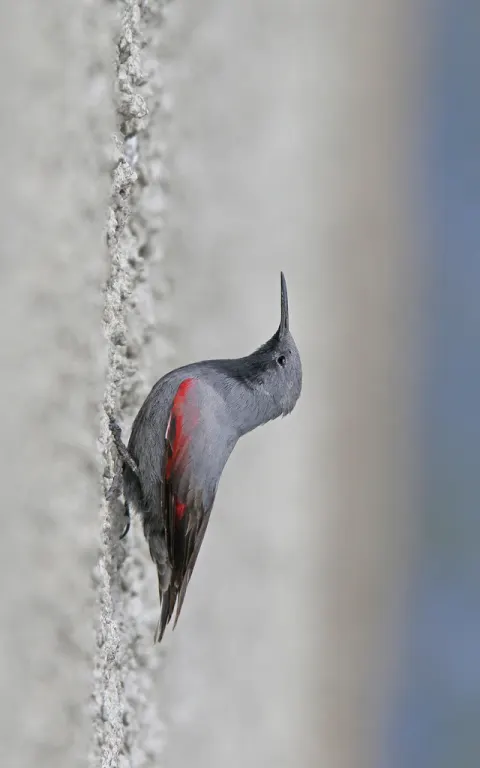
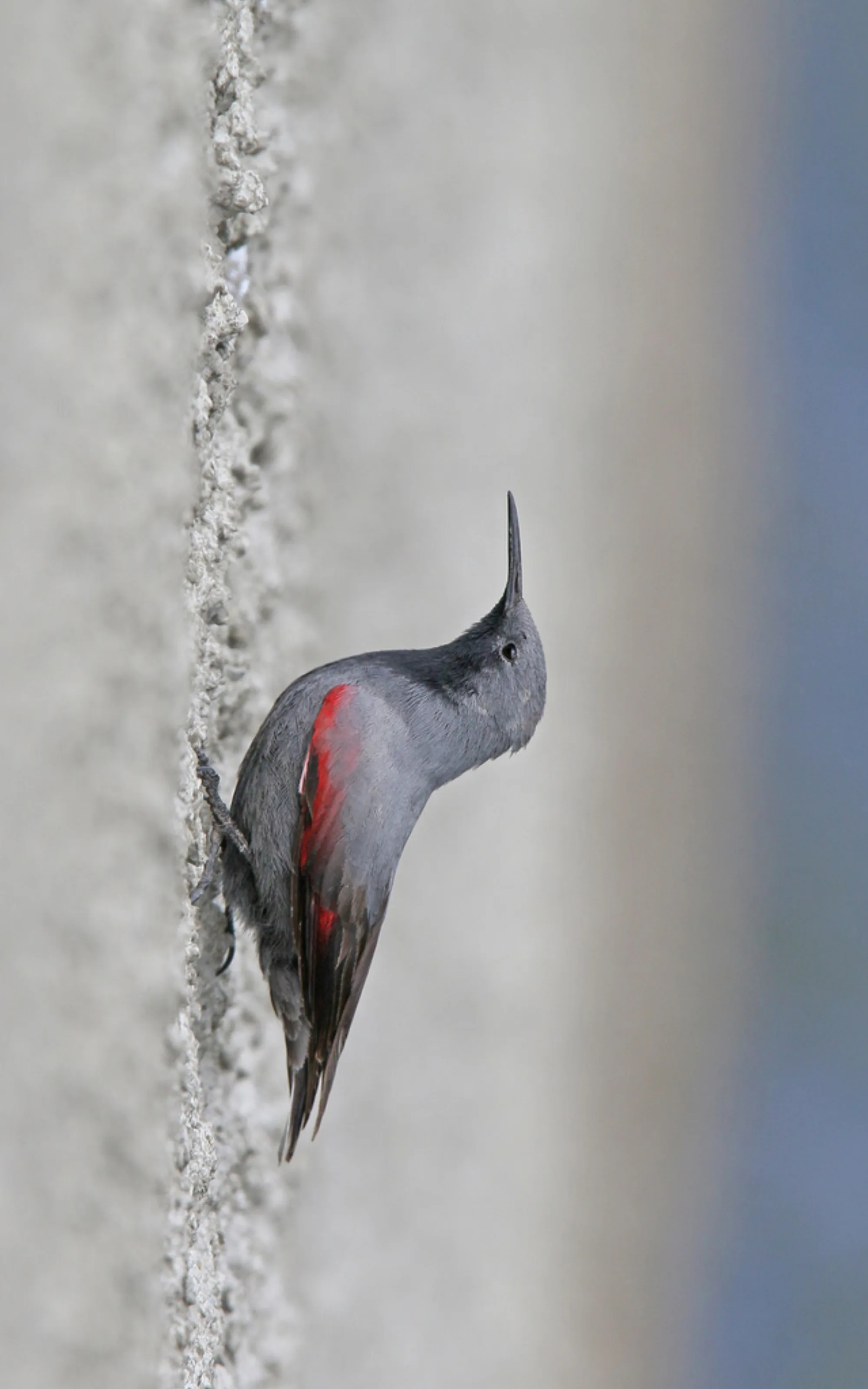
Against the rock, the Wallcreeper can be surprisingly hard to spot, even though it is sometimes quite tame. This small mountain bird is 15.5 to 17 centimetres long, with mostly blue-grey plumage and a short black tail edged narrowly in white. Its crimson wings carry white spots, but much of that colour stays hidden when the wings are folded. In summer, males have black throats, while females have white throats or a small dark patch; in autumn and winter, both sexes have white throats. Usually quiet, the bird has a high, drawn-out whistling song whose notes rise and fall.
The Wallcreeper lives in the mountains of Eurasia, from southern Europe to central China. It stays in much of its range year-round, moving downhill in winter, when it may visit quarries and buildings. In Brittany and Normandy, it regularly spends the winter on viaducts and cathedrals. On a cliff face, it searches for insects and spiders, moving in quick hops and short flights, often with its wings partly open. It also sometimes darts out from a rock perch to catch flying insects.
Pairs defend breeding territories in summer, while in winter individual birds defend feeding areas and live alone. A female builds a grass and moss cup deep inside a rock crevice, hole or cave, lining it with softer material such as feathers or wool. She usually lays 4 to 5 eggs and incubates them for 19 to 20 days, with her mate bringing food. Both parents feed the young until they leave the nest, and each pair raises one brood a year.
Written from the English Wikipedia article Wallcreeper (CC BY-SA 4.0).
- Records
- 23,200
- Countries
- 26
- Atlas places
- 5
These are open occurrence records, so they show where people looked for and recorded the Wallcreeper as much as where it lives. Cells are up to 25 km across, and every location is generalised to its cell.
Generalised encounter areas, not exact locations. Each shape is a grid cell coloured by how likely the species is there.
- Very likelyFrance25 km zone · medium confidence · 12643 records · updated 80 days ago
- Very likelyIndia25 km zone · medium confidence · 3675 records · updated 80 days ago
- Very likelySpain25 km zone · high confidence · 2521 records · updated 80 days ago
- Very likelyBhutan25 km zone · high confidence · 672 records · updated 80 days ago
- Very likelyNepal25 km zone · medium confidence · 424 records · updated 80 days ago
- Very likelyGeorgia25 km zone · high confidence · 386 records · updated 80 days ago
- Very likelyCzechia25 km zone · high confidence · 313 records · updated 80 days ago
- Very likelyItaly25 km zone · medium confidence · 309 records · updated 80 days ago
- Very likelyChina25 km zone · high confidence · 295 records · updated 80 days ago
- Very likelyTürkiye25 km zone · high confidence · 271 records · updated 80 days ago
Conservation status not assessed here yet, so every location is generalised to its grid cell.