Arctic Grayling
Thymallus arcticus
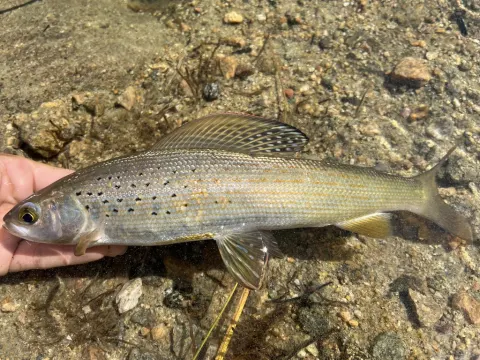
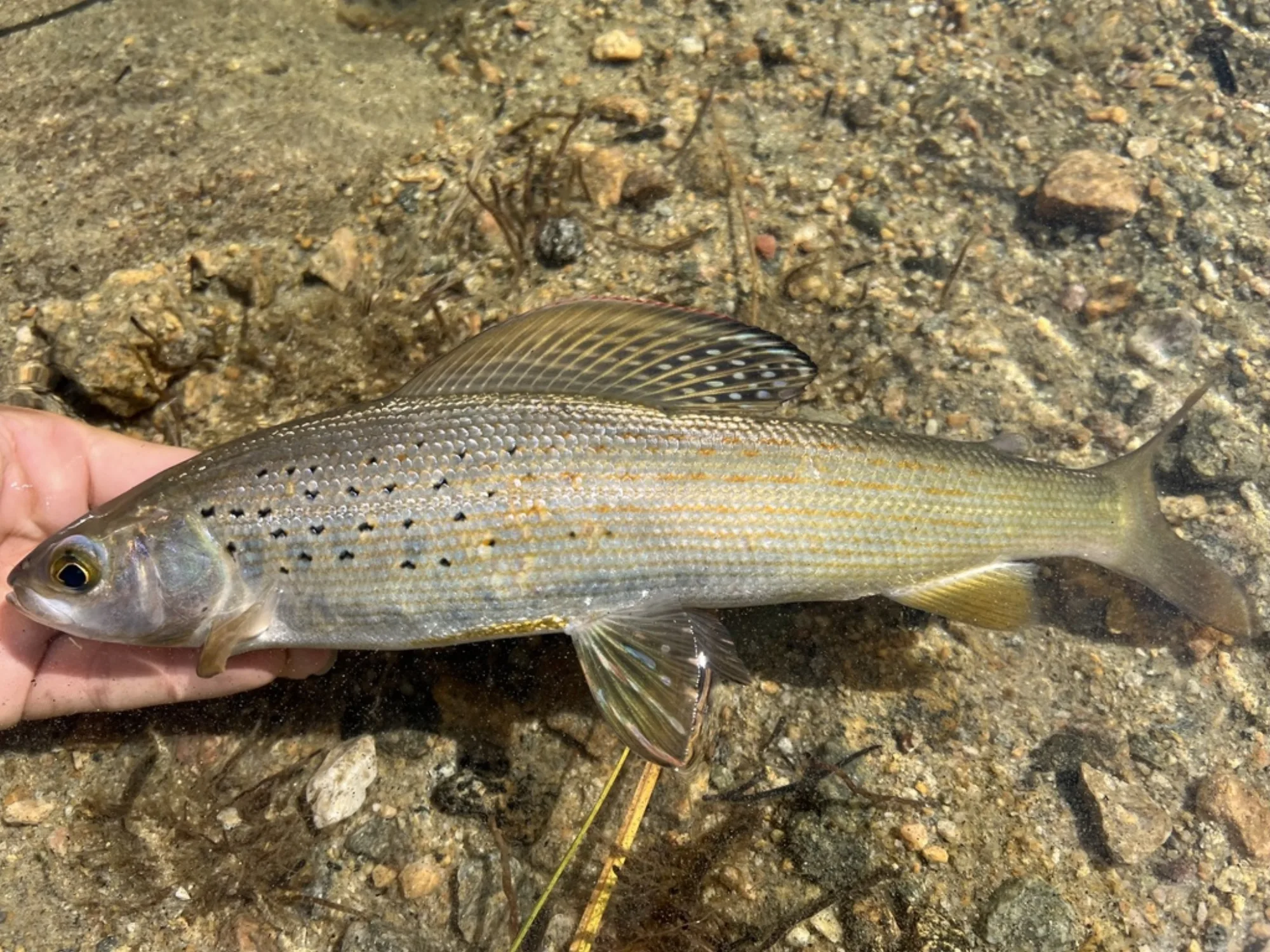
A dark stripe along its side and a possible pink sheen on its flanks help distinguish the Arctic Grayling, a freshwater member of the salmon family. Its dorsal fin is colourful, and males flash it when courting. The largest recorded individuals reached 76 cm in length and 3.8 kg in weight.
Across northern North America, Arctic Grayling live in drainages running towards the Arctic and Pacific oceans, from the Hudson Bay region to Alaska and south to central Alberta and British Columbia. Their natural range also includes parts of Siberia and tributaries of the Pechora River in European Russia. In Montana, native river populations persist in the upper Missouri drainage, in the Red Rock basin and the Big Hole River. Introduced lake populations live in several mountain regions, including the Rockies, and reach as far south as Arizona. The fish favour cold water in medium-sized to large rivers and lakes, with some living and breeding in rivers, others in lakes, and others moving from lakes into tributary streams to spawn.
Arctic Grayling eat crustaceans, insects, insect larvae and fish eggs. Young fish also take zooplankton, while larger individuals eat fish. Breeding takes place in spring, when adults seek shallow river areas with moderate currents and fine sand. Males defend territories, and the eggs are left among the riverbed material. After hatching and absorbing their yolk, the young emerge and gather in shoals along river margins. Some populations at the southern edge of the native range have disappeared; in Michigan, their loss followed damage to habitat, unrestricted logging and competition from introduced fish.
Written from the English Wikipedia article Arctic grayling (CC BY-SA 4.0).
- Records
- 784
- Countries
- 4
- Atlas places
- 4
These are open occurrence records, so they show where people looked for and recorded the Arctic Grayling as much as where it lives. Cells are up to 25 km across, and every location is generalised to its cell.
Generalised encounter areas, not exact locations. Each shape is a grid cell coloured by how likely the species is there.
- Very likelyUnited States25 km zone · medium confidence · 725 records · updated 80 days ago
- LikelyRussia25 km zone · medium confidence · 28 records · updated 80 days ago
- LikelyCanada25 km zone · medium confidence · 26 records · updated 80 days ago
- LikelyMongolia25 km zone · medium confidence · 5 records · updated 80 days ago
Conservation status not assessed here yet, so every location is generalised to its grid cell.