Bluefin Tuna
Thunnus thynnus
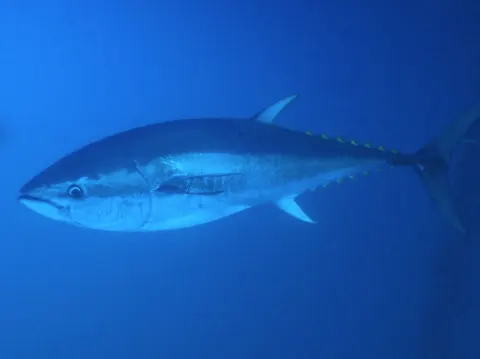
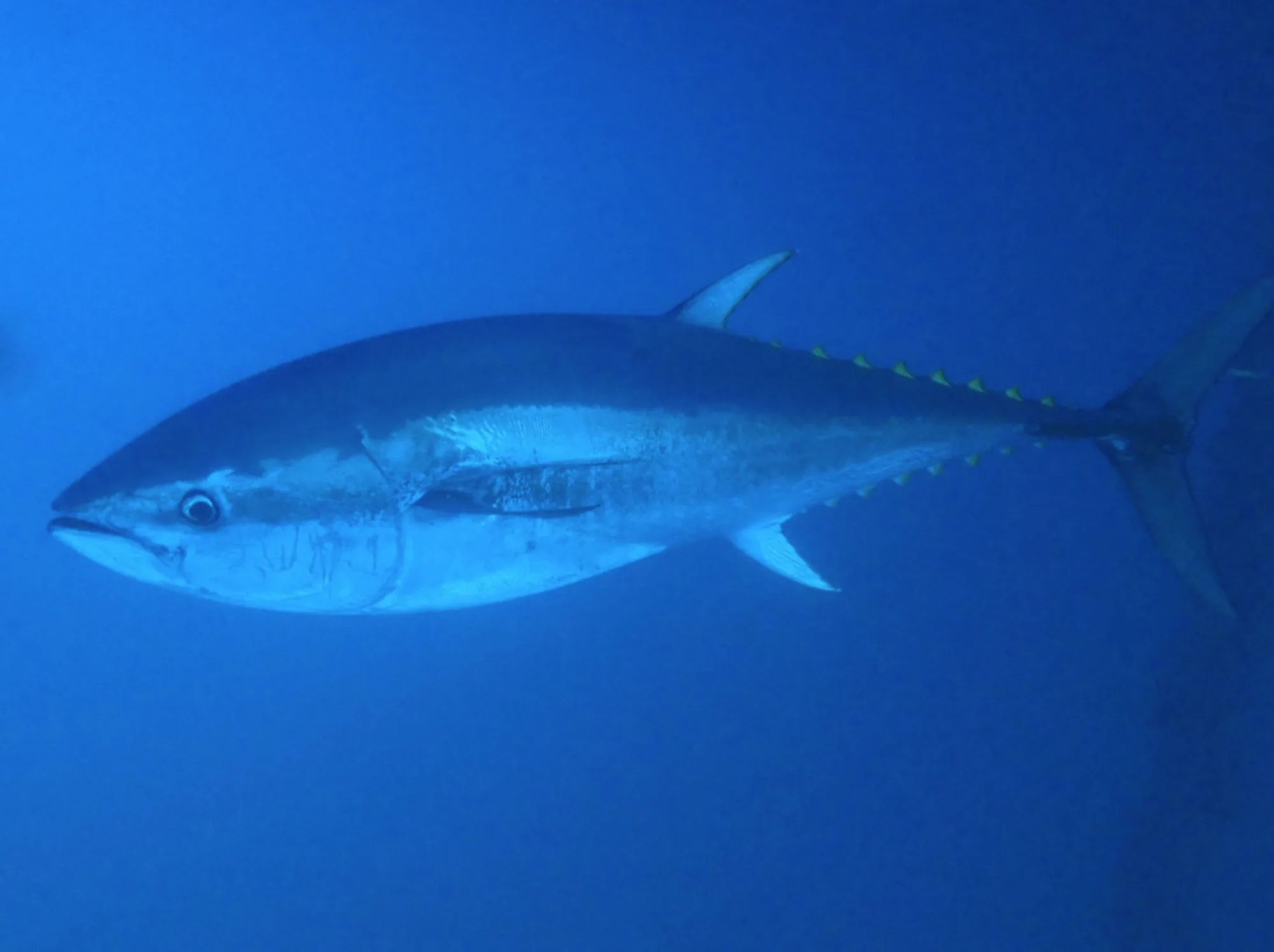
Built for powerful swimming, the Bluefin Tuna has a robust body, a large mouth and short pectoral fins. Its back is dark blue, its underside grey, and a golden sheen covers its body, with bright yellow finlets near the tail. Fully mature adults average 2 to 2.5 m in length and weigh around 225 to 250 kg. Native to both sides of the Atlantic and the Mediterranean Sea, the species has disappeared from the Black Sea. It can seek food in the chilly North Atlantic and dive to depths of 1,006 m.
Bluefin hunt small fish, including sardines, herring, mackerel and eels, as well as squid and crustaceans. They hunt opportunistically and form schools with others of a similar size. To spawn, they gather in large groups, and the vast majority return to the area where they hatched. Eastern fish spawn in the western Mediterranean, particularly around the Balearic Islands, while western fish spawn in the Gulf of Mexico. Researchers have also proposed a spawning area in the Slope Sea, beyond the northwestern edge of the continental shelf off the northeastern United States. Newly hatched tuna face predators including other fish and jellyfish, while adults may fall prey to some sharks in the open ocean, toothed whales and the biggest billfish.
Commercial demand has driven severe overfishing, and spawning gatherings leave bluefin especially exposed to fishing. Young fish are also taken from the wild for ranching before they can reproduce. Enforcement of regional fishing quotas has brought some population increases, though many regional populations remain severely depleted, including the western stock that spawns in the Gulf of Mexico.
Written from the English Wikipedia article Atlantic bluefin tuna (CC BY-SA 4.0).
- Records
- 2,830
- Countries
- 9
No atlas park has a record of the Bluefin Tuna in or around it yet.
These are open occurrence records, so they show where people looked for and recorded the Bluefin Tuna as much as where it lives. Cells are up to 25 km across, and every location is generalised to its cell.
Generalised encounter areas, not exact locations. Each shape is a grid cell coloured by how likely the species is there.
- Very likelyUnited States25 km zone · medium confidence · 2580 records · updated 80 days ago
- Very likelyCroatia25 km zone · high confidence · 114 records · updated 80 days ago
- Very likelyItaly25 km zone · medium confidence · 54 records · updated 80 days ago
- LikelyUnnamed area25 km zone · medium confidence · 27 records · updated 80 days ago
- LikelyCanada25 km zone · medium confidence · 13 records · updated 80 days ago
- LikelyFrance25 km zone · medium confidence · 13 records · updated 80 days ago
- LikelyCuba25 km zone · medium confidence · 10 records · updated 80 days ago
- LikelyDenmark25 km zone · medium confidence · 8 records · updated 80 days ago
- PossibleBahamas25 km zone · medium confidence · 11 records · updated 80 days ago
Conservation status not assessed here yet, so every location is generalised to its grid cell.