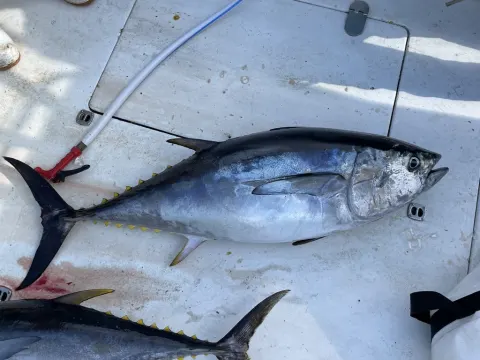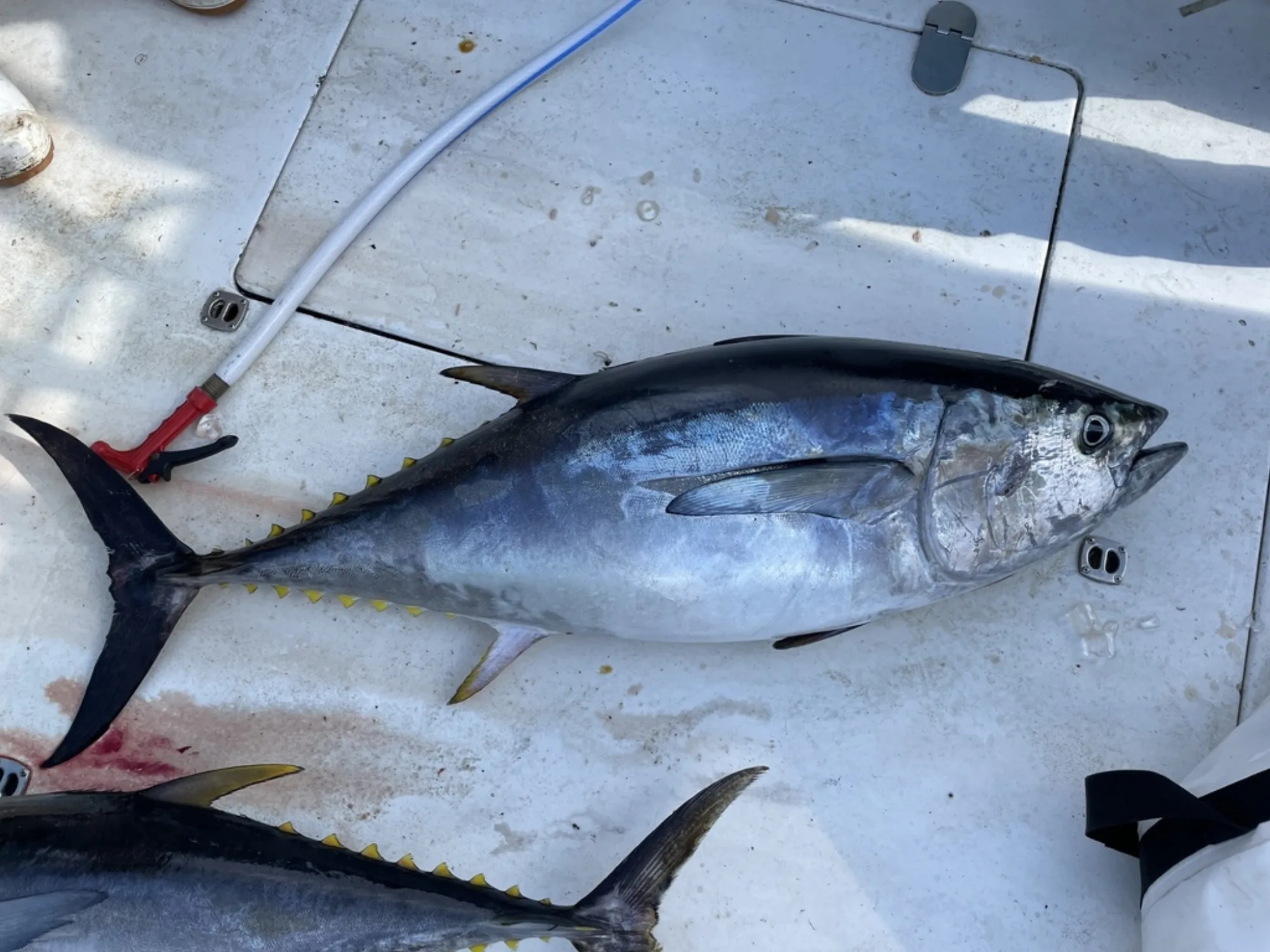
Bigeye Tuna
Thunnus obesus
Built for the open ocean, the Bigeye Tuna has a deep, streamlined body, a large head and conspicuously large eyes. It can reach 2.5 m in length, and its very long pectoral fins extend back towards the dorsal fins. It lives in tropical and temperate oceans around the world, but does not occur in the Mediterranean Sea. Its well-developed eyes help it see in dim conditions, while its physiology lets it feed in cold, deep water where oxygen is scarce.
A typical day takes this tuna down into cooler water at dawn and back towards warmer, shallower water at dusk. During daylight it can move to depths of 300 to 500 m, making periodic returns to warmer water to regain heat. Across the Pacific, the depths where it spends most of the day vary, from 200 to 350 m in the eastern Pacific to 300 to 500 m in the Coral Sea. Bigeye Tuna eat fish, crustaceans and cephalopods, and their daily movements may follow those of their prey. Around seamounts, buoys and fish aggregating devices, they can change their usual pattern and stay near the surface for approximately 10 to 30 days. Tagging studies show that they can cross ocean basins, though some also remain closely associated with particular regions.
In tropical parts of the Pacific, spawning takes place in most months, while at higher latitudes it becomes seasonal. Commercial fishing is a major pressure: vessels caught approximately 450,500 metric tonnes worldwide in 2012. Stocks are considered overfished in the western, central and eastern Pacific, and close to or already overfished in the Atlantic.
Written from the English Wikipedia article Bigeye tuna (CC BY-SA 4.0).
- Records
- 20,209
- Countries
- 10
No atlas park has a record of the Bigeye Tuna in or around it yet.
These are open occurrence records, so they show where people looked for and recorded the Bigeye Tuna as much as where it lives. Cells are up to 25 km across, and every location is generalised to its cell.
Generalised encounter areas, not exact locations. Each shape is a grid cell coloured by how likely the species is there.
- Very likelyUnited States25 km zone · medium confidence · 16847 records · updated 80 days ago
- Very likelyBahamas25 km zone · medium confidence · 1496 records · updated 80 days ago
- Very likelyCuba25 km zone · high confidence · 612 records · updated 80 days ago
- Very likelyUnnamed area25 km zone · medium confidence · 366 records · updated 80 days ago
- Very likelyFrance25 km zone · medium confidence · 349 records · updated 80 days ago
- Very likelyUnited Kingdom25 km zone · high confidence · 300 records · updated 80 days ago
- Very likelyU.S. Virgin Islands25 km zone · high confidence · 122 records · updated 80 days ago
- Very likelyHaiti25 km zone · medium confidence · 34 records · updated 80 days ago
- Very likelyCanada25 km zone · medium confidence · 31 records · updated 80 days ago
- Very likelyGhana25 km zone · medium confidence · 27 records · updated 80 days ago
Conservation status not assessed here yet, so every location is generalised to its grid cell.