Yellowfin Tuna
Thunnus albacares
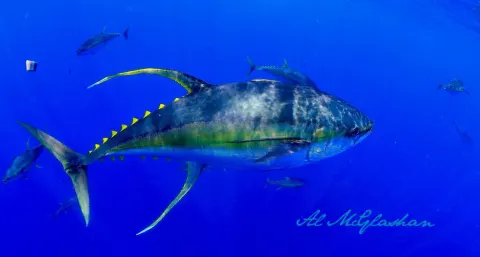
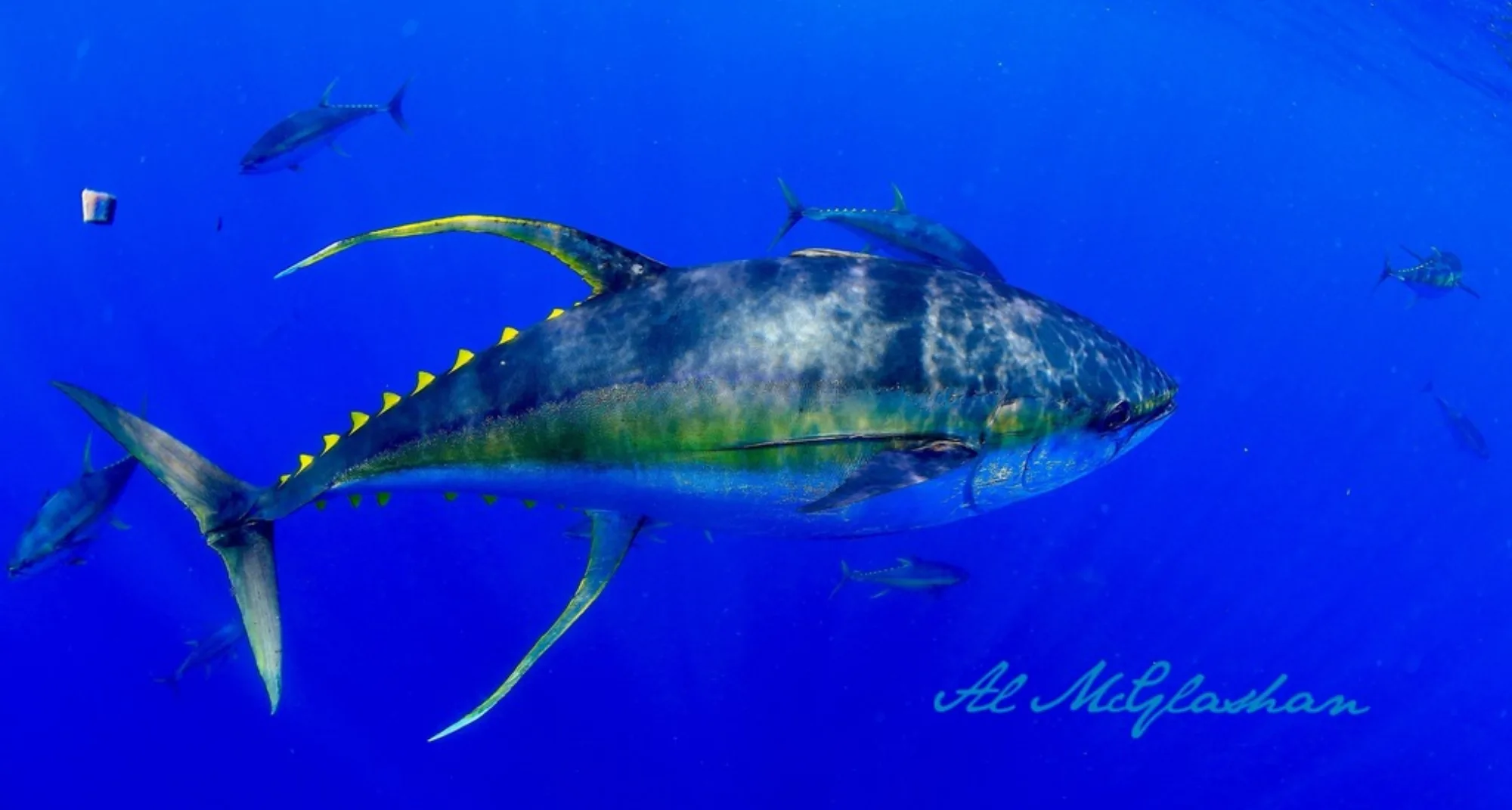
Bright yellow fins give the Yellowfin Tuna its name, and in mature fish the long fins can curve back almost to the tail like sickles. Its body is dark metallic blue above and silver on the belly, where around 20 vertical lines are visible. One of the larger tunas, it can exceed 180 kg, and reported specimens have reached 2.4 m in length.
Yellowfin roam tropical and subtropical oceans around the world, usually in deep offshore water near the surface. They can also approach islands and move inshore when the water is suitably warm and clear and food is plentiful. Around places such as Hawaii, the Maldives, Ascension Island and Saint Helena, they feed on baitfish concentrated close to shore. They often travel in schools of similar-sized fish, sometimes alongside other tuna, dolphins, porpoises, whales or whale sharks. Logs, pallets and other drifting objects can attract them too, and tagged fish have been recorded following moving vessels.
Built for speed, yellowfin chase fish including flying fish, mackerel, anchovies and sardines, as well as eating squid and open-ocean crustaceans. Young fish fall prey to seabirds, larger tuna, sharks and other hunters, while adults are pursued by powerful predators including false killer whales and large sharks. Industrial tuna fisheries are their main source of mortality, catching them with encircling nets and longlines. Nets set around floating objects can take large numbers of young yellowfin before they have reached breeding age, with potential consequences for tuna stocks worldwide.
Written from the English Wikipedia article Yellowfin tuna (CC BY-SA 4.0).
- Records
- 40,261
- Countries
- 7
No atlas park has a record of the Yellowfin Tuna in or around it yet.
These are open occurrence records, so they show where people looked for and recorded the Yellowfin Tuna as much as where it lives. Cells are up to 25 km across, and every location is generalised to its cell.
Generalised encounter areas, not exact locations. Each shape is a grid cell coloured by how likely the species is there.
- Very likelyUnited States25 km zone · high confidence · 34946 records · updated 80 days ago
- Very likelyUnited Kingdom25 km zone · high confidence · 2162 records · updated 80 days ago
- Very likelyFaroe Islands25 km zone · high confidence · 1048 records · updated 80 days ago
- Very likelyCuba25 km zone · high confidence · 813 records · updated 80 days ago
- Very likelyBahamas25 km zone · high confidence · 609 records · updated 80 days ago
- Very likelyFrance25 km zone · high confidence · 528 records · updated 80 days ago
- Very likelyUnnamed area25 km zone · high confidence · 155 records · updated 80 days ago
Conservation status not assessed here yet, so every location is generalised to its grid cell.