Albacore
Thunnus alalunga
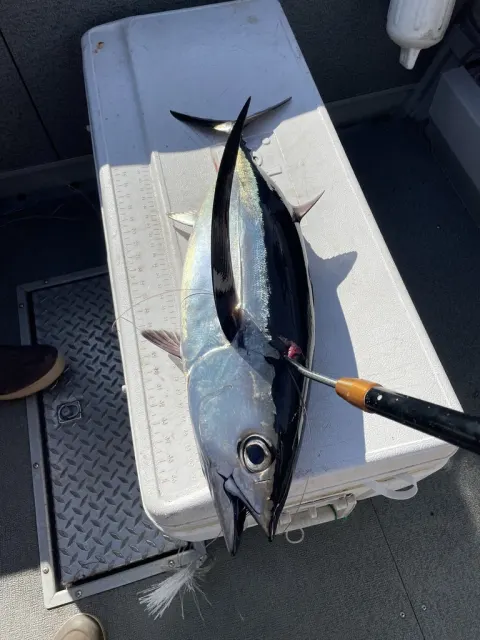
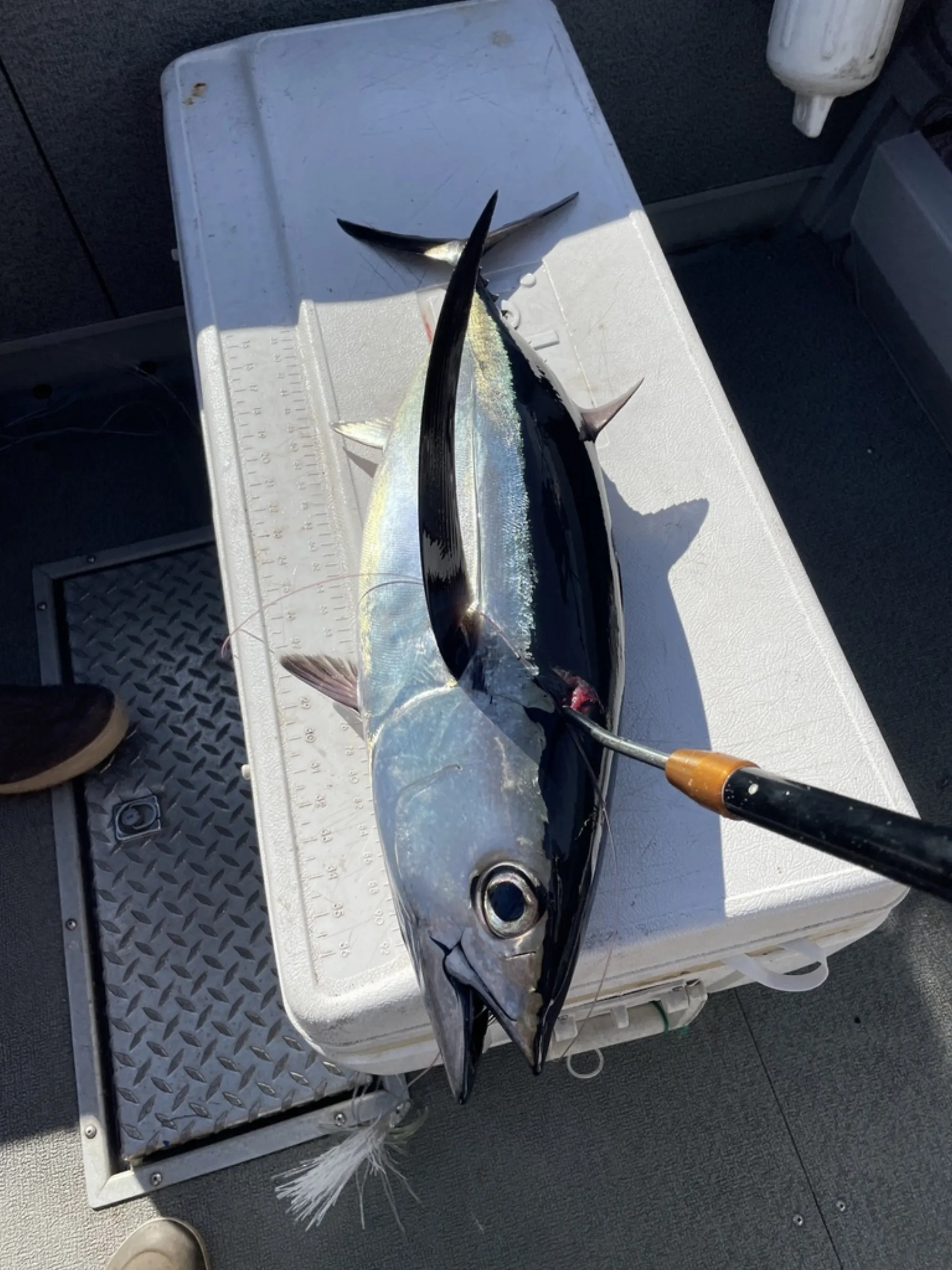
Long pectoral fins give the Albacore one of its most distinctive features. This streamlined tuna has a pointed snout, large eyes, a dark blue back and a silvery white underside. It can reach 1.4 m in length, although younger fish have much shorter pectoral fins.
Albacore live in tropical and temperate waters around the world, including the Mediterranean Sea. They range from the surface down to 600 m and favour places where warm and cool water meet. Their movements can bring them within reach of coastal waters: North Atlantic fish visit the Bay of Biscay off France and Spain each summer. Around Baja California, they dive frequently below 200 m by day and remain near the surface at night. Fish off the coasts of Washington and Oregon spend the entire day close to the surface.
These open-sea predators feed mainly on cephalopods, but also eat fish, crustaceans and gelatinous organisms. Their schools are organised by age and maturity, and the older fish gather in more compact groups. They may also join other tuna species, sometimes gathering around floating sargassum weed. Albacore must keep moving to obtain oxygen, and schools of adults migrate over great distances. Spawning usually takes place between November and February, and a female can release more than two million eggs in a cycle. Young fish remain close to where they hatched for about a year before beginning to migrate. Commercial and recreational fisheries both target Albacore, and overfishing has threatened the species. Several stocks declined substantially, though regional fishing quotas have helped them recover.
Written from the English Wikipedia article Albacore (CC BY-SA 4.0).
- Records
- 13,613
- Countries
- 10
No atlas park has a record of the Albacore in or around it yet.
These are open occurrence records, so they show where people looked for and recorded the Albacore as much as where it lives. Cells are up to 25 km across, and every location is generalised to its cell.
Generalised encounter areas, not exact locations. Each shape is a grid cell coloured by how likely the species is there.
- Very likelyUnited States25 km zone · medium confidence · 10084 records · updated 80 days ago
- Very likelyNew Zealand25 km zone · high confidence · 2149 records · updated 80 days ago
- Very likelyBahamas25 km zone · high confidence · 688 records · updated 80 days ago
- Very likelyCuba25 km zone · high confidence · 158 records · updated 80 days ago
- Very likelyIceland25 km zone · medium confidence · 140 records · updated 80 days ago
- Very likelyUnnamed area25 km zone · medium confidence · 103 records · updated 80 days ago
- Very likelyFrench Polynesia25 km zone · medium confidence · 94 records · updated 80 days ago
- Very likelyHaiti25 km zone · high confidence · 75 records · updated 80 days ago
- Very likelyAustralia25 km zone · medium confidence · 74 records · updated 80 days ago
- Very likelyIreland25 km zone · medium confidence · 28 records · updated 80 days ago
Conservation status not assessed here yet, so every location is generalised to its grid cell.