Carolina Wren
Thryothorus ludovicianus
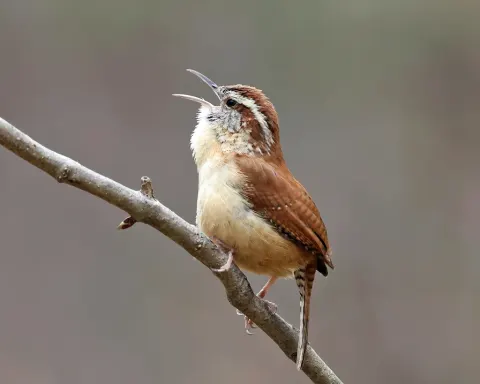
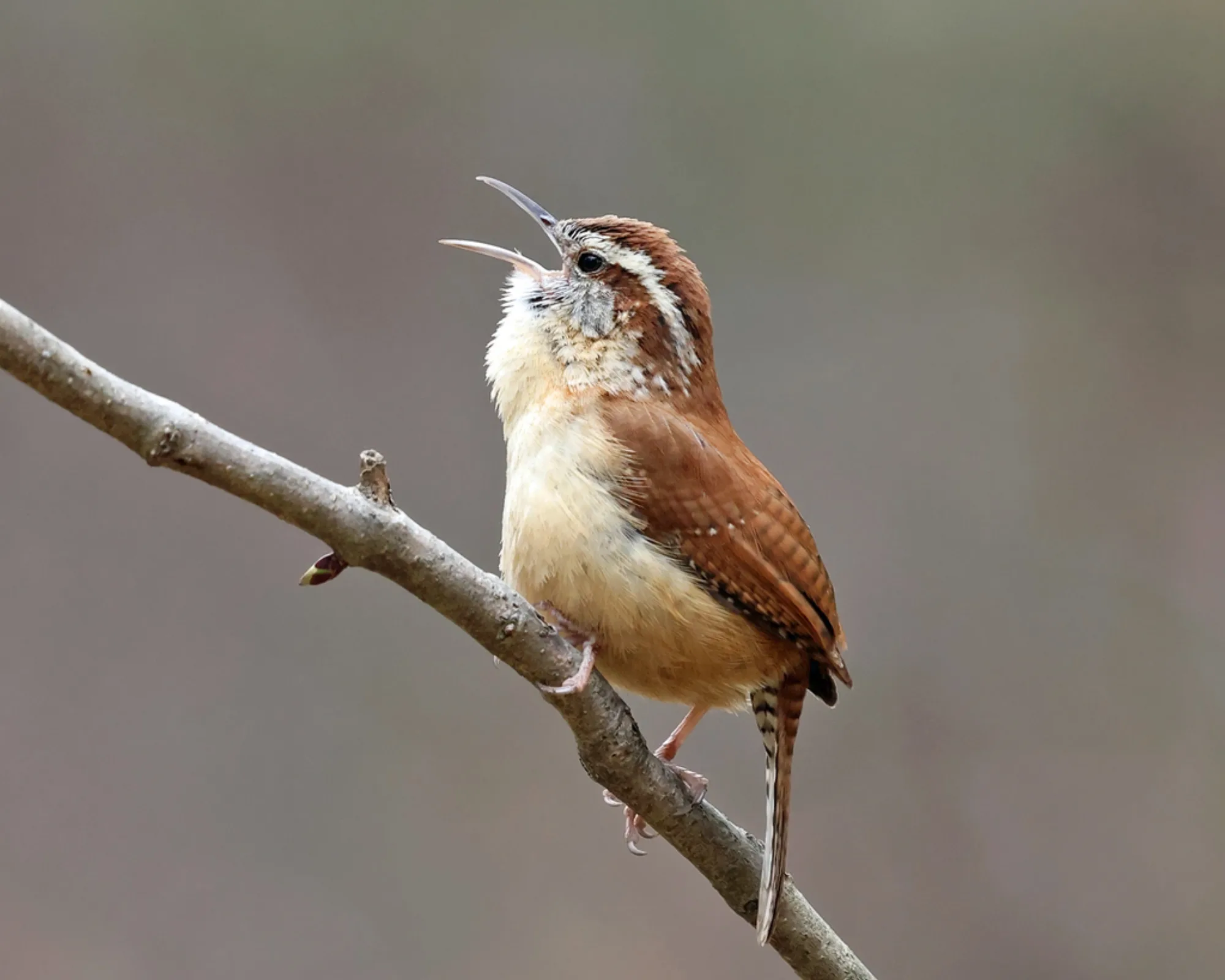
Often heard before it is seen, the Carolina Wren is a fairly large wren that usually keeps to cover. It measures 12.5 to 14 cm long, and one widespread form has rich brown upperparts, a pale stripe above the eye and a buff chest and belly. Colour varies across its range, with some forms darker and others paler. Males sing throughout the year, often repeating a phrase for several minutes; one familiar rendition sounds like “teakettle-teakettle-teakettle”.
Look for this bird across much of the eastern United States, as well as in southernmost Ontario, parts of Mexico and northern Central America. It favours dense cover, from wooded places and swamp margins to untended farmland and shrubby suburban gardens. Wary and seldom still when exposed, it searches on or near the ground, hopping through objects and investigating leaf litter and bark crevices. Beetles, grasshoppers, spiders and other invertebrates form part of its diet, alongside small lizards and tree frogs; fruit pulp and seeds make up a small portion. In the north, it also visits bird feeders. Pairs defend a territory and usually stay together for life. Their arched nests have side entrances and can be tucked into tree cavities, bird boxes, buildings or even hanging jacket pockets. A pair may raise as many as three broods in a breeding season, feeding the young invertebrates.
Cold, ice and prolonged snow can affect both adults and young, while harsh winters limit the bird's northern range. Brown-headed cowbirds sometimes lay in wren nests, reducing the success of wren eggs and young. Domestic cats and snakes prey on adults, while raccoons and black rat snakes take eggs and nestlings.
Written from the English Wikipedia article Carolina wren (CC BY-SA 4.0).
- Records
- 5,520,484
- Countries
- 7
- Atlas places
- 2
These are open occurrence records, so they show where people looked for and recorded the Carolina Wren as much as where it lives. Cells are up to 25 km across, and every location is generalised to its cell.
Generalised encounter areas, not exact locations. Each shape is a grid cell coloured by how likely the species is there.
- Very likelyUnited States25 km zone · high confidence · 5403758 records · updated 86 days ago
- Very likelyCanada25 km zone · high confidence · 88411 records · updated 86 days ago
- Very likelyMexico25 km zone · high confidence · 23587 records · updated 86 days ago
- LikelyBelize25 km zone · high confidence · 2807 records · updated today
- LikelyGuatemala25 km zone · high confidence · 1756 records · updated today
- PossibleHonduras25 km zone · high confidence · 125 records · updated today
- UncommonNicaragua25 km zone · medium confidence · 40 records · updated today
Conservation status not assessed here yet, so every location is generalised to its grid cell.