Bewick's Wren
Thryomanes bewickii
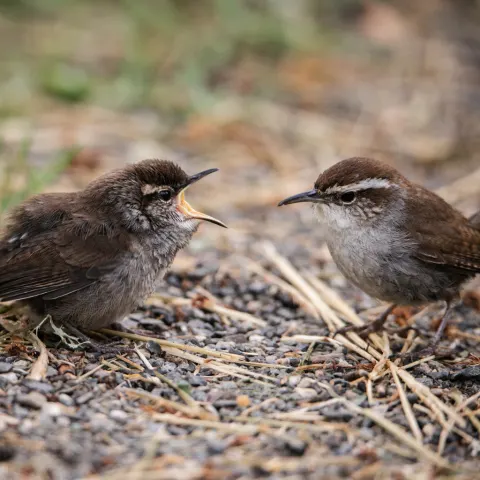
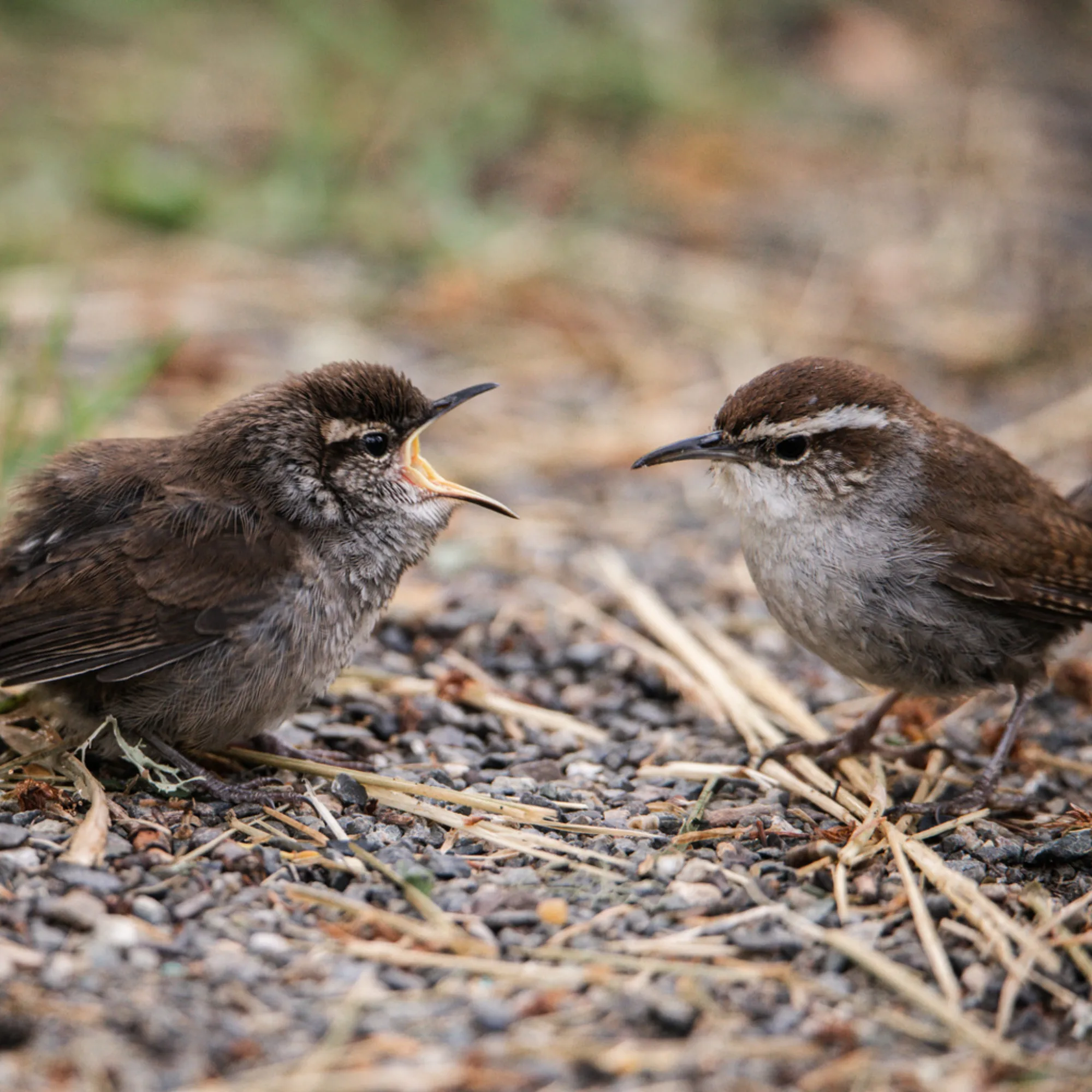
A long white eyebrow and a tail that rarely seems to stay still can help a traveller pick out Bewick's Wren. This North American wren is about 14 cm long, grey-brown above and pale below, with black bars and white corners on its long tail. Its slender bill curves slightly, and males and females look much alike. Listen, too, for a loud, melodious song: males sing to attract mates and defend territory, while both sexes call as they forage.
The bird occurs on the Pacific coast between British Columbia and Baja California, as well as in Mexico and much of the Southwest; sightings east of the Mississippi River are now exceedingly rare. Look for it in open woodland, scrub, thickets and hedgerows, often near streams. It favours dry, brushy hillsides and uplands, though it also lives locally in humid areas. In California it can be found in chaparral, and western populations tend to stay in their range year-round.
Bewick's Wrens search vegetation and the ground for insects and spiders, sometimes hanging upside down to reach prey beneath a branch. They also take insect eggs, add seeds to their diet in winter and visit backyard feeders. Pairs forage together and build a cup-shaped nest of twigs and other plant material in a cavity or birdhouse, often lining it with feathers. A clutch has 5 to 7 white eggs marked with brown, and two broods are produced in a season. Eastern populations have suffered a severe decline, with competition from house wrens considered the most likely cause: house wrens use similar nest sites and destroy wren nests and eggs. Pesticides and the return of forest to open land have also been suggested as factors in the eastern decline, while development has caused habitat loss in California.
Written from the English Wikipedia article Bewick's wren (CC BY-SA 4.0).
- Records
- 2,376,201
- Countries
- 3
- Atlas places
- 3
These are open occurrence records, so they show where people looked for and recorded the Bewick's Wren as much as where it lives. Cells are up to 25 km across, and every location is generalised to its cell.
Generalised encounter areas, not exact locations. Each shape is a grid cell coloured by how likely the species is there.
- Very likelyUnited States25 km zone · high confidence · 2201849 records · updated 80 days ago
- Very likelyCanada25 km zone · high confidence · 125988 records · updated 80 days ago
- Very likelyMexico25 km zone · high confidence · 48364 records · updated 80 days ago
Conservation status not assessed here yet, so every location is generalised to its grid cell.