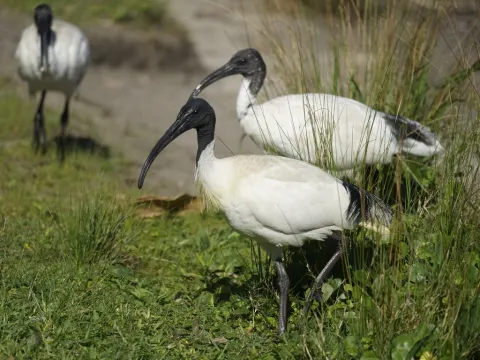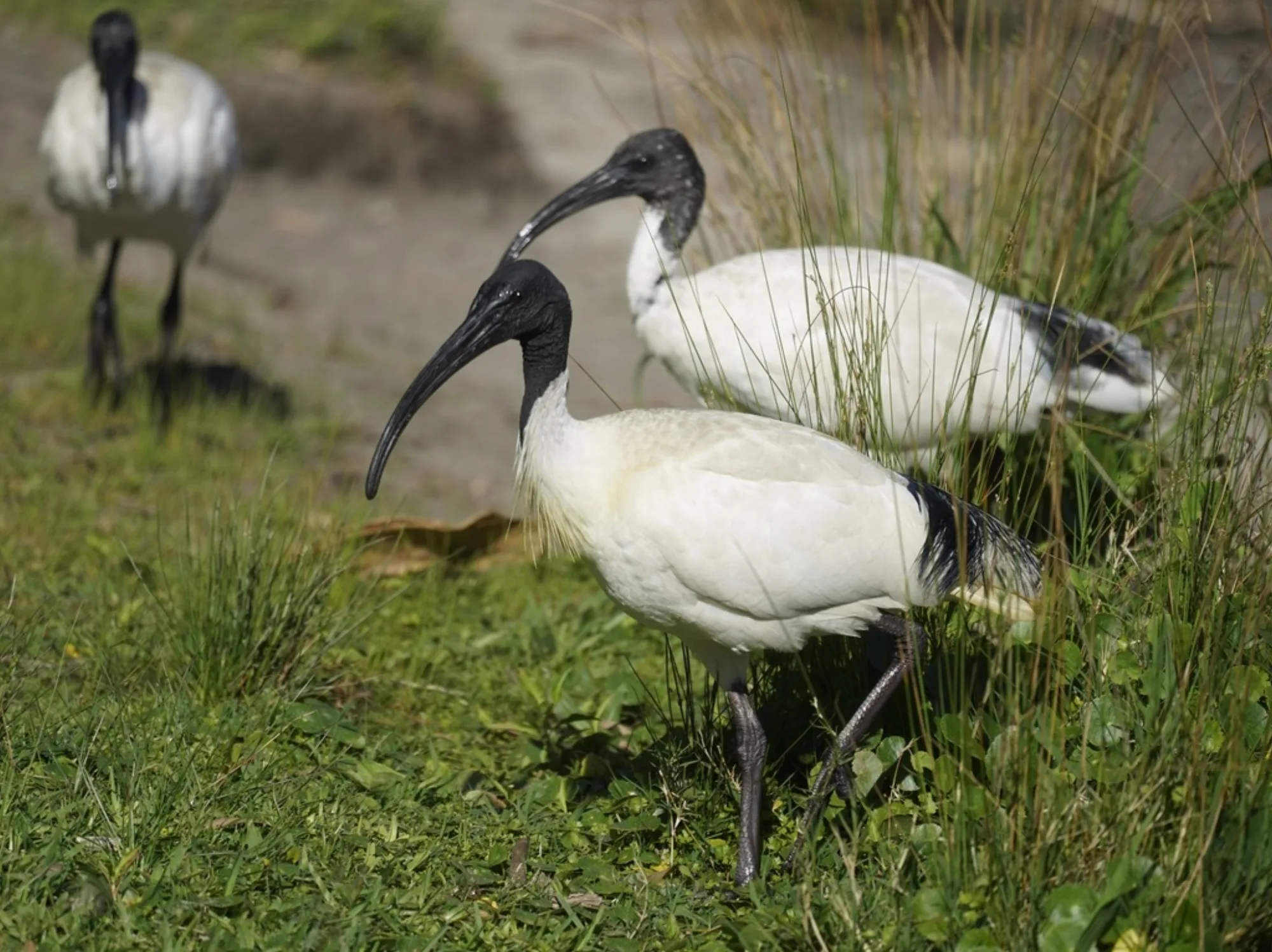
Australian White Ibis
Threskiornis molucca
A long, downcurved black bill and a bare black head give the Australian White Ibis a distinctive profile. This large wading bird has mostly white plumage, dark legs and lacy black feathers that look like a tail. Its white feathers can become stained brown, while breeding birds develop yellow on the upper tail. Young birds have shorter bills and feathers on their heads and necks. Listen for a long croaking call.
Across much of eastern, northern and south-western Australia, the species lives in marshy wetlands, often close to open grassland. It is also a familiar sight in city parks and rubbish dumps, including those in Sydney, Perth, Brisbane and the Gold Coast. In urban areas, it has grown less fearful of people and added discarded human food to its diet. Away from rubbish, it eats land and water invertebrates, favouring crayfish and mussels, which it digs out with its bill. Some birds have learned to flick cane toads around and wash them before eating them.
Breeding generally takes place from August to November in southern Australia and from February to May in the north. A shallow platform of sticks, grasses or reeds is built in a tree, usually near water, often close to nesting herons, egrets or other waterbirds. A clutch contains two or three dull white eggs, and the chicks take 48 days to fledge. Drought has driven birds eastwards from inland areas, and the species has disappeared from some natural breeding areas, including the Macquarie Marshes. Some urban populations have also been culled.
Written from the English Wikipedia article Australian white ibis (CC BY-SA 4.0).
- Records
- 615,420
- Countries
- 7
- Atlas places
- 5
These are open occurrence records, so they show where people looked for and recorded the Australian White Ibis as much as where it lives. Cells are up to 25 km across, and every location is generalised to its cell.
Generalised encounter areas, not exact locations. Each shape is a grid cell coloured by how likely the species is there.
- Very likelyAustralia25 km zone · high confidence · 614590 records · updated 86 days ago
- Very likelyPapua New Guinea25 km zone · high confidence · 565 records · updated 86 days ago
- LikelyIndonesia25 km zone · medium confidence · 108 records · updated today
- LikelyChristmas Island25 km zone · medium confidence · 50 records · updated today
- PossibleSolomon Islands25 km zone · medium confidence · 80 records · updated today
- PossibleNorfolk Island25 km zone · medium confidence · 22 records · updated today
- UncommonTimor-Leste25 km zone · medium confidence · 5 records · updated today
Conservation status not assessed here yet, so every location is generalised to its grid cell.