Gelada
Theropithecus gelada
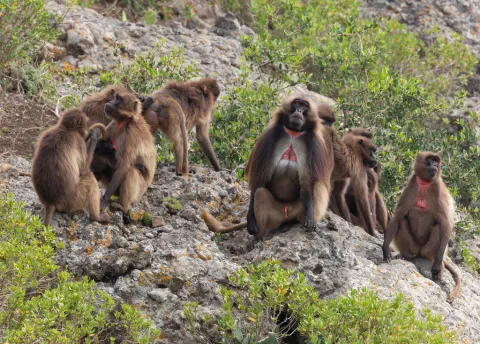
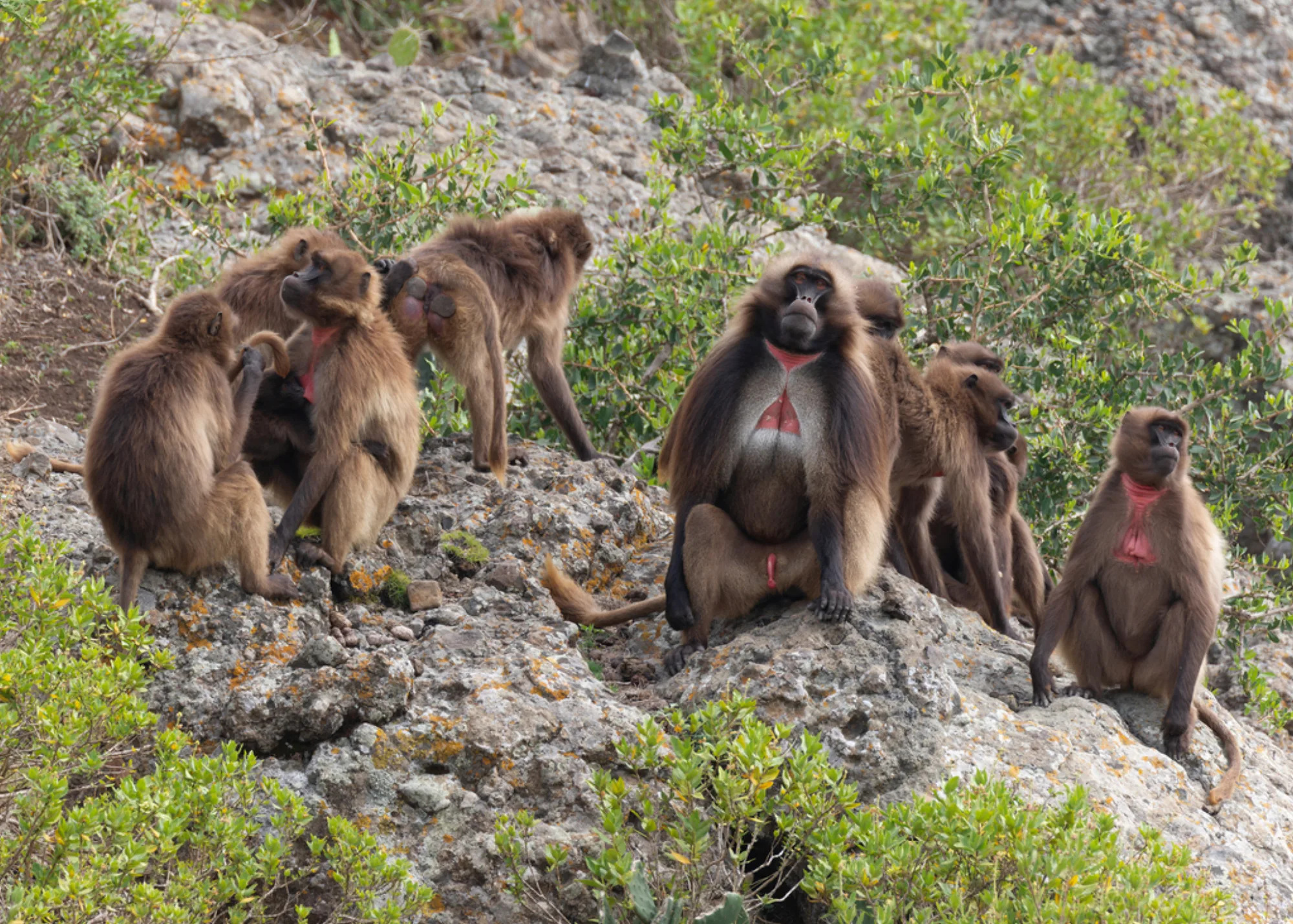
On the high grasslands of Ethiopia, the Gelada moves across the ground in search of food, often feeding in the open by day. This robust Old World monkey has buff to dark brown hair, a dark face and pale eyelids, with almost black arms and feet. Adult males carry a long cape of hair across their backs and a bright red, hourglass-shaped patch on the chest; the female's patch is less conspicuous. Found only in the Ethiopian Highlands, Geladas live at elevations of 1,800 to 4,400 m. They forage among grasslands with scattered trees, bushes and dense thickets, and sleep on cliff ledges.
At sunrise, they leave their sleeping cliffs for the plateau tops, where they feed and socialise, returning to the cliffs in the evening. Grass blades make up as much as 90% of their diet, although they also eat seeds, flowers, roots and other plants. While feeding, they can stay in a squat and shuffle along by sliding their feet. Their society has several layers: small breeding groups and all-male groups come together in bands, and bands form communities. Females in a breeding group are often closely related and maintain strong social bonds, while males leave the groups in which they were born. Breeding can take place throughout the year, and mothers carry infants on their bellies for the first five weeks, then on their backs. Geladas also communicate with a varied range of calls and gestures.
Agricultural expansion reduces their range, and they are shot where farmers consider them crop pests. Domestic dogs, leopards, servals, hyenas and lammergeiers have also been observed hunting them.
Written from the English Wikipedia article Gelada (CC BY-SA 4.0).
- Records
- 15
- Countries
- 1
No atlas park has a record of the Gelada in or around it yet.
These are open occurrence records, so they show where people looked for and recorded the Gelada as much as where it lives. Cells are up to 25 km across, and every location is generalised to its cell.
Generalised encounter areas, not exact locations. Each shape is a grid cell coloured by how likely the species is there.
- Very likelyEthiopia25 km zone · medium confidence · 15 records · updated 80 days ago
Conservation status not assessed here yet, so every location is generalised to its grid cell.