Common Garter Snake
Thamnophis sirtalis
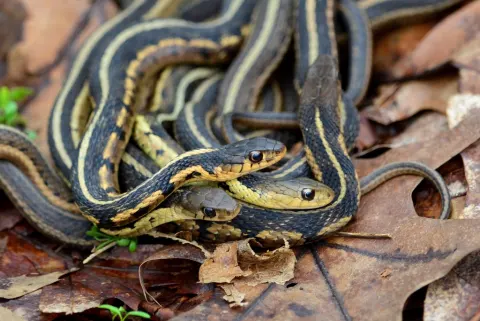
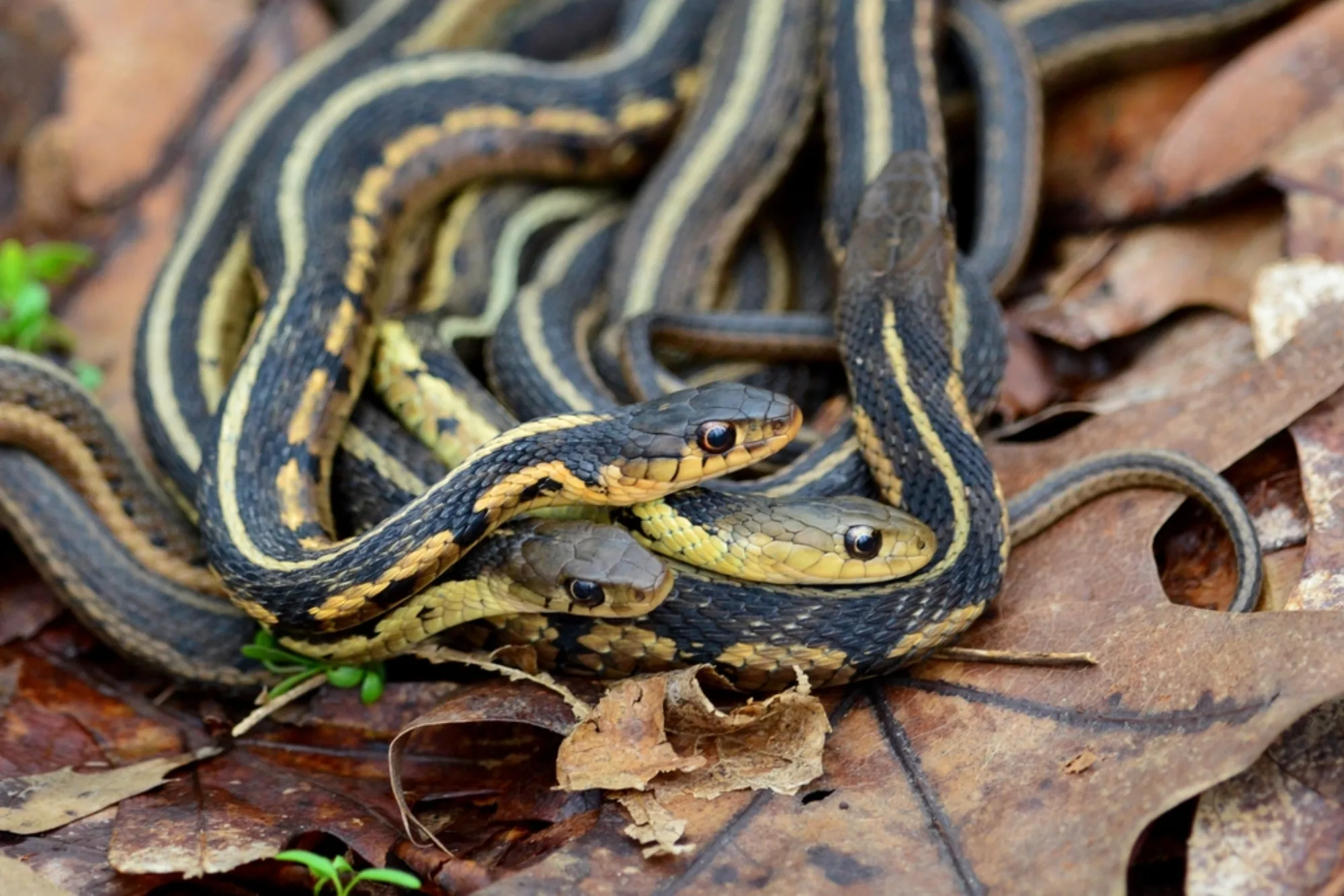
Look for a slender snake with yellow stripes running along a black, brown or green body. The Common Garter Snake also comes in colours ranging from blue and gold to red and orange, and most individuals remain under 1.2 m long. Its average total length, including the tail, is about 55 cm. Native to North America, it ranges from the southern tip of Florida to the southern tip of Canada's Northwest Territories, depending on the subspecies. It lives at elevations from sea level to mountains, in places as varied as forests, prairies, wetlands and ponds, often close to water.
Active by day, the snake tends to move about in the morning and late afternoon in summer, but favours warm afternoons in cooler weather. In warm southern areas it stays active all year; elsewhere it shelters through winter in shared dens, sometimes in large numbers. Some emerge on warm winter afternoons to bask. Its food consists mainly of amphibians and earthworms, though it also eats fish, insects, slugs, rodents and other small animals. It can catch quick-moving fish and tadpoles, and resists some natural poisons in its amphibian prey. Females may give birth to 12 to 40 young between July and October.
When threatened, a garter snake may freeze, relying on its inconspicuous colouring, before trying to slip away. It can also release a foul-smelling fluid when restrained. Predators include hawks, foxes, larger snakes and domestic cats and dogs. Water pollution, urban expansion, and residential and industrial development also threaten the species.
Written from the English Wikipedia article Common garter snake (CC BY-SA 4.0).
- Records
- 7,361
- Countries
- 2
- Atlas places
- 4
These are open occurrence records, so they show where people looked for and recorded the Common Garter Snake as much as where it lives. Cells are up to 25 km across, and every location is generalised to its cell.
Generalised encounter areas, not exact locations. Each shape is a grid cell coloured by how likely the species is there.
- Very likelyUnited States25 km zone · medium confidence · 5711 records · updated 80 days ago
- Very likelyCanada25 km zone · medium confidence · 1650 records · updated 80 days ago
Conservation status not assessed here yet, so every location is generalised to its grid cell.