Spotted Congo Puffer
Tetraodon schoutedeni
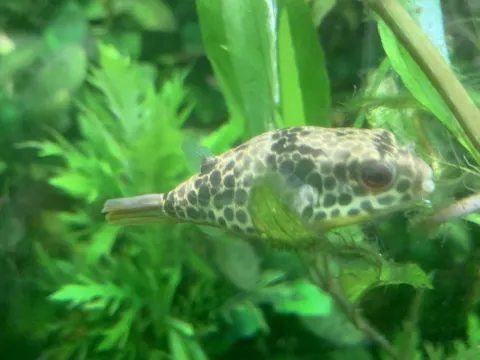
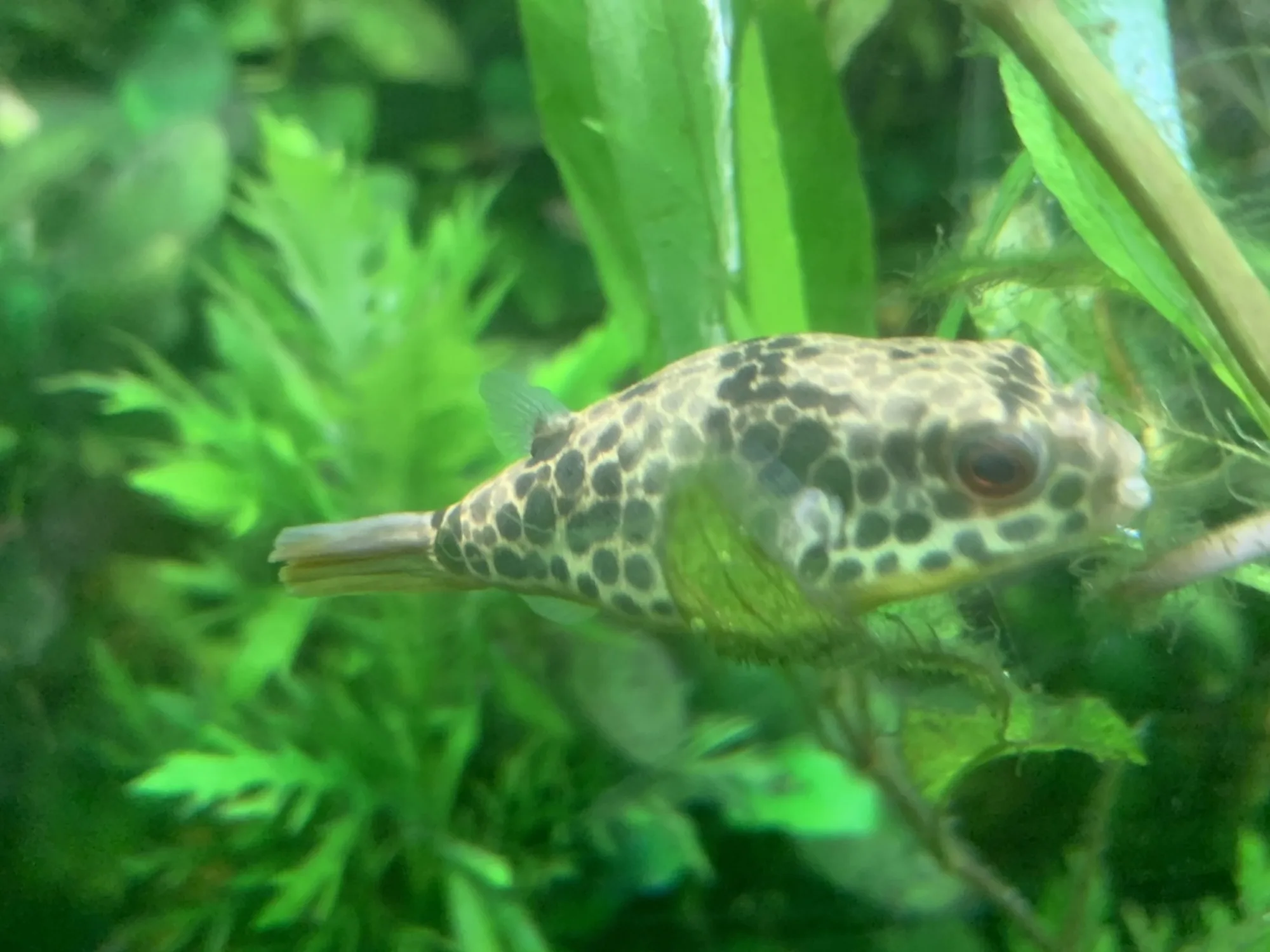
Growing to a length between 9 and 11.5 cm, the Spotted Congo Puffer is a small fish with a rounded, globular body that tapers toward the tail. Its name comes from the black spots covering its brownish-green skin. This skin is scaleless and can change color based on the environment or stress. These fish possess independently moving eyes and a sharp beak of fused teeth. For protection, they can inflate their bodies or rely on a neurotoxin found in their organs and skin. While females are generally rounder and larger than males, both sexes are known for a social yet sometimes aggressive temperament.
This strictly freshwater species lives in the large river systems of the Congo Basin, particularly the Lua River and Ubangi River basin. As demersal fish, they stay near the bottom to hunt for food. Their diet consists of insects, mollusks, and other benthic invertebrates. They use their strong beaks to crack open shelled organisms like snails, which helps grind down teeth that never stop growing.
During breeding, a female may swim with one or two males clinging to her abdomen. They scatter between 3 and 50 eggs across the substrate, which hatch after about a week. The young reach maturity in roughly a year. While the status of wild populations is not well-documented, they have likely been affected by environmental destruction resulting from political turmoil and civil war in the region. Because they are popular in the ornamental fish trade, wild-caught exports are common, though the species is also bred in captivity.
Written from the English Wikipedia article Tetraodon schoutedeni (CC BY-SA 4.0).
- Atlas places
- 0
These are open occurrence records, so they show where people looked for and recorded the Spotted Congo Puffer as much as where it lives. Cells are up to 25 km across, and every location is generalised to its cell.
No encounter zones yet
Where and when you can expect to see Spotted Congo Puffer is calculated from observation density. No zones have been computed for this species yet.
Conservation status not assessed here yet, so every location is generalised to its grid cell.