Western Capercaillie
Tetrao urogallus
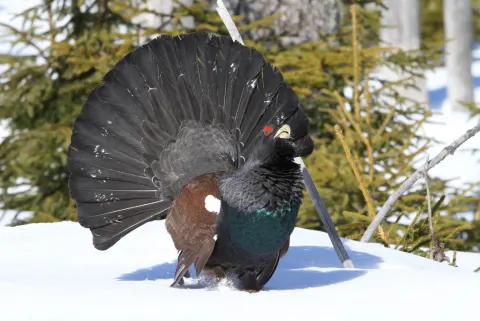
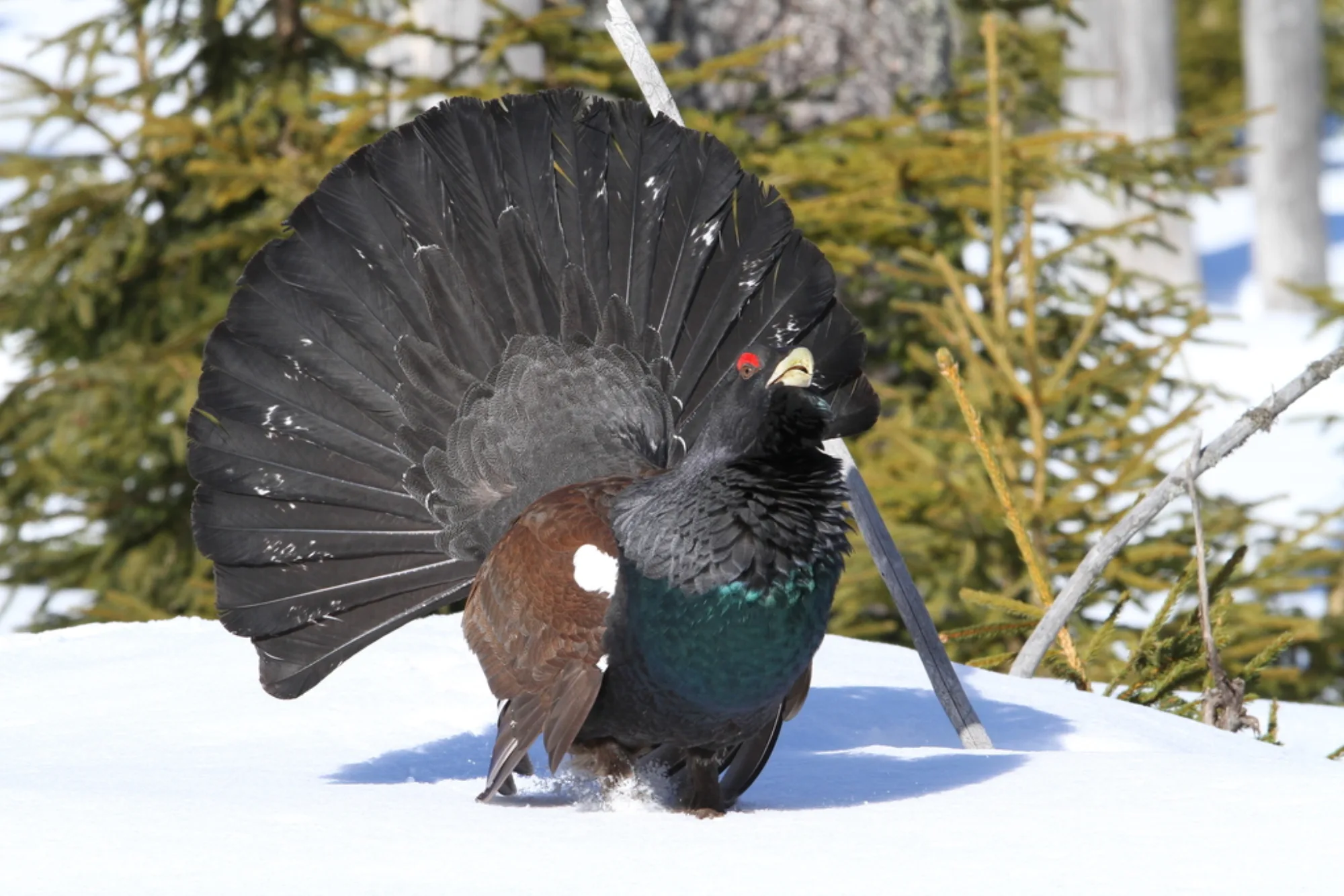
A heavy forest grouse, the Western Capercaillie is the largest living member of its group. Males are much larger than females, with dark grey to brown feathers and a metallic green breast. Females are brown above, barred with black and silver, and paler underneath. Both sexes have a white wing patch and a bright red patch above each eye.
The species lives across northern Europe and the Palearctic, favouring mature conifer forests with an open canopy and dense ground vegetation. It finds food among bilberry plants, shelter in young trees and space to fly between the trees. Although mainly a ground dweller, it spends nights in old trees, and in winter may remain in trees almost all day and night. Take-off can be startlingly loud, followed by a whistling sound from the feathers in flight. Its diet includes buds, leaves, berries and grasses, while conifer needles become a major food in winter. Young chicks mainly eat insects.
In spring, males display with raised, fanned tails and a song that moves from clicks to popping and scraping sounds. Hens nest on the ground, often concealed beneath low branches, and care for the chicks after they hatch. The birds are sensitive to disturbance during courtship, and even a single observer can cause females to leave. Habitat degradation is a major threat, particularly where diverse native forests become timber plantations. Collisions with deer fences also kill birds, while increased numbers of small predators cause problems in some areas. In Scotland, loss of suitable habitat, fencing and predation have contributed to a steep decline.
Written from the English Wikipedia article Western capercaillie (CC BY-SA 4.0).
- Records
- 45,837
- Countries
- 26
No atlas park has a record of the Western Capercaillie in or around it yet.
These are open occurrence records, so they show where people looked for and recorded the Western Capercaillie as much as where it lives. Cells are up to 25 km across, and every location is generalised to its cell.
Generalised encounter areas, not exact locations. Each shape is a grid cell coloured by how likely the species is there.
- Very likelyUnited Kingdom25 km zone · high confidence · 19167 records · updated 86 days ago
- Very likelyNorway25 km zone · high confidence · 16116 records · updated 86 days ago
- Very likelyFinland25 km zone · high confidence · 4218 records · updated 86 days ago
- Very likelyFrance25 km zone · high confidence · 1999 records · updated 86 days ago
- Very likelyRussia25 km zone · high confidence · 1004 records · updated 86 days ago
- Very likelyUkraine25 km zone · high confidence · 713 records · updated 86 days ago
- Very likelyEstonia25 km zone · high confidence · 643 records · updated 86 days ago
- Very likelyAustria25 km zone · high confidence · 639 records · updated 86 days ago
- Very likelySweden25 km zone · high confidence · 467 records · updated 86 days ago
- Very likelyGermany25 km zone · high confidence · 423 records · updated 86 days ago
Conservation status not assessed here yet, so every location is generalised to its grid cell.