Four-horned Antelope
Tetracerus quadricornis
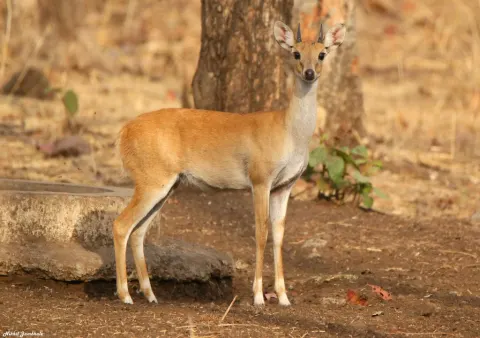
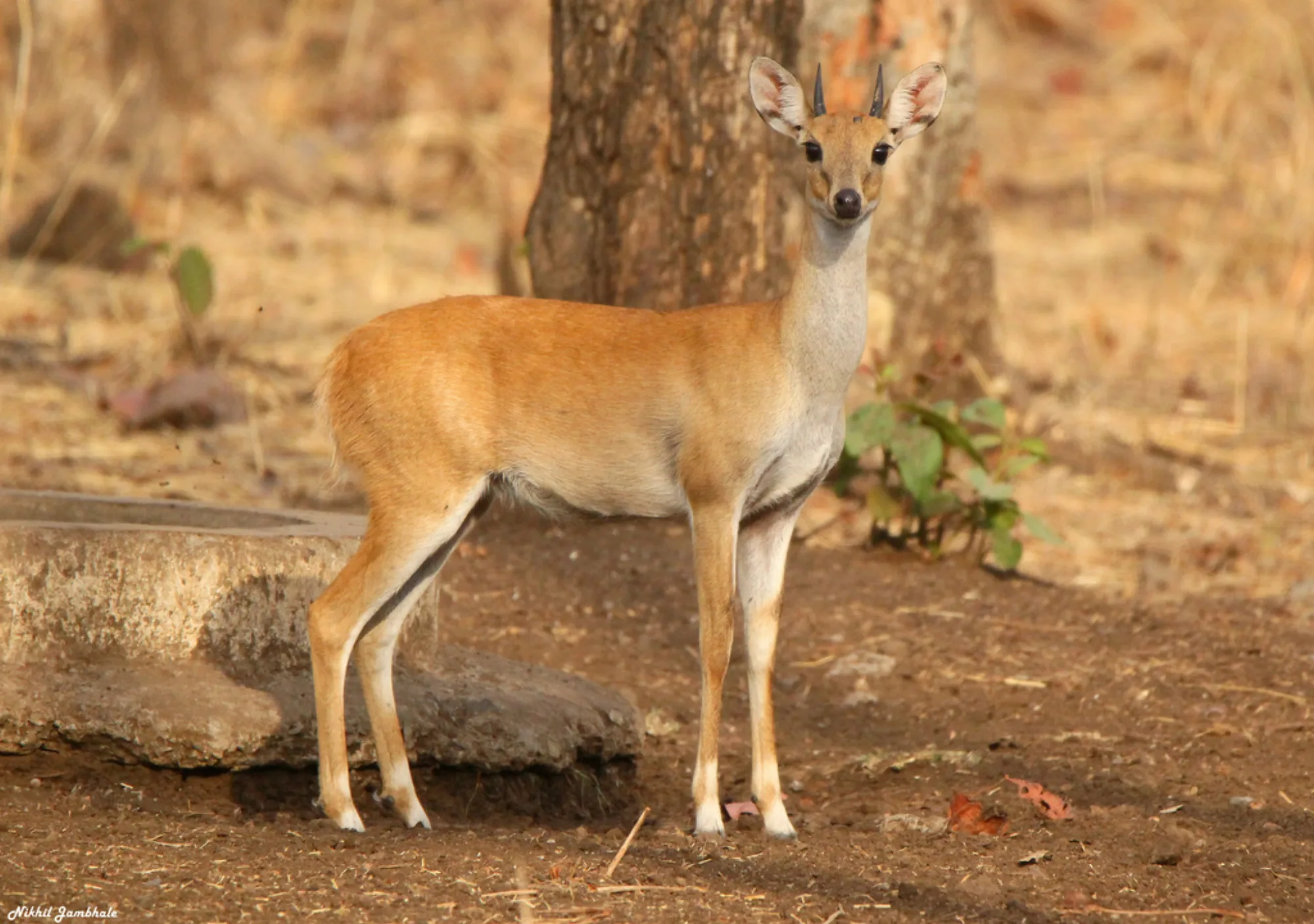
Slender and small, the Four-horned Antelope has a yellowish-tan coat that can look reddish or golden, thin legs and a short tail. Its white underparts and inner legs contrast with black markings on the muzzle, behind the ears and along the outside of each leg. Only males have horns: the longer pair rises between the ears, while the shorter pair sits on the forehead and may look like fur-covered studs. An adult stands about 55 to 64 cm at the shoulder and weighs around 17 to 22 kg.
Also called the chousingha, this antelope lives mainly in India, with a smaller population in Nepal. It inhabits open, dry deciduous forest across flat and hilly ground, favouring grassy cover or thick undergrowth near water. Shy and elusive, it is active mainly by day and often rests or chews its food in dense cover at noon. It usually lives alone, although loose groups of three to five can include adults and young. When alarmed, it may freeze, leap away or sprint, and it often hides in tall grass from predators. Its diet includes grasses, herbs, shrubs, leaves, flowers and fruit, and it needs to drink frequently.
After a pregnancy of about eight months, a female gives birth to one or two calves, which are kept hidden for their first few weeks. The young stay with their mother for about a year. Agricultural expansion removes habitat, while human activity, construction and feral dogs also affect numbers. Populations are scattered and fragmented, raising concern that inbreeding could threaten their future stability; the animal has also been targeted by trophy hunters for its horns and skull.
Written from the English Wikipedia article Four-horned antelope (CC BY-SA 4.0).
- Records
- 0
- Countries
- 1
- Atlas places
- 1
These are open occurrence records, so they show where people looked for and recorded the Four-horned Antelope as much as where it lives. Cells are up to 25 km across, and every location is generalised to its cell.
Generalised encounter areas, not exact locations. Each shape is a grid cell coloured by how likely the species is there.
- Very likelyIndia25 km zone · low confidence · 0 records · updated 81 days ago
Conservation status not assessed here yet, so every location is generalised to its grid cell.