Common Tortoise
Testudo graeca
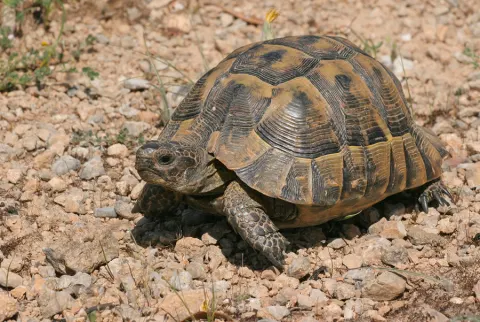
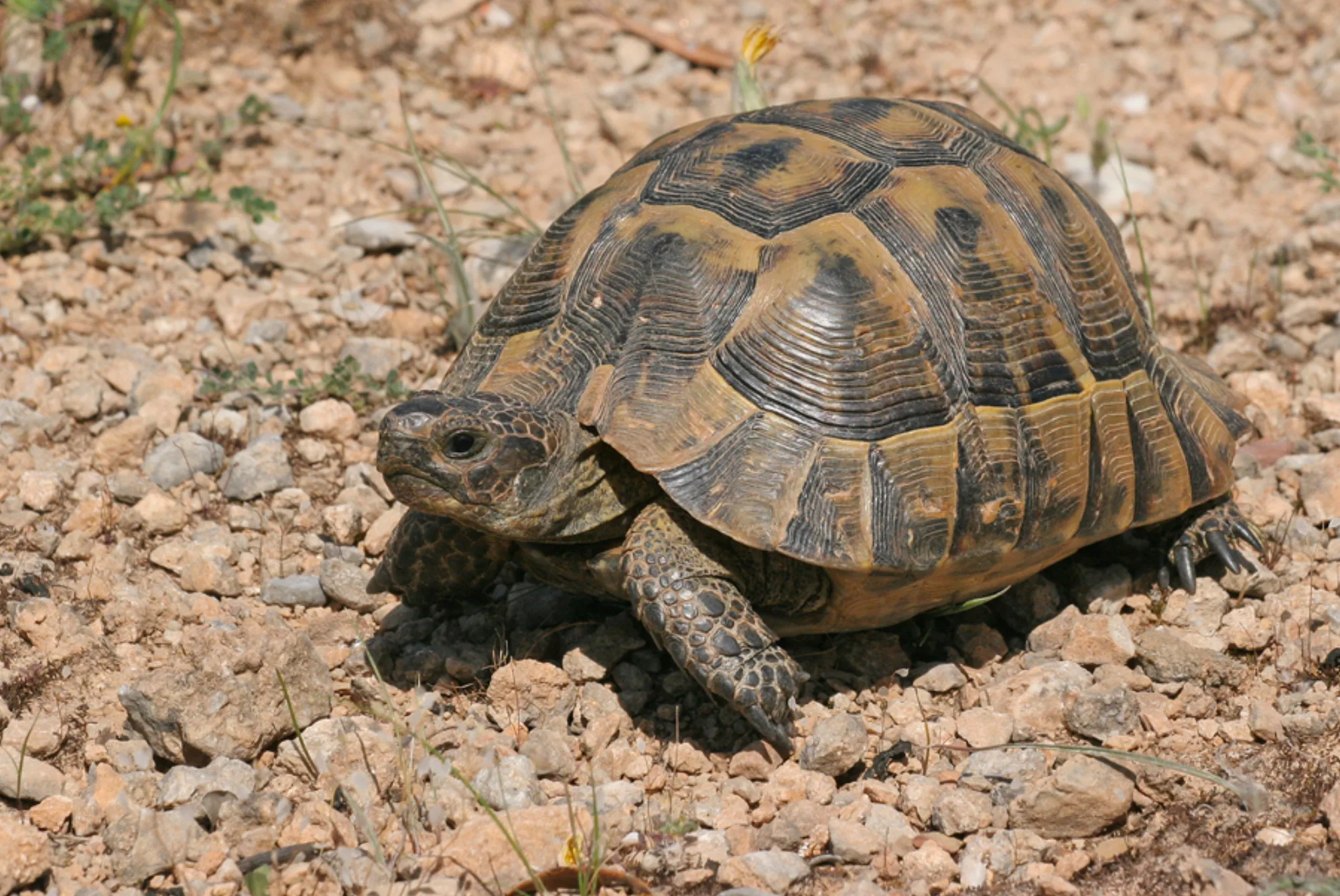
Across the Mediterranean region, the Common Tortoise (Testudo graeca) is a medium-sized, plant-eating tortoise whose appearance varies considerably across its range. Also called the Greek, Moorish or spur-thighed tortoise, it can be confused with Hermann's tortoise. Its size, shell shape and colour patterns vary between populations, making geographical origin a useful clue to identification. Some of the largest individuals come from northeastern Turkey and weigh up to 7 kg. Males are generally smaller than females and have longer tails that taper to a point. The species can also be long-lived, with verified lifespans exceeding 100 years.
Its range includes southern Europe, southwestern Asia and northern Africa. Around the Caucasus, it is common on the Black Sea shore between Anapa in Russia and Sukhumi in Abkhazia, Georgia; populations also occur in areas of Armenia, Azerbaijan, Georgia and Iran. During cold months, the tortoise enters a dormant period, although individuals may come out on warm winter days. In hot coastal areas, they can emerge as early as February. In captivity, they eat leafy greens, favouring dandelion leaves and related vegetation. Breeding behaviour begins shortly after emergence, and a single successful mating can produce several clutches of eggs. Before laying, females become restless and sniff and dig as they search for nesting sites.
The pet trade poses a risk to wild populations, particularly where tortoises are taken for local sale or international export. Trade in wild-caught animals continues despite legal restrictions, including in countries such as Morocco and Spain. Poor housing and care during captivity and transport have also been associated with high mortality.
Written from the English Wikipedia article Greek tortoise (CC BY-SA 4.0).
- Records
- 2,649
- Countries
- 17
No atlas park has a record of the Common Tortoise in or around it yet.
These are open occurrence records, so they show where people looked for and recorded the Common Tortoise as much as where it lives. Cells are up to 25 km across, and every location is generalised to its cell.
Generalised encounter areas, not exact locations. Each shape is a grid cell coloured by how likely the species is there.
- Very likelySpain25 km zone · high confidence · 2069 records · updated 80 days ago
- Very likelyTürkiye25 km zone · medium confidence · 201 records · updated 80 days ago
- Very likelyIsrael25 km zone · medium confidence · 102 records · updated 80 days ago
- Very likelyRussia25 km zone · medium confidence · 51 records · updated 80 days ago
- Very likelyBulgaria25 km zone · medium confidence · 49 records · updated 80 days ago
- Very likelyGeorgia25 km zone · medium confidence · 42 records · updated 80 days ago
- Very likelyGreece25 km zone · medium confidence · 35 records · updated 80 days ago
- Very likelyPalestinian Territories25 km zone · medium confidence · 28 records · updated 80 days ago
- Very likelyRomania25 km zone · medium confidence · 21 records · updated 80 days ago
- Very likelyAlgeria25 km zone · medium confidence · 19 records · updated 80 days ago
Conservation status not assessed here yet, so every location is generalised to its grid cell.