Common Box Turtle
Terrapene carolina
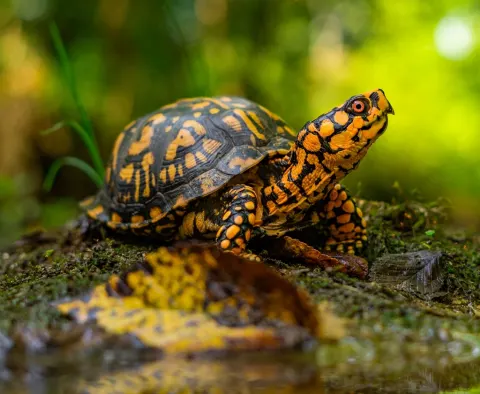
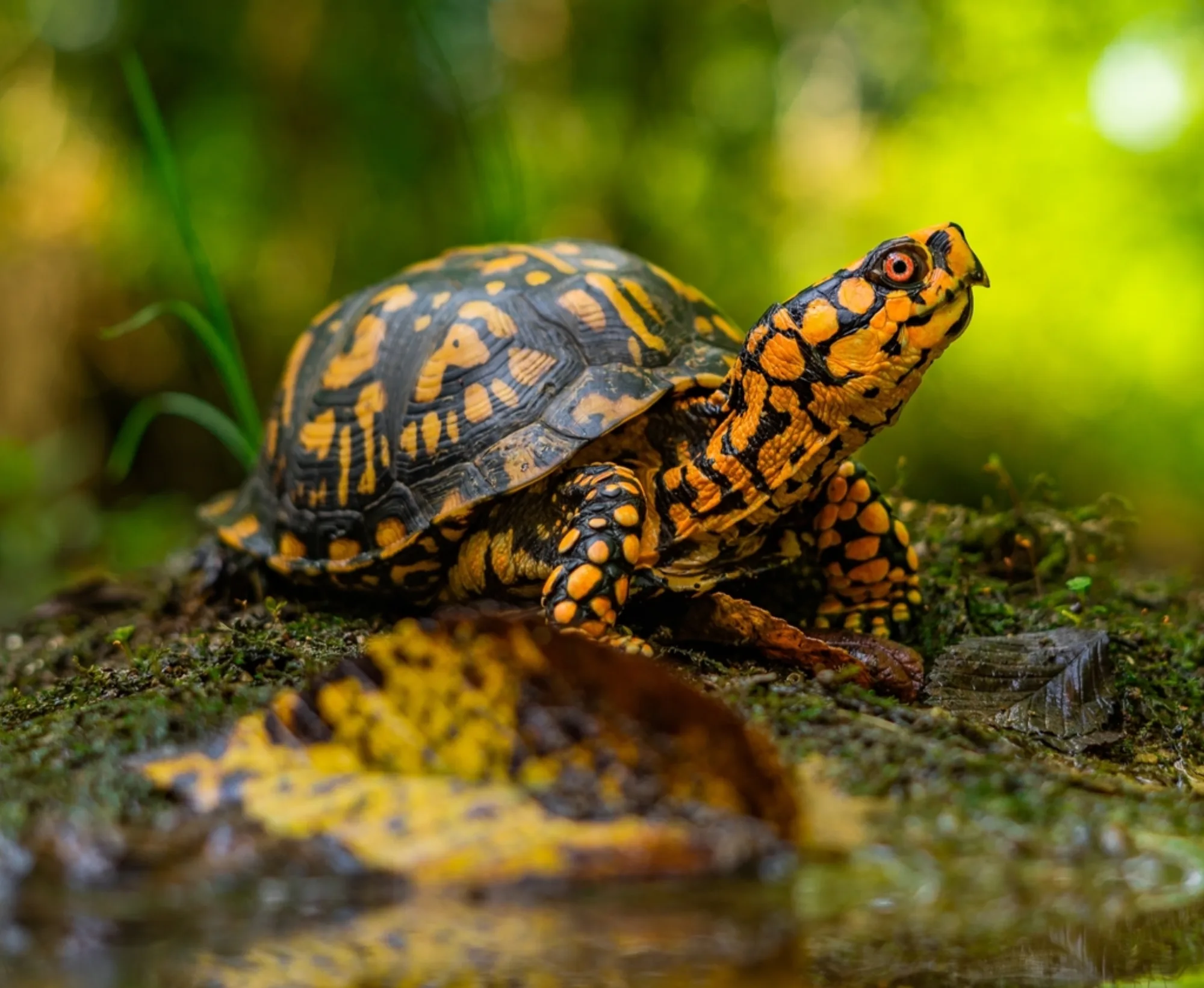
A high, domed brown shell, often marked with orange or yellow lines, spots or blotches, helps distinguish the Common Box Turtle (Terrapene carolina). Its hinged lower shell can close around its head and limbs, and its upper jaw has a distinctive hook. Most adult males have red eyes, while females have yellowish-brown eyes.
This mainly land-dwelling turtle lives across a broad stretch of the eastern United States, reaching from Maine and Michigan south to Florida and west to eastern Texas. It also lives along Mexico's Gulf Coast and on the Yucatán Peninsula, with a gap in western Texas separating the Mexican and US populations. Look for it in open woodland, marshy meadows, floodplains, scrub forest and brushy grassland. It often emerges early in the day or after rain, leaving shelter beneath rotting leaves or logs, or in a mammal's burrow, to forage. In the warmer months of summer, it is often found around the margins of swamps and marshes. Its varied menu includes earthworms, snails, insects, berries, roots, flowers, fungi and small animals, as well as eggs and carrion. In northern parts of its range, it shelters through winter, sometimes burrowing into loose soil, sand or mud.
Females usually lay 1 to 11 eggs in sandy or loamy soil in May, June or July, and the young emerge in late summer. Many populations are declining as farming and urban development destroy habitat, fire management degrades it, and turtles are killed on roads. In some places, capture for the international pet trade may put further pressure on populations.
Written from the English Wikipedia article Common box turtle (CC BY-SA 4.0).
- Records
- 876
- Countries
- 1
No atlas park has a record of the Common Box Turtle in or around it yet.
These are open occurrence records, so they show where people looked for and recorded the Common Box Turtle as much as where it lives. Cells are up to 25 km across, and every location is generalised to its cell.
Generalised encounter areas, not exact locations. Each shape is a grid cell coloured by how likely the species is there.
- Very likelyUnited States25 km zone · medium confidence · 876 records · updated 80 days ago
Conservation status not assessed here yet, so every location is generalised to its grid cell.