Bateleur
Terathopius ecaudatus
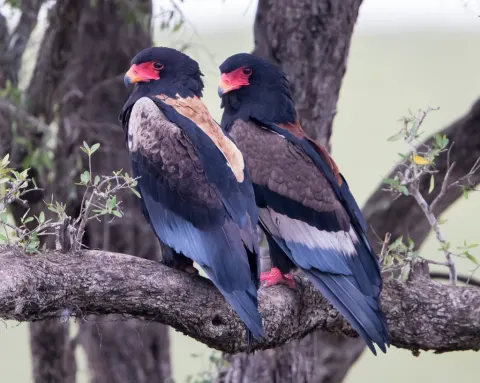
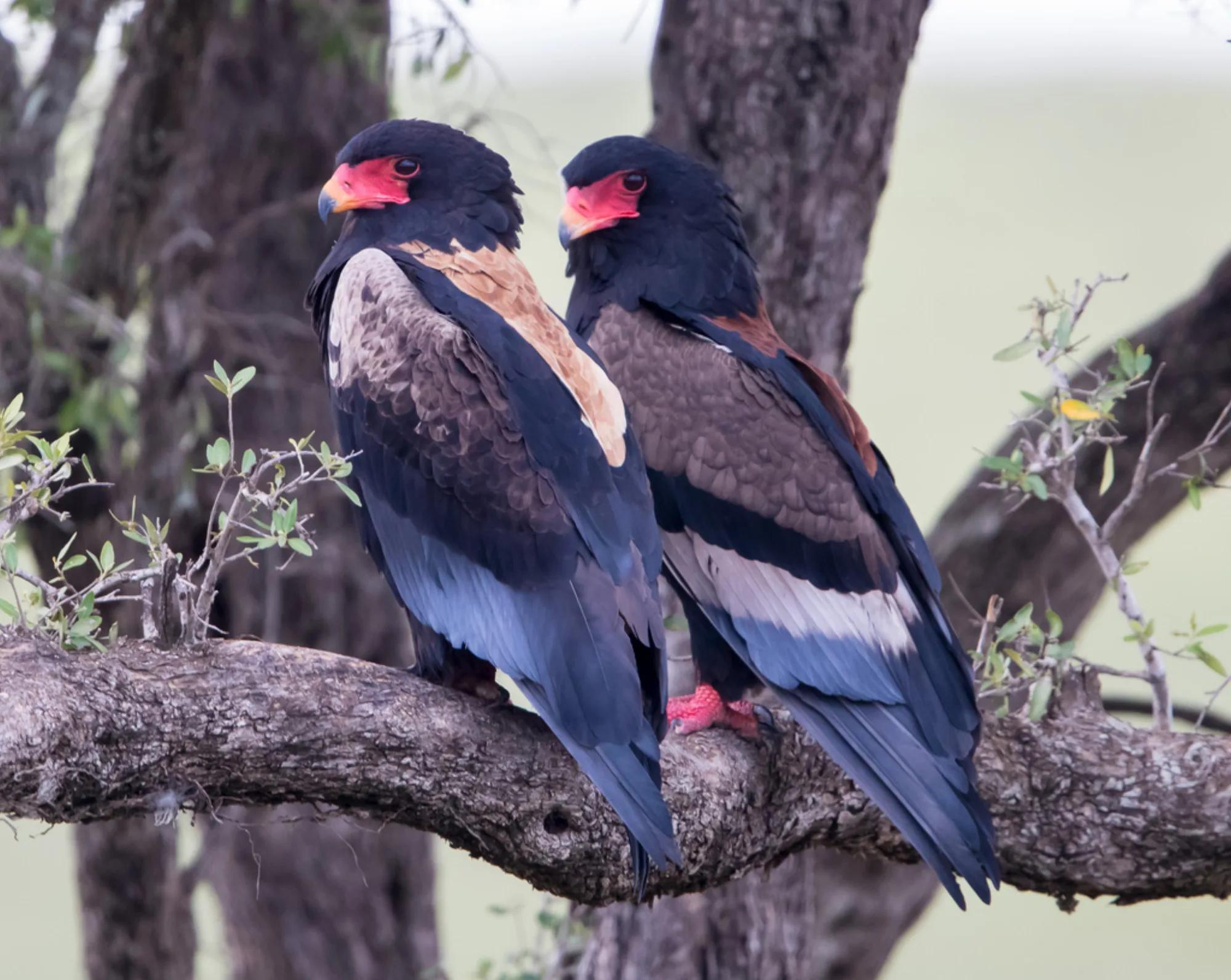
Watch for the Bateleur soaring over African savanna, its long wings rocking from side to side and its exceptionally short tail giving it a distinctive outline. This medium-sized eagle is generally black as an adult, with a chestnut back and tail, grey shoulders and bright red facial skin and feet. In flight, an adult's tail is so short that its feet extend beyond the tip. Young birds look different: they are mostly brown, with paler markings and a longer tail.
Bateleurs range widely across sub-Saharan Africa, with a rare population also believed to persist in southwestern Saudi Arabia and western Yemen. They favour partly open savanna and woodland, and may be seen near watering holes. Breeding birds tend to need savanna woodland with a closed canopy, including acacia, mopane and miombo habitats. Usually solitary, these eagles spend much of their time airborne, often gliding low but sometimes circling high overhead. They may also bathe and then spread their wings in the sun.
A Bateleur searches for food from the air, scanning the ground and descending to investigate possible meals. Its varied diet includes carrion as well as live mammals, reptiles and birds. It sometimes takes food from other birds of prey. A pair builds a small, sturdy nest of sticks high in a large tree, where it lays a single egg. Nesting birds are sensitive to disturbance and can leave their nests easily, exposing them to predators, including humans. Habitat destruction, pesticide use and persecution have contributed to a pronounced decline, and the species is now mostly confined to protected areas.
Written from the English Wikipedia article Bateleur (CC BY-SA 4.0).
- Records
- 88,571
- Countries
- 34
- Atlas places
- 39
- Kruger National Park· South Africa
- Okavango Delta· Botswana
- Serengeti National Park· Tanzania
- iSimangaliso Wetland Park· South Africa
- Kgalagadi Transfrontier Park· South Africa
- Chobe National Park· Botswana
- Etosha National Park· Namibia
- Ngorongoro Conservation Area· Tanzania
- Tsavo East National Park· Kenya
- Maasai Mara National Reserve· Kenya
- Tsavo West National Park· Kenya
- Bwabwata National Park· Namibia
- Murchison Falls National Park· Uganda
- Hluhluwe-iMfolozi Park· South Africa
- Hwange National Park· Zimbabwe
- Kafue National Park· Zambia
- Mana Pools National Park· Zimbabwe
- Nkasa Rupara National Park· Namibia
- Akagera National Park· Rwanda
- Gonarezhou National Park· Zimbabwe
- Kidepo Valley National Park· Uganda
- Nyerere National Park· Tanzania
- Queen Elizabeth National Park· Uganda
- Samburu National Reserve· Kenya
- South Luangwa National Park· Zambia
- Tarangire National Park· Tanzania
- Zambezi National Park· Zimbabwe
- Lake Manyara National Park· Tanzania
- Lower Zambezi National Park· Zambia
- Mudumu National Park· Namibia
- Ruaha National Park· Tanzania
- Amboseli National Park· Kenya
- Lake Mburo National Park· Uganda
- Lake Nakuru National Park· Kenya
- Liuwa Plain National Park· Zambia
- Meru National Park· Kenya
- Mikumi National Park· Tanzania
- Nairobi National Park· Kenya
- Udzungwa Mountains National Park· Tanzania
These are open occurrence records, so they show where people looked for and recorded the Bateleur as much as where it lives. Cells are up to 25 km across, and every location is generalised to its cell.
Generalised encounter areas, not exact locations. Each shape is a grid cell coloured by how likely the species is there.
- Very likelySouth Africa25 km zone · high confidence · 49038 records · updated 86 days ago
- Very likelyTanzania25 km zone · high confidence · 8112 records · updated 86 days ago
- Very likelyKenya25 km zone · high confidence · 7308 records · updated 86 days ago
- Very likelyUganda25 km zone · high confidence · 6142 records · updated 86 days ago
- Very likelyBotswana25 km zone · high confidence · 4474 records · updated 86 days ago
- Very likelyNamibia25 km zone · high confidence · 2903 records · updated 86 days ago
- Very likelyZimbabwe25 km zone · high confidence · 2200 records · updated 86 days ago
- Very likelyMozambique25 km zone · high confidence · 1823 records · updated 86 days ago
- Very likelyZambia25 km zone · high confidence · 1734 records · updated 86 days ago
- Very likelyGhana25 km zone · high confidence · 1279 records · updated 86 days ago
Conservation status not assessed here yet, so every location is generalised to its grid cell.