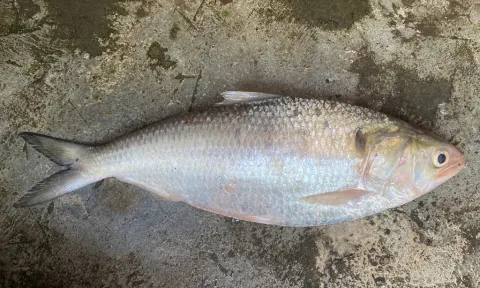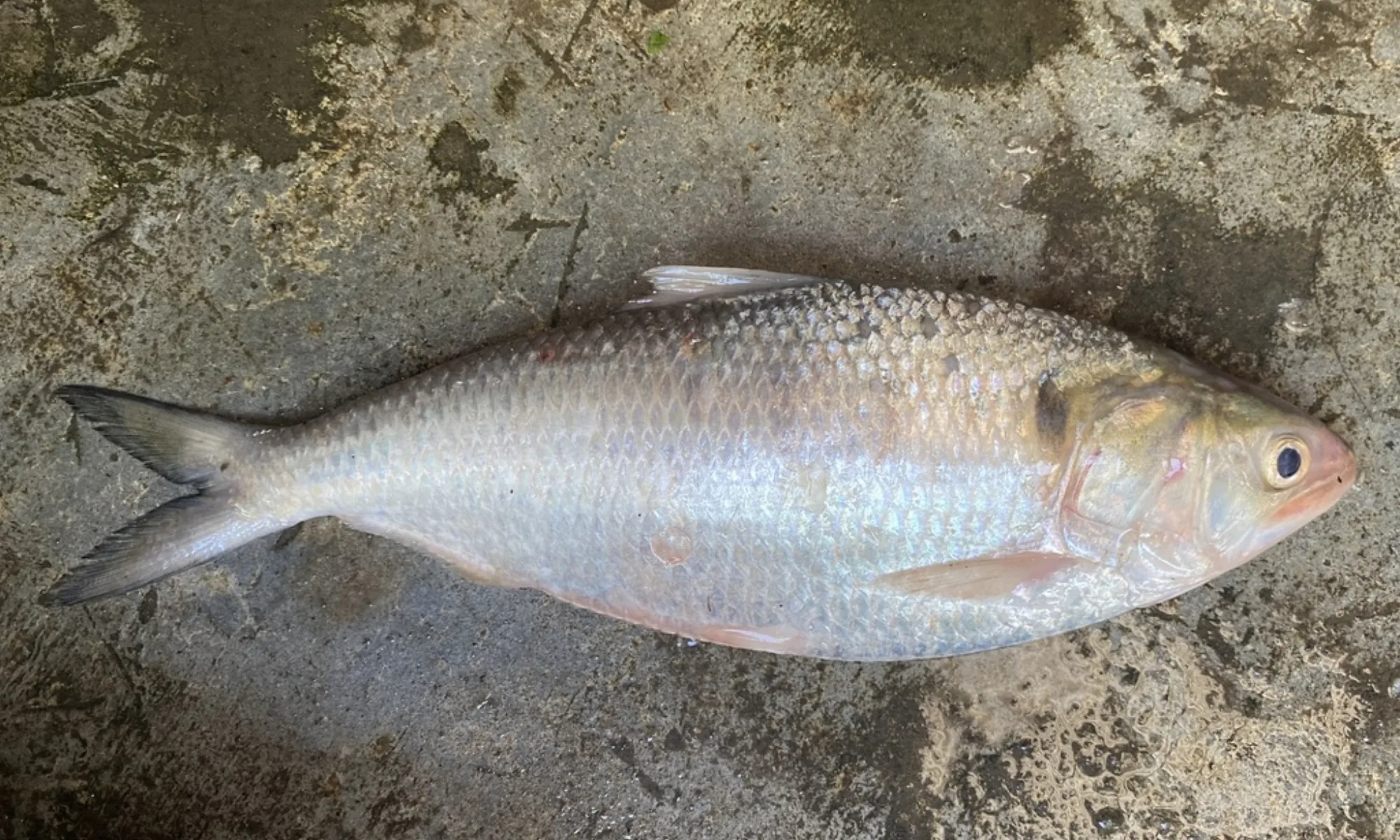
Hilsa
Tenualosa ilisha
Silver with a wash of gold and purple when alive, the Hilsa is a fish related to the herring. A dark mark sits behind its gill opening, and young fish have a line of small spots along their sides. Females grow larger than males, reaching up to 55 cm, while males do not exceed 46 cm. Also called ilish, the fish is a popular food in the Bengal region and is Bangladesh's national fish.
Hilsa live in the sea, in brackish water and in freshwater, at depths of up to about 200 m. Their range includes rivers and estuaries in Bangladesh, India, Pakistan and Myanmar, as well as the Persian Gulf area and the Tigris and Euphrates around Iran and southern Iraq. The species also occurs in Kuwait, Bahrain, Indonesia, Malaysia and Thailand. In coastal waters, Hilsa gather in schools, then travel up rivers to spawn, typically covering around 50 to 100 km. After spawning they return to the sea, although some populations stay in rivers. They filter plankton from the water and search for food on muddy bottoms. Adults generally eat green algae and diatoms, while young fish rely mainly on small crustaceans.
Heavy demand has driven widespread overfishing, and finer nets catch even small fish. In India, specimens of 2 to 3 kilograms are now seldom found. Advanced trawling and damage to rivers have added to the pressure, while river pollution has worsened conditions. Global warming has gradually depleted breeding grounds, further reducing Hilsa populations. In Bangladesh, catching young jatka is illegal, and fishing restrictions also apply during the breeding season.
Written from the English Wikipedia article Ilish (CC BY-SA 4.0).
- Records
- 424
- Countries
- 2
No atlas park has a record of the Hilsa in or around it yet.
These are open occurrence records, so they show where people looked for and recorded the Hilsa as much as where it lives. Cells are up to 25 km across, and every location is generalised to its cell.
Generalised encounter areas, not exact locations. Each shape is a grid cell coloured by how likely the species is there.
- Very likelyBangladesh25 km zone · medium confidence · 331 records · updated 80 days ago
- Very likelyIraq25 km zone · medium confidence · 93 records · updated 80 days ago
Conservation status not assessed here yet, so every location is generalised to its grid cell.