Finless Sleeper Ray
Temera hardwickii
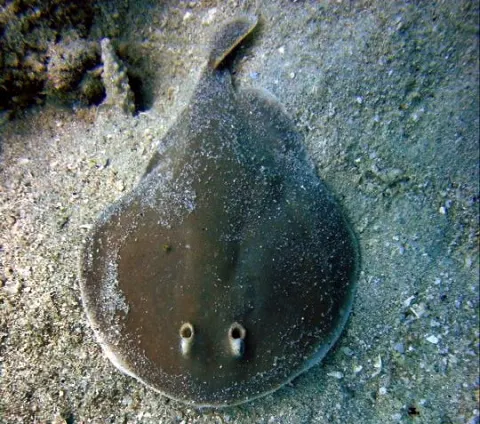
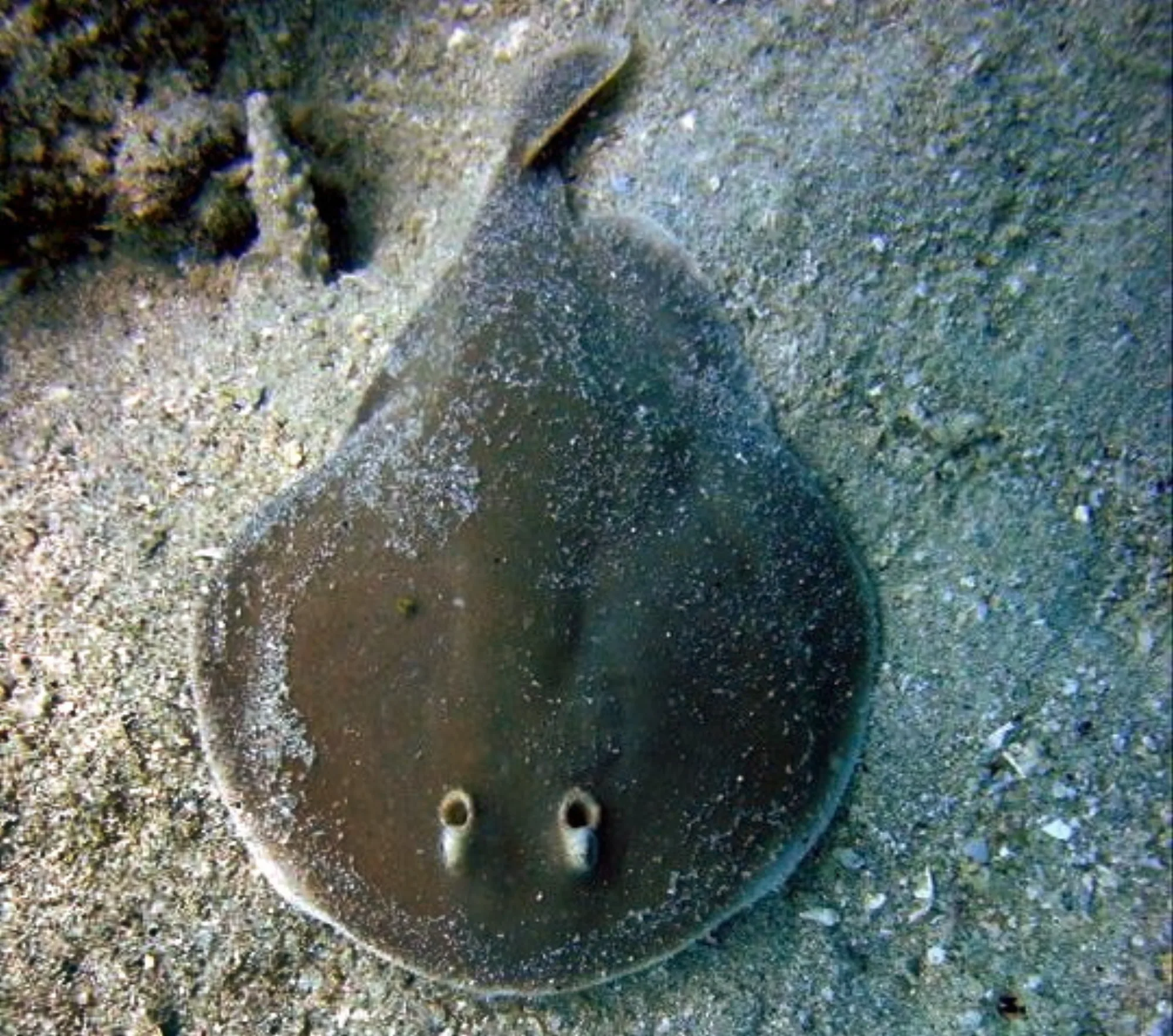
Reaching a maximum length of perhaps 18 cm, the Finless Sleeper Ray is potentially the smallest cartilaginous fish in the ocean. This electric ray is easily identified by its oval body disc and a thick, short tail that lacks any dorsal fins. Its skin is a simple light brown on top, occasionally marked with white spots or dark patches, while the underside is pale with darker edges. On either side of its head, kidney-shaped organs are visible through the skin. These allow the ray to deliver a moderate electric shock to protect itself from predators.
This bottom-dwelling species lives on the fine sediment of the continental shelf. Its range stretches across Southeast Asia from the eastern Andaman Sea and the Strait of Malacca to the waters of Vietnam and Borneo. While it was once considered abundant in the 19th century, it is now found in both inshore and offshore areas. To find food, it likely hunts small invertebrates. The sturdy design of its jaws suggests it may have a preference for prey with hard shells.
Like other rays in its family, this species gives birth to live young. Developing embryos are sustained by a yolk sac, and a single female has been recorded carrying a litter of four. This slow-reproducing fish faces significant pressure from the fishing industry. It is frequently caught as bycatch in intensive bottom trawls and other demersal gear used throughout its territory. Even if fishers return them to the sea, the survival rate for these rays is thought to be extremely low. In some regions, such as the Andaman Sea, these fishing activities are especially heavy.
Written from the English Wikipedia article Finless sleeper ray (CC BY-SA 4.0).
- Atlas places
- 0
These are open occurrence records, so they show where people looked for and recorded the Finless Sleeper Ray as much as where it lives. Cells are up to 25 km across, and every location is generalised to its cell.
No encounter zones yet
Where and when you can expect to see Finless Sleeper Ray is calculated from observation density. No zones have been computed for this species yet.
Conservation status not assessed here yet, so every location is generalised to its grid cell.