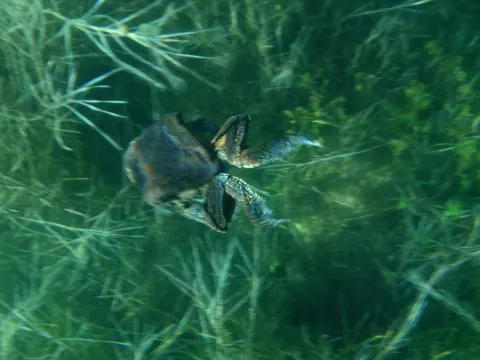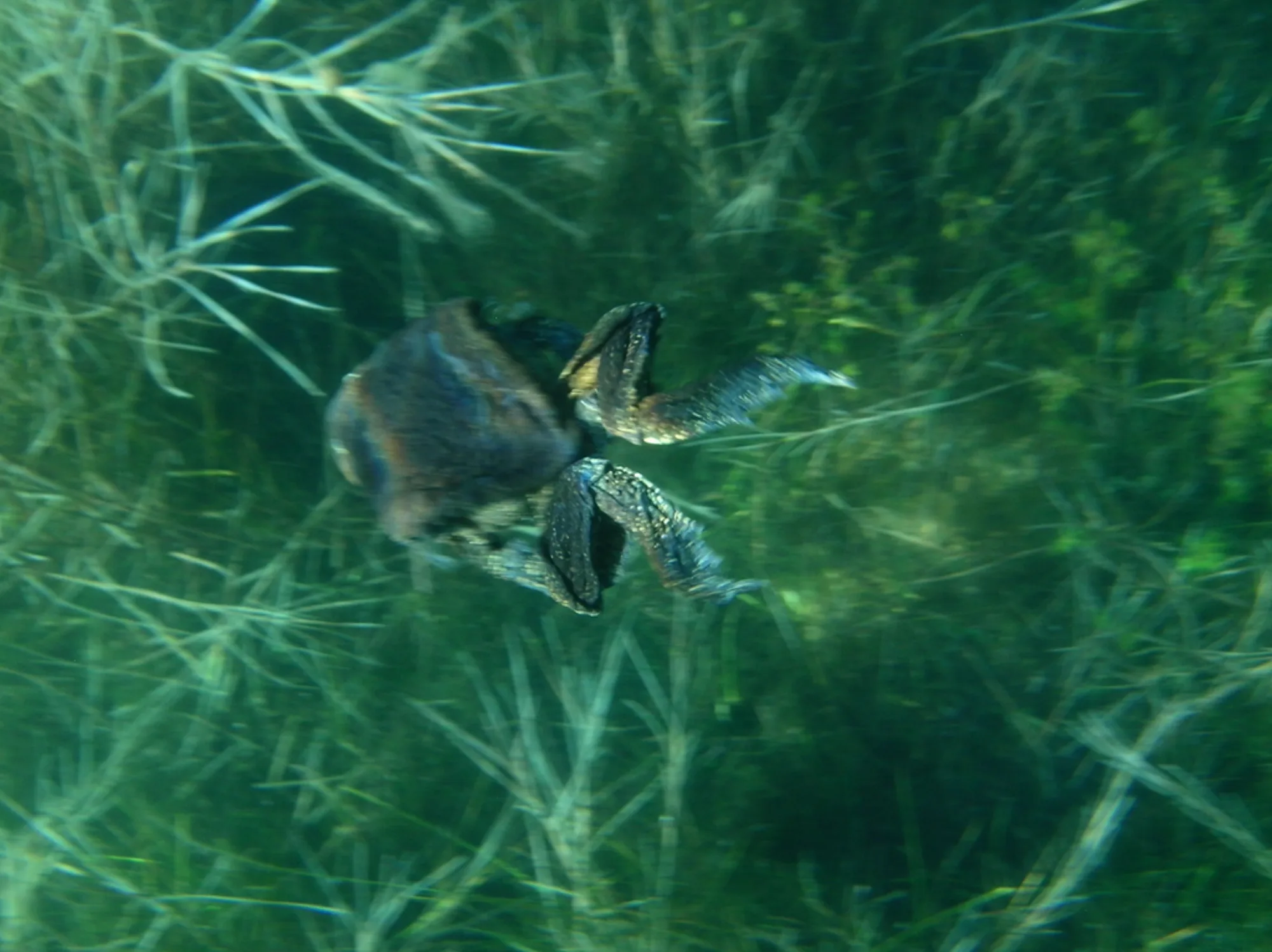
Lake Titicaca Frog
Telmatobius culeus
Loose folds of skin give the Lake Titicaca Frog a distinctive appearance, especially in large individuals. Its colour varies, but it is generally grey, brown or greenish above and paler underneath, often with spots that form a marbled pattern. Some frogs in the southernmost coastal parts of Lake Titicaca have striped thighs and bright orange underparts. The largest frogs are substantial: an expedition reported individuals up to 60 cm in outstretched length, though most do not reach such sizes.
This entirely aquatic frog lives only in the Lake Titicaca basin, a highland region of the Andes shared by Peru and Bolivia, including connected lakes, rivers and streams. It favours bottoms with a mixture of rocks and mud, sand or aquatic plants. Frogs usually stay near the bottom, sometimes resting alongside one another, and are most active at night. Their skin absorbs oxygen from the water, and they sometimes bob up and down to pass more water over its folds. Adults may also sit on underwater rocks to bask in sunlight. Small aquatic crustaceans and snails make up most of their diet, though they also take tadpoles and insects; fish are a regular meal for adults. Breeding takes place throughout the year in shallow coastal water, where females lay about 80 to 500 eggs. Males usually guard the nest until the tadpoles hatch, and the young remain in the shallows until adulthood.
The frog has declined drastically. Collection for food and traditional medicine, pollution and introduced trout all threaten it, while disease may also pose a risk. Pollution can be absorbed through its skin, and agricultural runoff can trigger algal blooms that deplete oxygen. Trout may eat tadpoles, while fishing nets catch frogs and trout farming pens overlap with breeding habitat.
Written from the English Wikipedia article Telmatobius culeus (CC BY-SA 4.0).
- Records
- 0
- Countries
- 1
No atlas park has a record of the Lake Titicaca Frog in or around it yet.
These are open occurrence records, so they show where people looked for and recorded the Lake Titicaca Frog as much as where it lives. Cells are up to 25 km across, and every location is generalised to its cell.
Generalised encounter areas, not exact locations. Each shape is a grid cell coloured by how likely the species is there.
- Very likelyBolivia25 km zone · low confidence · 0 records · updated 80 days ago
Conservation status not assessed here yet, so every location is generalised to its grid cell.