American Badger
Taxidea taxus
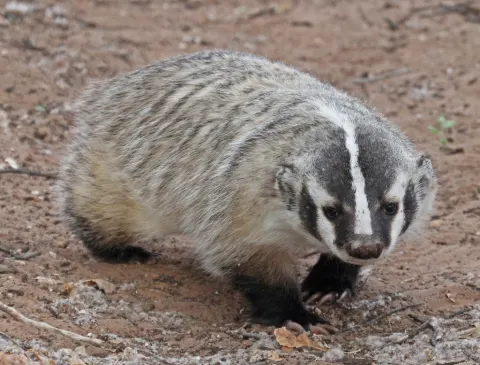
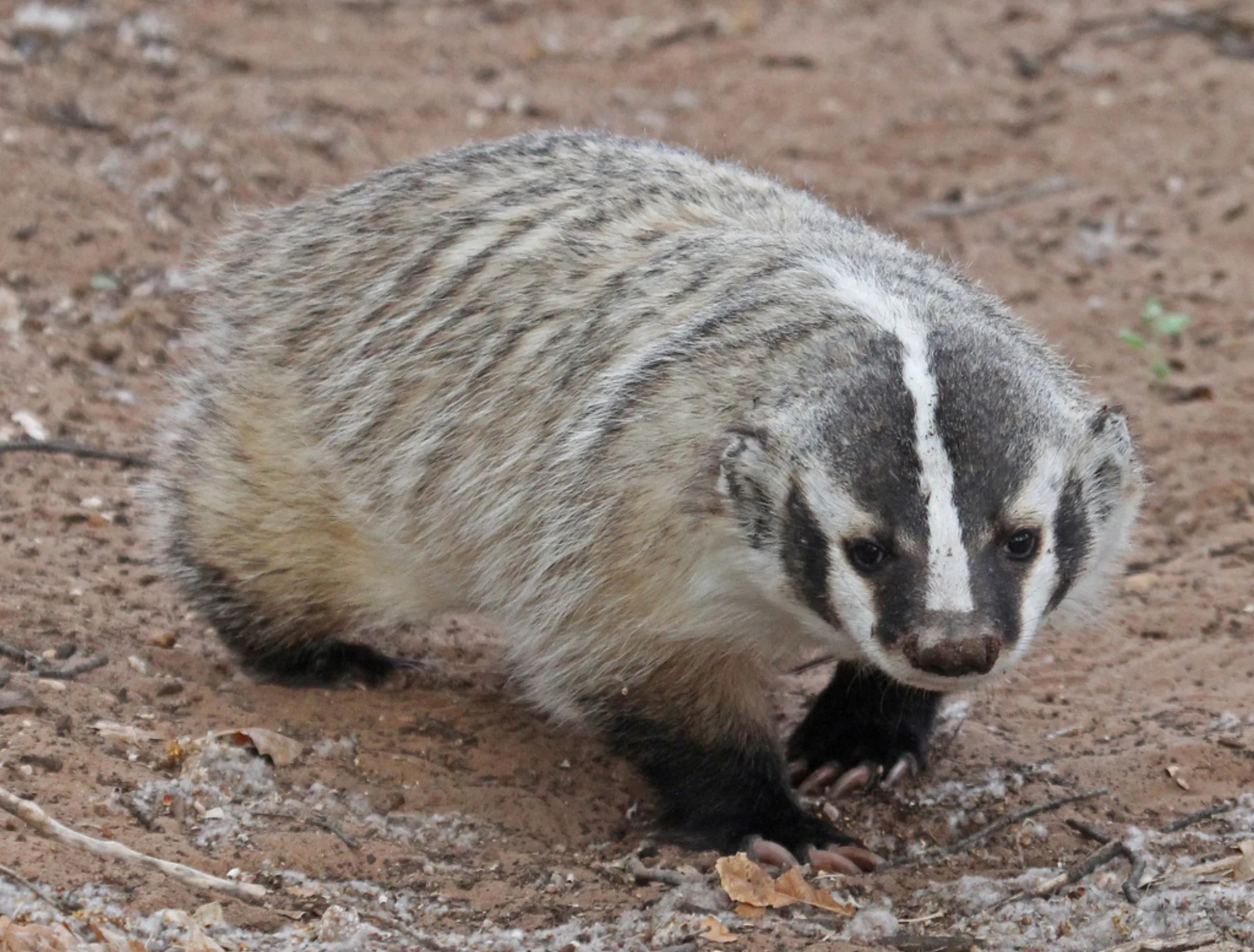
Low to the ground, the American Badger has a stocky body, short powerful legs and large foreclaws that can reach 5 cm. Its coarse coat is a grizzled mix of brown, black and white, while its triangular face carries dark cheek patches and a white stripe running up its nose and back over its head. The coat helps it blend into grassland.
Its range includes northern Mexico and south-central Canada, as well as western, central and northeastern parts of the United States, and extends to areas of southwestern British Columbia. Look for it in open grasslands and prairies, where sandy loam makes digging easier and prey is available. It also uses farms, forest meadows, marshes, brushy country and deserts, and can occur in mountain meadows.
Usually solitary and active at night, badgers may forage by day in remote places without human encroachment. They dig after pocket gophers, ground squirrels and other small mammals, sometimes pursuing them into their dens, and also eat snakes, birds, insects and some plant foods. Badgers have been seen hunting alongside coyotes, whose different hunting style makes it harder for ground squirrels to escape. In winter they do not hibernate, but can become less active and spend long periods in torpor. Litters of one to five arrive between late March and early April, and the young first venture out of the den alone at five to six weeks old. Development has reduced habitat and prey, leaving badgers to forage between fragments and bringing them into contact with people. People also trap badgers for their pelts, while large predators sometimes kill them.
Written from the English Wikipedia article American badger (CC BY-SA 4.0).
- Records
- 226
- Countries
- 3
- Atlas places
- 9
- Yellowstone National Park· United States
- Badlands National Park· United States
- Grand Teton National Park· United States
- Kootenay National Park· Canada
- Waterton Lakes National Park· Canada
- Banff National Park· Canada
- Big Bend National Park· United States
- Rocky Mountain National Park· United States
- Theodore Roosevelt National Park· United States
These are open occurrence records, so they show where people looked for and recorded the American Badger as much as where it lives. Cells are up to 25 km across, and every location is generalised to its cell.
Generalised encounter areas, not exact locations. Each shape is a grid cell coloured by how likely the species is there.
- Very likelyUnited States25 km zone · medium confidence · 170 records · updated 80 days ago
- Very likelyCanada25 km zone · medium confidence · 28 records · updated 80 days ago
- Very likelyMexico25 km zone · medium confidence · 28 records · updated 80 days ago
Conservation status not assessed here yet, so every location is generalised to its grid cell.