Derby Eland
Taurotragus derbianus
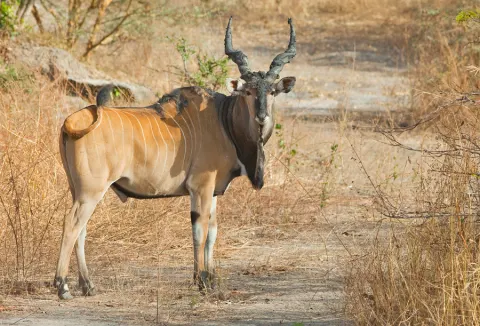
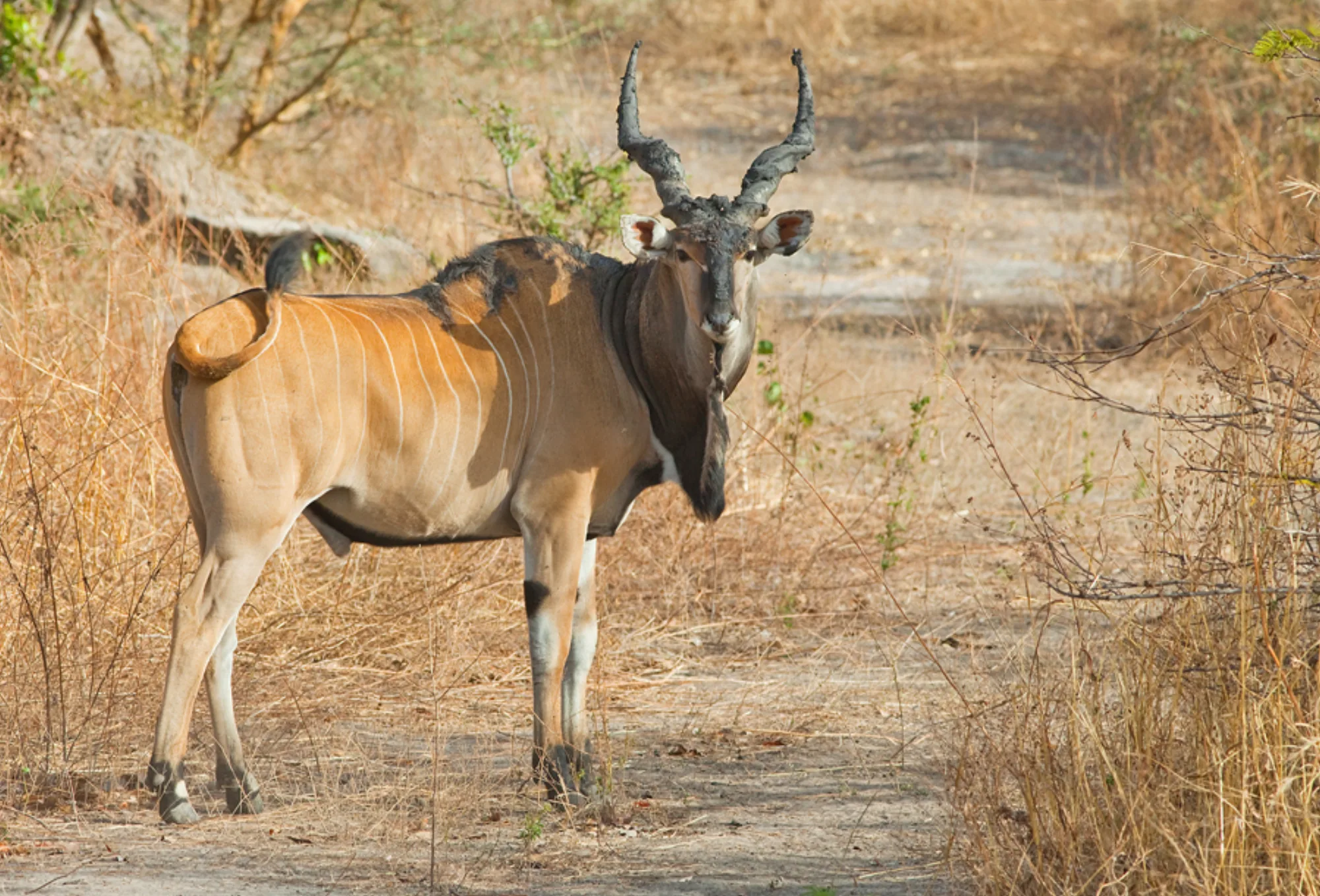
The Derby Eland, also known as the giant eland, is the world's largest antelope, with a reddish-brown to chestnut coat marked by vertical white stripes. Both sexes carry tightly spiralled horns that form a V, while a crest of short black hair runs from the neck towards the middle of the back. Males are larger than females, and their coats tend to be darker. A dark tuft at the end of the long tail and black and white markings above the hooves offer further clues.
Giant elands live in the broad-leaved savannas, woodlands and glades of West and Central Africa, as well as forests and desert fringes. The western giant eland is largely confined to Senegal's Niokolo-Koba National Park, while the eastern form occurs in several reserves in Cameroon and the Central African Republic. Wary and alert, these animals can be difficult to approach or watch. They are mainly active at night and often rest in sheltered places during the day. Herds usually contain 15 to 25 animals, although adult males often live alone. They eat grasses, foliage, branches and fruit, sometimes using their horns to break off branches. They favour places near water, though they can also obtain moisture from succulent plants in deserts.
Breeding takes place throughout the year, with a peak in the wet season. After a nine-month pregnancy, a female generally gives birth to one calf, which stays with her for six months. Hunting for meat and habitat destruction associated with expanding human and livestock populations threaten both western and eastern giant elands. Continued drought, competition from domestic animals and damage linked to wars and political conflicts have also contributed to declines in the east.
Written from the English Wikipedia article Giant eland (CC BY-SA 4.0).
- Records
- 0
- Countries
- 2
No atlas park has a record of the Derby Eland in or around it yet.
These are open occurrence records, so they show where people looked for and recorded the Derby Eland as much as where it lives. Cells are up to 25 km across, and every location is generalised to its cell.
Generalised encounter areas, not exact locations. Each shape is a grid cell coloured by how likely the species is there.
- Very likelyCameroon25 km zone · low confidence · 0 records · updated 80 days ago
- PossibleCentral African Republic25 km zone · low confidence · 0 records · updated 80 days ago
Conservation status not assessed here yet, so every location is generalised to its grid cell.