Siau Island Tarsier
Tarsius tumpara
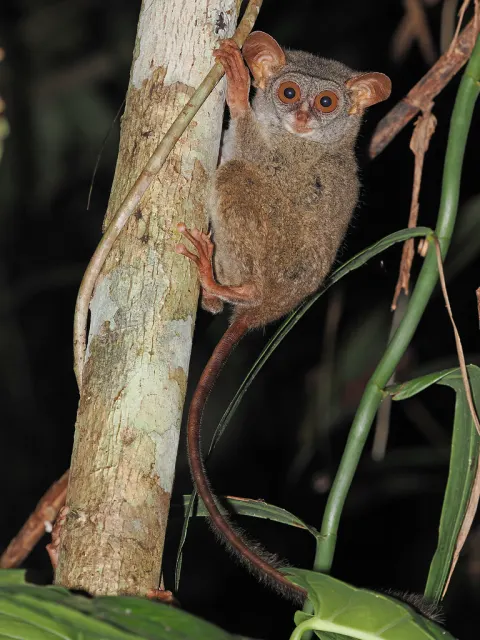
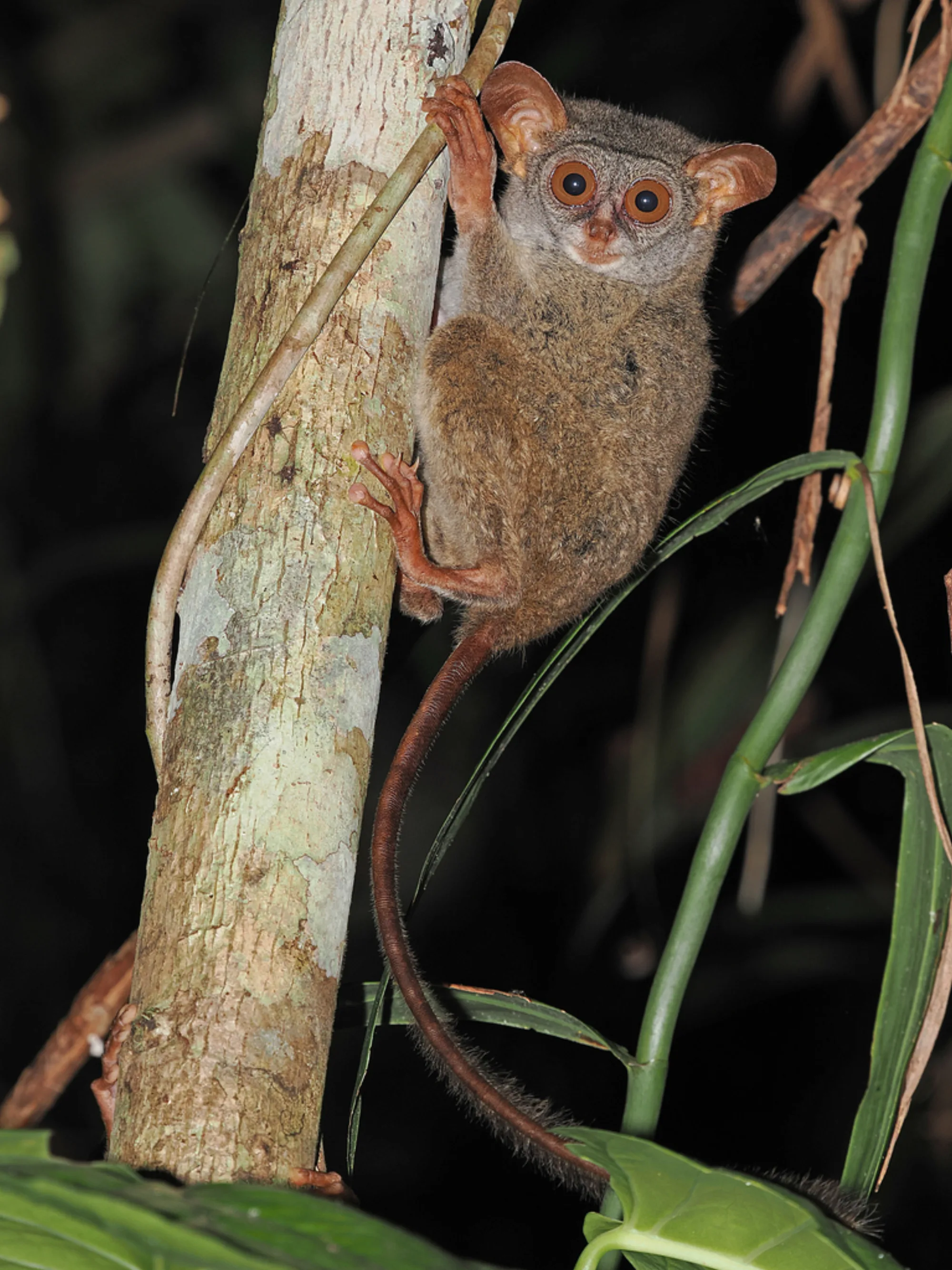
Found only on the small volcanic island of Siau in Indonesia, the Siau Island Tarsier is a tiny primate with a body length of 4 to 6 inches. These animals are distinguished by their white belly fur and a skull that is larger than those of their relatives. Their most striking feature is a pair of golden or brown eyes that are nearly as large as their brain. Because these eyes are fixed in their sockets, the tarsier compensates with a neck that can rotate 180 degrees.
These nocturnal creatures spend their lives in the trees, often sleeping inside hollows in fig trees during the day. At night, they use their long fingers and sharp teeth to hunt a carnivorous diet of spiders, insects, frogs, and lizards. They are incredibly agile, capable of jumping up to 10 feet between branches. To protect the group from predators, individual family members sleep in separate trees. Females reach maturity at two years old and typically produce a single offspring after a six-month pregnancy.
Despite their agility, these primates face many dangers. Local people hunt them for meat, use them in traditional medicine, and sell them as pets. Their small habitat, which covers an occupancy range of about 19.4 square kilometres, is not a protected area and is being lost to a growing human population. They also face natural threats from volcanic activity and predators such as feral cats, snakes, and birds of prey. Consequently, their numbers have dropped by more than 25 percent over the last 25 years.
Written from the English Wikipedia article Siau Island tarsier (CC BY-SA 4.0).
- Atlas places
- 0
These are open occurrence records, so they show where people looked for and recorded the Siau Island Tarsier as much as where it lives. Cells are up to 25 km across, and every location is generalised to its cell.
No encounter zones yet
Where and when you can expect to see Siau Island Tarsier is calculated from observation density. No zones have been computed for this species yet.