Spectral Tarsier
Tarsius tarsier
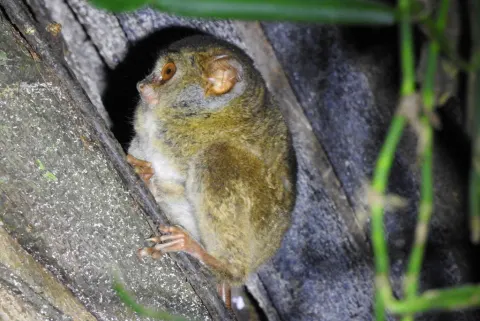
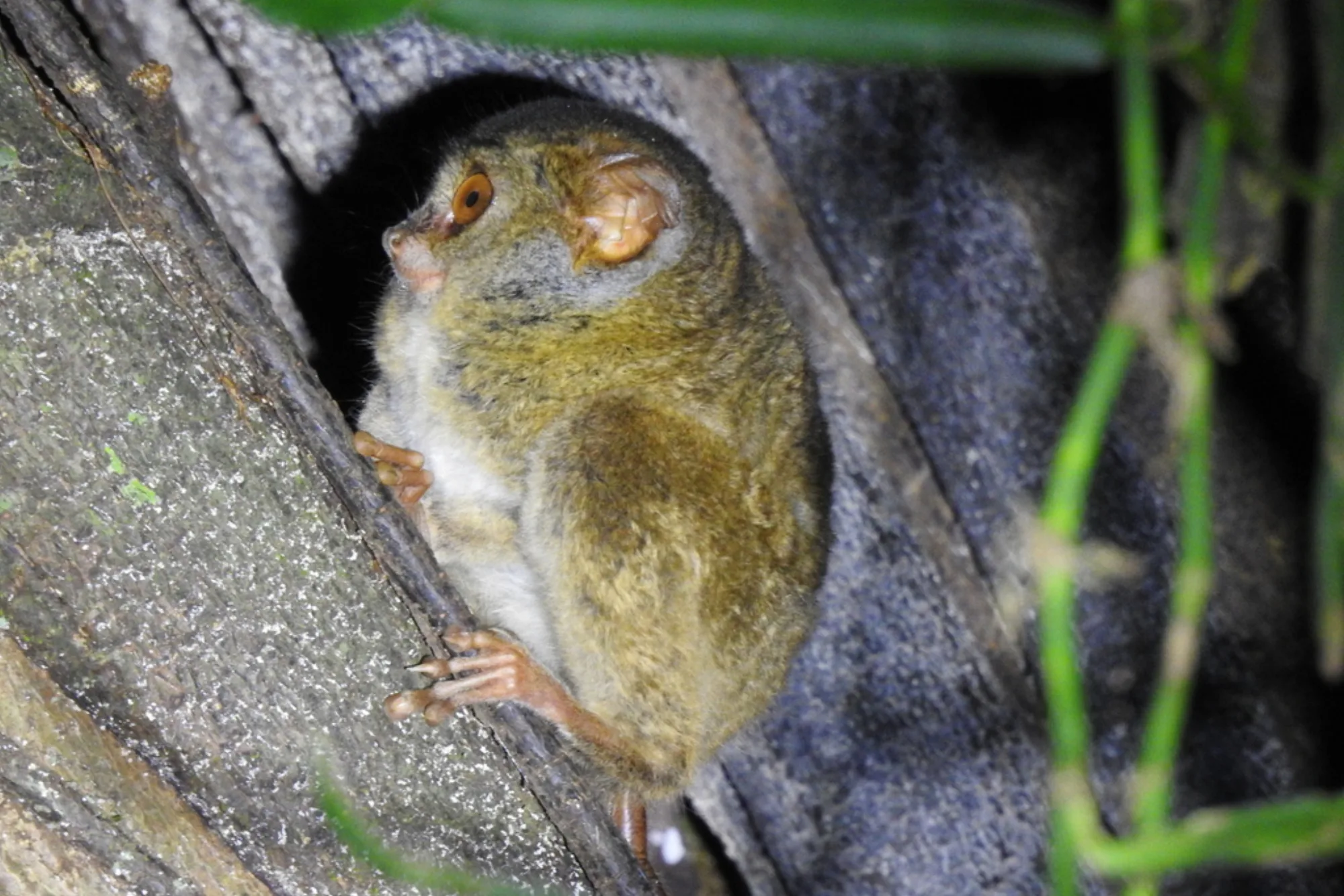
Found on the Indonesian island of Selayar, this primate is recognizable by its small stature and long tail. A typical Spectral Tarsier weighs 200 grams and measures 240 mm in total length, though its head and body alone are only 80 mm. Unlike some of its relatives, it lacks adhesive toes. These nocturnal mammals wake up at sunset to hunt, using ultrasonic vocalizations for navigation. They are entirely carnivorous, eating insects they catch in the air, on the ground, or from foliage.
Their habitat ranges from primary forests to secondary habitats on plantations growing coffee, nutmeg, or coconut. They roost in dense vegetation such as bamboo, shrubs, and thickets of grass. Living in groups of 2 to 6 individuals, they often sleep at the same sites each day and perform duet songs as they gather. While some live in pairs, others are polygynous or live alone. Young tarsiers are quite advanced and may start traveling alone when only 23 days old.
In the wild, these animals usually live around ten years. They face threats from several primary predators, including reticulated pythons, monitor lizards, civets, and birds of prey. When a terrestrial predator appears, the group may mob the threat by lunging and retreating while vocalizing. However, the most significant long-term pressures come from human activity. Habitat loss and deforestation are responsible for a decline in populations across their range.
Written from the English Wikipedia article Spectral tarsier (CC BY-SA 4.0).
- Atlas places
- 0
These are open occurrence records, so they show where people looked for and recorded the Spectral Tarsier as much as where it lives. Cells are up to 25 km across, and every location is generalised to its cell.
No encounter zones yet
Where and when you can expect to see Spectral Tarsier is calculated from observation density. No zones have been computed for this species yet.
Conservation status not assessed here yet, so every location is generalised to its grid cell.