Roughskin Newt
Taricha granulosa
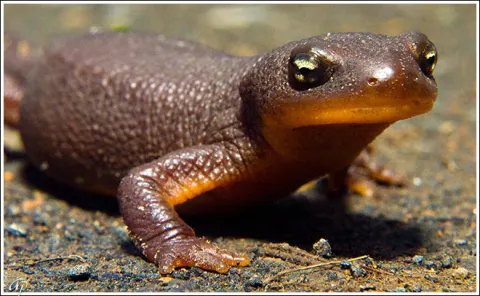
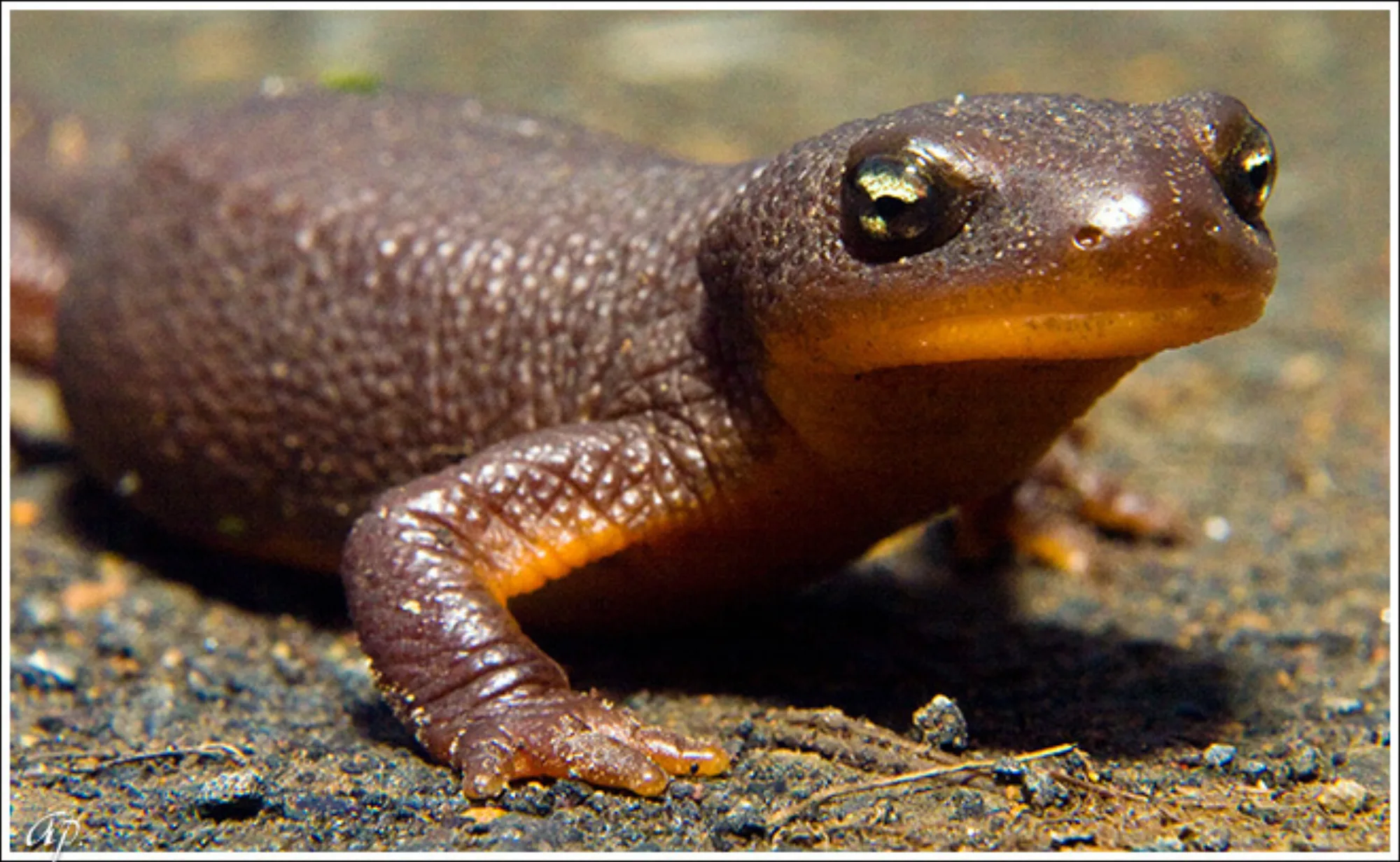
Stocky and round-snouted, the Roughskin Newt has a dark back that can range from light brown through olive to brownish-black. Its underside provides a striking contrast, with orange to yellow extending across the head, legs and tail. The skin has a granular texture, although males become smooth-skinned during the breeding season. Adults measure 11 to 18 cm overall. Similar California newts have larger eyes, while the Roughskin Newt has yellow irises and uniformly dark eyelids.
This North American newt occurs throughout the Pacific Northwest, from Santa Cruz in California north to Alaska. It is uncommon east of the Cascade Mountains, although it has occasionally been found as far away as Montana. Several ponds near Moscow, Idaho, hold an isolated population that was probably introduced. The newt produces a powerful skin toxin that helps defend it against predators, and its acrid smell serves as a warning. The toxin is generally dangerous when the animal is swallowed, though handling it can cause skin irritation in some people, particularly if they touch their eyes without washing their hands.
Common garter snakes prey on these newts in much of their range, and some snake populations have developed resistance to the toxin. A snake may partly swallow a newt before either releasing it or continuing to eat it, depending on whether it can tolerate the toxin level. Newts can detect a chemical signal released by a snake that has eaten one of their kind and respond by avoiding it. The toxin also occurs in the newt's eggs, where it may help protect offspring from predators.
Written from the English Wikipedia article Rough-skinned newt (CC BY-SA 4.0).
- Records
- 3,273
- Countries
- 2
- Atlas places
- 3
These are open occurrence records, so they show where people looked for and recorded the Roughskin Newt as much as where it lives. Cells are up to 25 km across, and every location is generalised to its cell.
Generalised encounter areas, not exact locations. Each shape is a grid cell coloured by how likely the species is there.
- Very likelyUnited States25 km zone · medium confidence · 2883 records · updated 80 days ago
- Very likelyCanada25 km zone · medium confidence · 390 records · updated 80 days ago
Conservation status not assessed here yet, so every location is generalised to its grid cell.