Brazilian Tapir
Tapirus terrestris
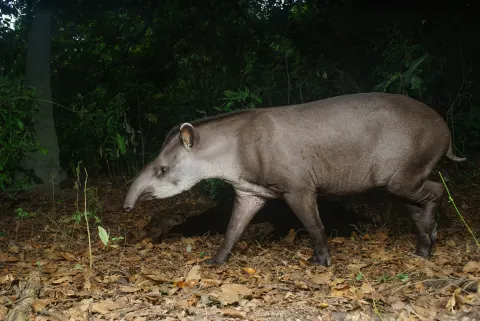
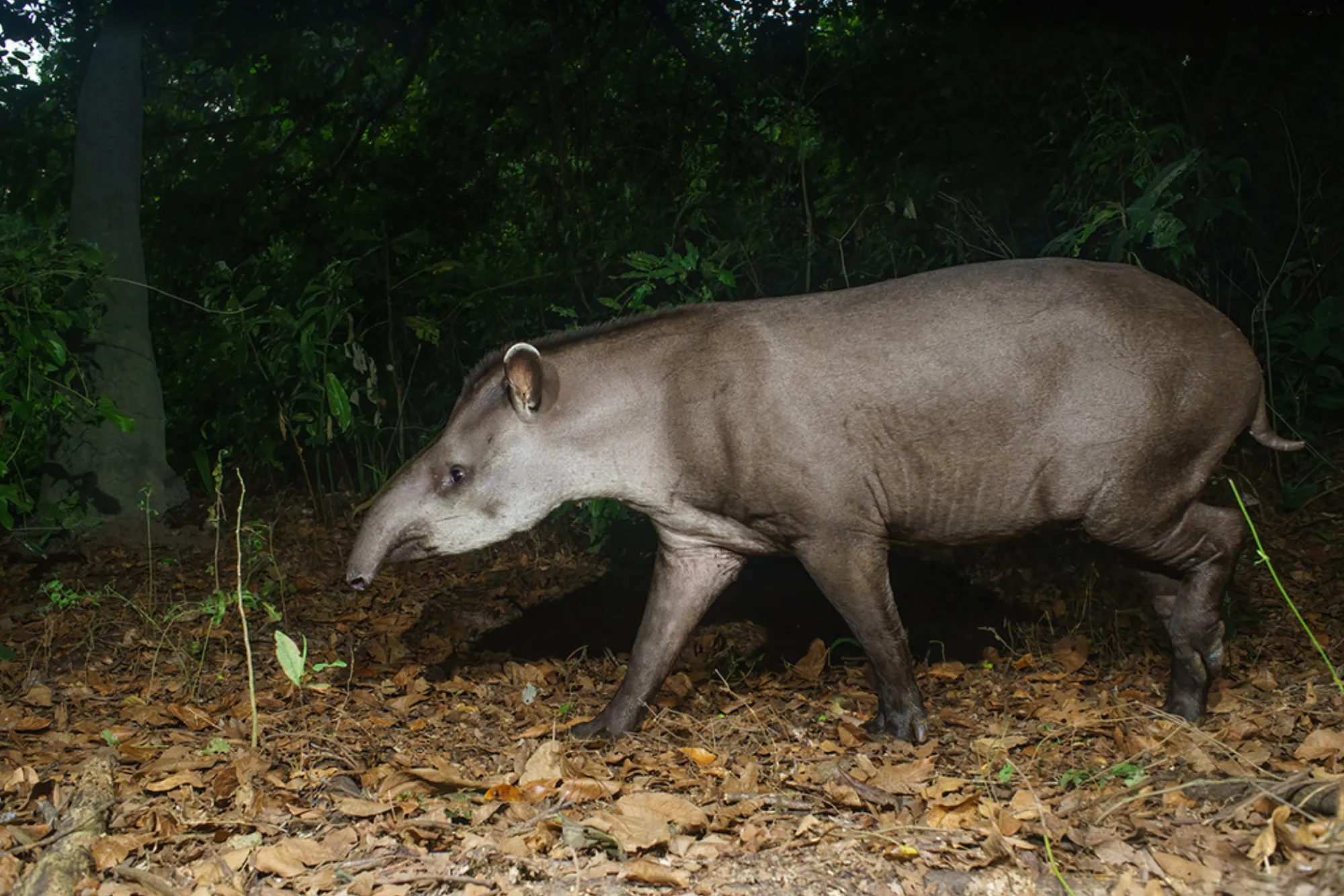
A dark brown coat, pale face and white-edged, rounded ears help identify the Brazilian Tapir, Tapirus terrestris. A low, upright crest runs from the top of its head down its neck. It is the largest surviving land mammal native to the Amazon, reaching 1.8 to 2.5 m in body length and averaging around 225 kg. Newborns look different from adults, with small white spots and stripes across their dark brown coats.
In South America, it lives east of the Andes, close to water across the Amazon basin and rainforest. Its range extends from Venezuela, Colombia and the Guianas south to Brazil, Argentina and Paraguay, and west to Bolivia, Peru and Ecuador. It swims and dives with ease, and can also move quickly across rugged, mountainous ground. When threatened, it may escape into water or bush, though it can defend itself with a powerful bite. Jaguars, cougars, crocodilians and green anacondas all attack tapirs; the large cats often strike at night when tapirs come out of the water and sleep on riverbanks.
The tapir eats plants, using its mobile nose to gather leaves, buds, shoots and small branches, as well as fruit, grasses and aquatic plants. It also eats many of the seeds found in the rainforest. Females usually produce one young every two years after a pregnancy of 13 months, and the young are weaned at about six months. Poaching for meat and hide, along with habitat destruction, has reduced its numbers. Further habitat loss is a threat as forests are cleared, development spreads and human populations grow.
Written from the English Wikipedia article South American tapir (CC BY-SA 4.0).
- Records
- 4,746
- Countries
- 8
- Atlas places
- 9
These are open occurrence records, so they show where people looked for and recorded the Brazilian Tapir as much as where it lives. Cells are up to 25 km across, and every location is generalised to its cell.
Generalised encounter areas, not exact locations. Each shape is a grid cell coloured by how likely the species is there.
- Very likelyArgentina25 km zone · high confidence · 2899 records · updated 86 days ago
- Very likelyFrench Guiana25 km zone · medium confidence · 1654 records · updated 86 days ago
- Very likelyBrazil25 km zone · medium confidence · 85 records · updated 86 days ago
- Very likelyEcuador25 km zone · medium confidence · 76 records · updated 86 days ago
- LikelyColombia25 km zone · medium confidence · 14 records · updated 86 days ago
- LikelyUnited States25 km zone · medium confidence · 4 records · updated 86 days ago
- PossiblePeru25 km zone · medium confidence · 14 records · updated 86 days ago
- RareSuriname25 km zone · low confidence · 0 records · updated 86 days ago
Conservation status not assessed here yet, so every location is generalised to its grid cell.