Mountain Tapir
Tapirus pinchaque
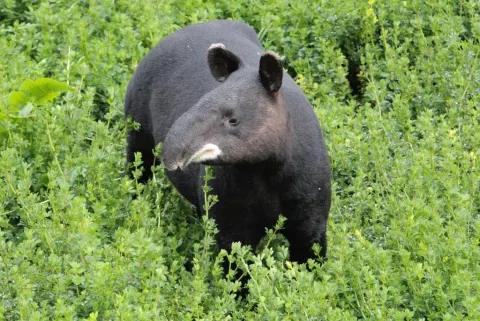
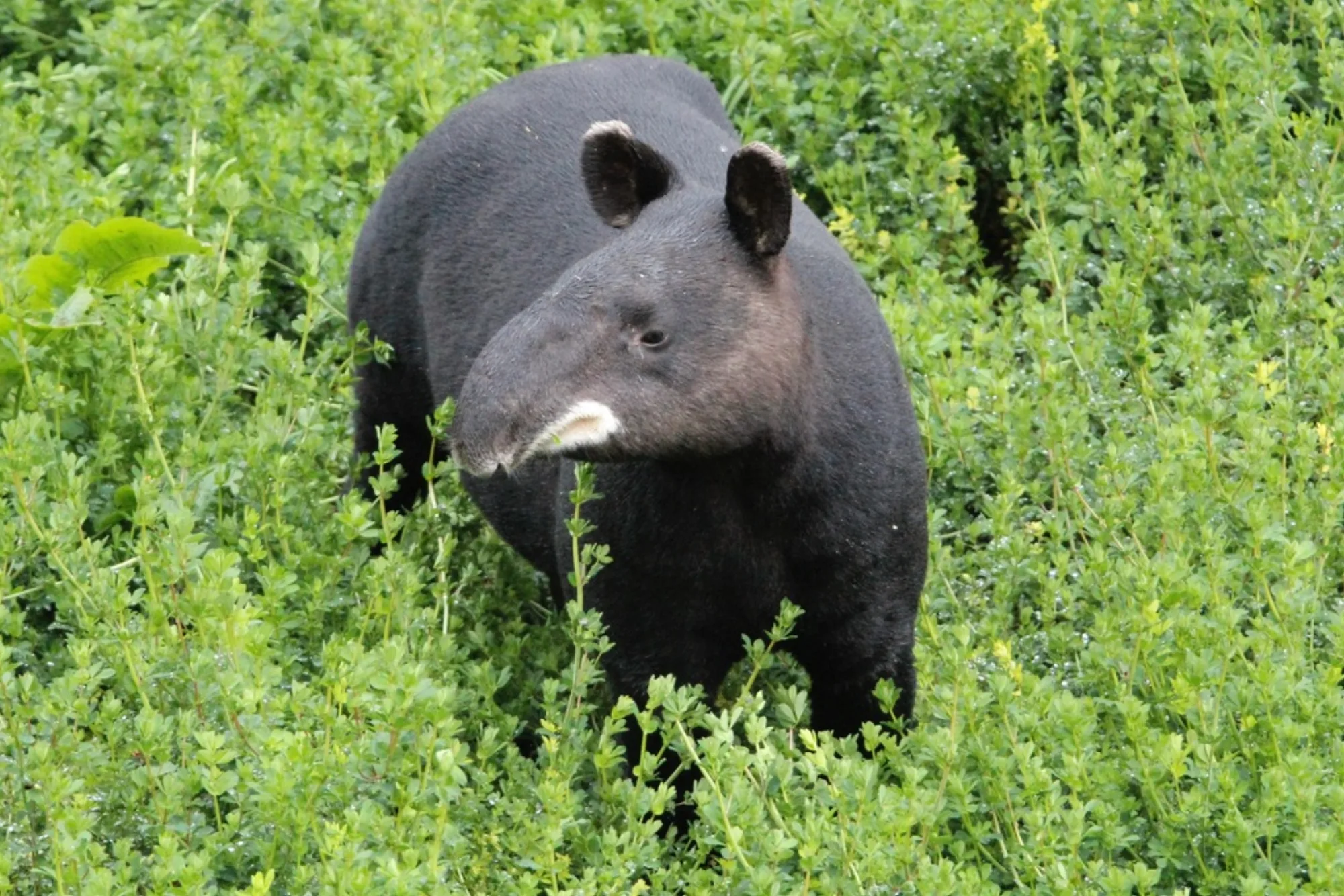
A thick, woolly coat and white lips distinguish the Mountain Tapir from its relatives. Its fur is black or very dark brown, with paler colouring underneath and on the cheeks; white bands usually edge the ears. Adults are around 1.8 m long and stand 0.75 to 1 m at the shoulder, with a small tail and a long, flexible snout.
This shy animal inhabits cloud forests and páramo in the mountains of Colombia and Ecuador, reaching northernmost Peru, commonly at elevations of 2,000 to 4,300 metres. It tends to stay in forest during the wet season and move into the páramo in drier months. Mostly solitary, it follows well-worn paths while foraging and travels easily through dense vegetation, up steep slopes and in water. It often swims and wallows, and usually rests under heavy vegetation during the hottest part of the day. Mountain tapirs are generally most active around dawn and dusk, though they spend more time active in daylight than other tapirs. They eat leaves, grasses, bromeliads, ferns and other plants, and visit natural salt licks for minerals. They also disperse seeds, including those of the wax palm.
Females usually breed once every other year and give birth to a single young after 392 or 393 days. The young have yellowish-white spots and stripes on a brown coat, and their mothers care for them for around 18 months. Poaching and forest clearance for farming and mining are the main threats. Fragmented habitat is a concern because breeding and a healthy population depend on connected areas of cloud forest and páramo. Farmers also sometimes kill tapirs that eat their crops, and attacks by domestic dogs have been reported.
Written from the English Wikipedia article Mountain tapir (CC BY-SA 4.0).
- Records
- 498
- Countries
- 2
- Atlas places
- 1
These are open occurrence records, so they show where people looked for and recorded the Mountain Tapir as much as where it lives. Cells are up to 25 km across, and every location is generalised to its cell.
Generalised encounter areas, not exact locations. Each shape is a grid cell coloured by how likely the species is there.
- Very likelyEcuador25 km zone · high confidence · 484 records · updated 80 days ago
- PossibleColombia25 km zone · medium confidence · 14 records · updated 80 days ago
Conservation status not assessed here yet, so every location is generalised to its grid cell.