White Cloud Mountain Minnow
Tanichthys albonubes
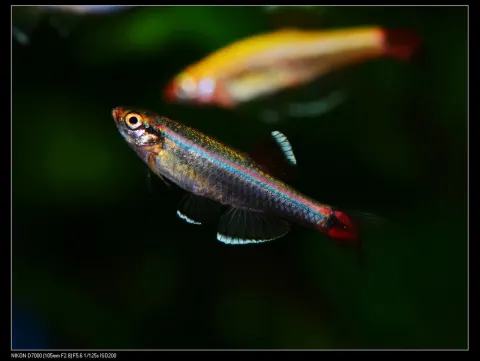
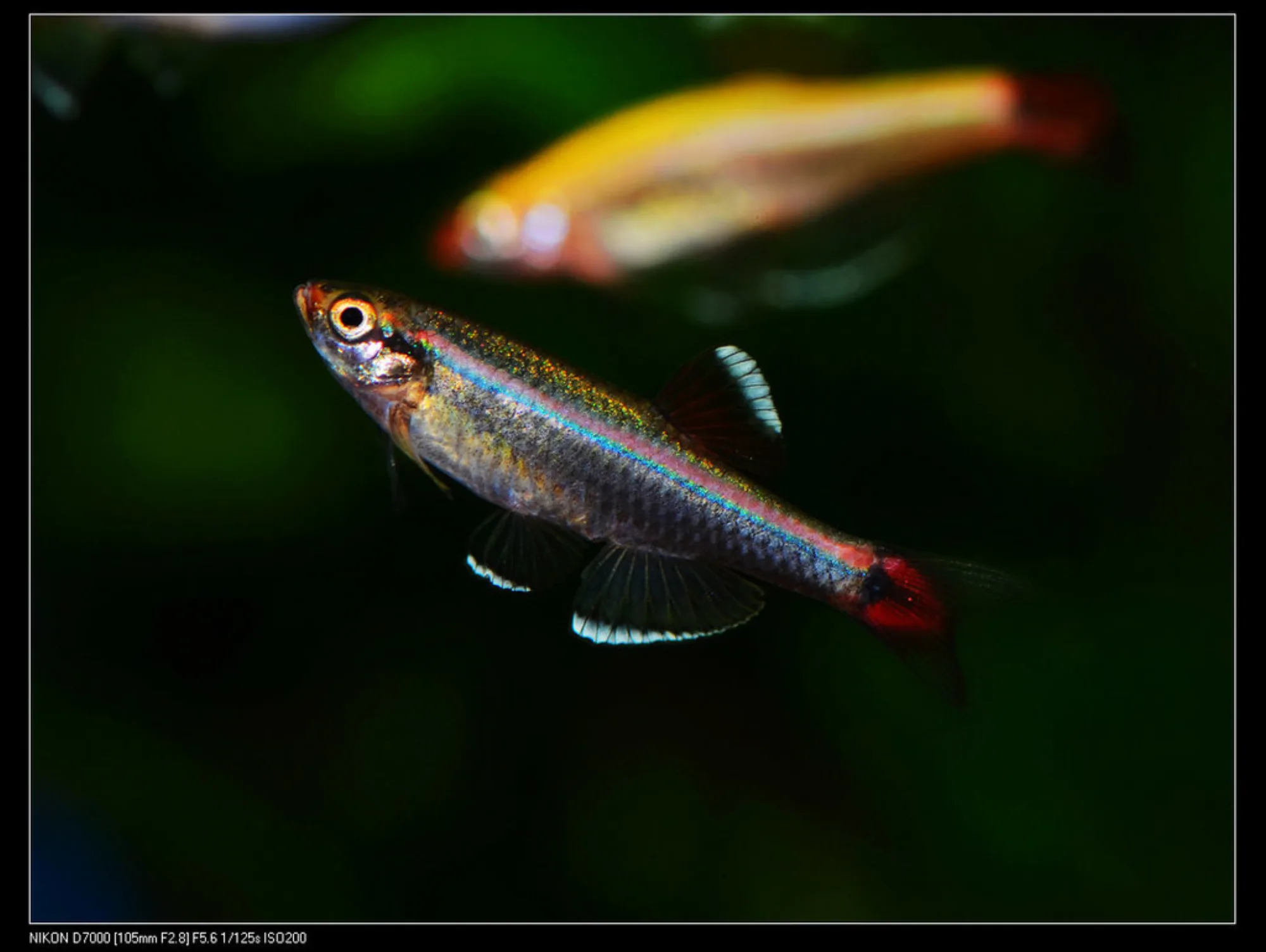
Look for a small, silver-green fish with bright red fins at its tail and on its back: the White Cloud Mountain Minnow grows to about 4 cm long. Native to China, it was discovered at White Cloud Mountain in Guǎngzhōu, in the province of Guǎngdōng. An apparently native population was later found on Hainan Island, far from the mountain. The species is now practically extinct in its native habitat, with pollution and tourism named as causes. Wild water temperatures normally range from 18 to 22 °C, although the fish can survive temperatures as low as 5 °C.
White Cloud Mountain Minnows live in shoals and are most comfortable in groups of at least five. In an aquarium, they tend to swim near the surface or in midwater, rarely approaching the bottom. They are generally peaceful with other fish, though larger tankmates may eat them. Their varied diet includes aquatic plants and insect larvae, with mosquitoes and shrimp among their favoured foods. Under severe pressure, such as drought, they may also eat fruit and nuts or scavenge from the carcasses of other pond animals. Males display their fins to attract females, sometimes displaying alongside one another. The fish scatter their eggs among vegetation, and the young hatch within 48 to 60 hours. Parents do not generally eat their offspring. The fish are bred on farms for the aquarium trade, but inbreeding has produced genetically weak stock that is susceptible to disease and physical deformities.
Written from the English Wikipedia article White Cloud Mountain minnow (CC BY-SA 4.0).
- Records
- 3
- Countries
- 1
No atlas park has a record of the White Cloud Mountain Minnow in or around it yet.
These are open occurrence records, so they show where people looked for and recorded the White Cloud Mountain Minnow as much as where it lives. Cells are up to 25 km across, and every location is generalised to its cell.
Generalised encounter areas, not exact locations. Each shape is a grid cell coloured by how likely the species is there.
- Very likelyAustralia25 km zone · medium confidence · 3 records · updated 80 days ago
Conservation status not assessed here yet, so every location is generalised to its grid cell.