Red Squirrel
Tamiasciurus hudsonicus
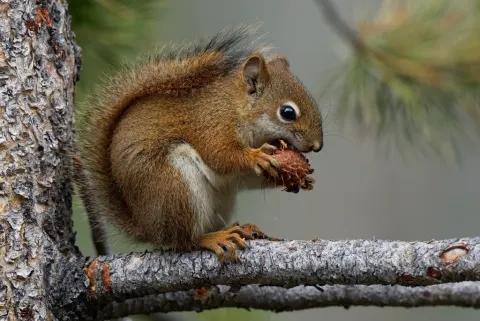
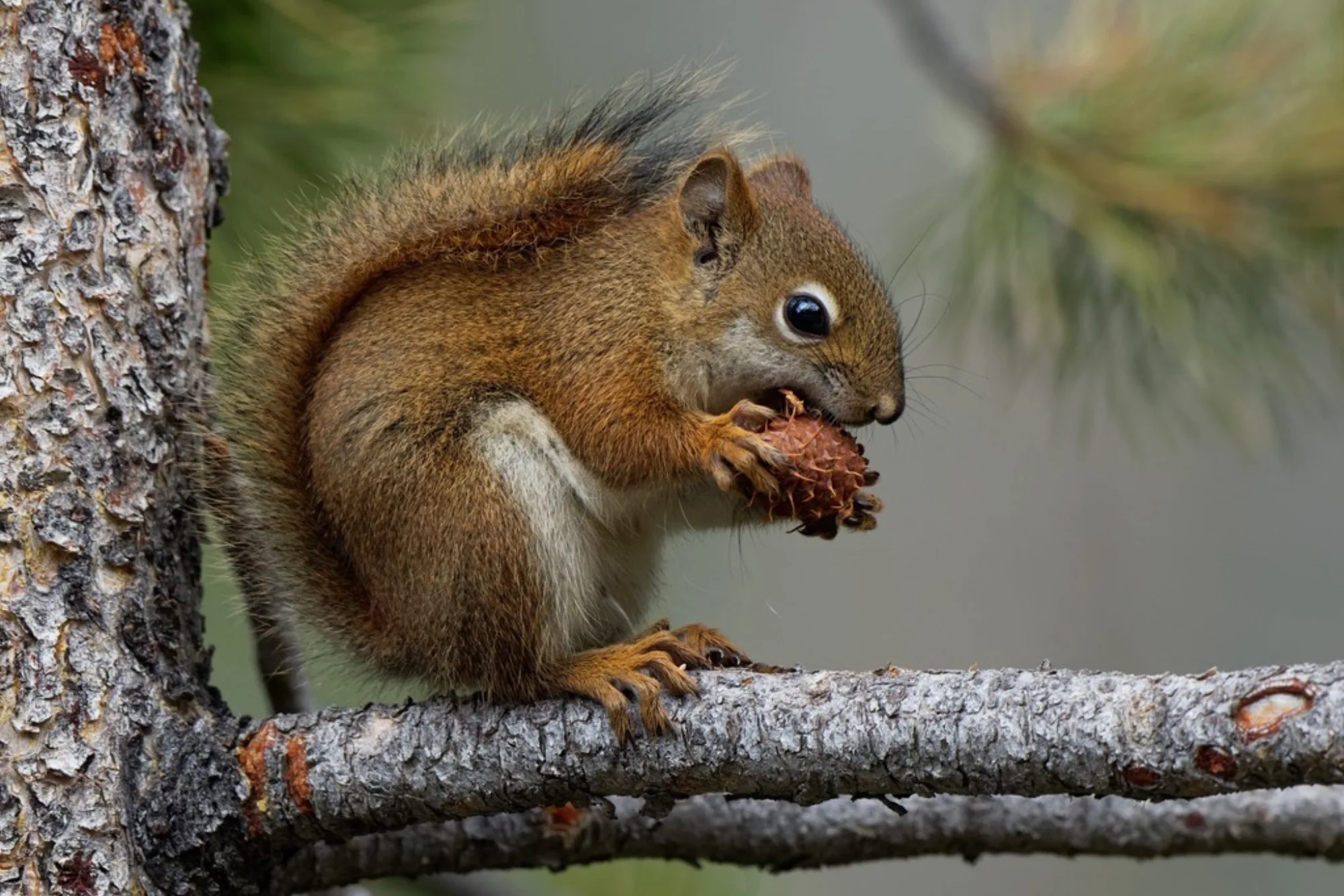
Look for the Red Squirrel in the trees during the day: this small North American squirrel has reddish fur, a white belly and a total length of 28 to 35 cm, including its tail. It is smaller than other North American tree squirrels, though somewhat larger than a chipmunk. Its range covers most of Canada, southern Alaska, the US Rocky Mountains and the northern part of the eastern United States. It is found widely wherever conifers are common and has also been expanding into hardwood forests. In Alberta, it is associated with mature white spruce or forests dominated by conifers.
Each squirrel defends its own territory year round and drives away intruders. Conifer seeds are its main food, but its varied diet can also include mushrooms, buds, berries and bird eggs. In the Yukon, squirrels gather white spruce cones in August and September, storing them in a central cache for winter and the following spring. Discarded cone scales can accumulate in piles up to 12 metres across, and a territory may contain one or several of these middens.
Most females have one litter a year, typically of one to five young, though some skip breeding or have two litters. Nests are usually made from grass in tree branches, but squirrels also use cavities in tree trunks or dense growths known as witches' brooms. Young squirrels need a territory and a midden to survive their first winter, and only 22% survive to one year on average. Predators include lynx, coyotes, owls, hawks, martens, foxes and weasels.
Written from the English Wikipedia article American red squirrel (CC BY-SA 4.0).
- Records
- 6,849
- Countries
- 2
- Atlas places
- 14
- Banff National Park· Canada
- Jasper National Park· Canada
- Acadia National Park· United States
- Grand Teton National Park· United States
- Kootenay National Park· Canada
- Rocky Mountain National Park· United States
- Yellowstone National Park· United States
- Algonquin Provincial Park· Canada
- Denali National Park· United States
- Grand Canyon National Park· United States
- Great Smoky Mountains National Park· United States
- Olympic National Park· United States
- Pacific Rim National Park Reserve· Canada
- Yoho National Park· Canada
These are open occurrence records, so they show where people looked for and recorded the Red Squirrel as much as where it lives. Cells are up to 25 km across, and every location is generalised to its cell.
Generalised encounter areas, not exact locations. Each shape is a grid cell coloured by how likely the species is there.
- Very likelyCanada25 km zone · medium confidence · 3932 records · updated 80 days ago
- Very likelyUnited States25 km zone · high confidence · 2917 records · updated 80 days ago
Conservation status not assessed here yet, so every location is generalised to its grid cell.