Douglas's Squirrel
Tamiasciurus douglasii
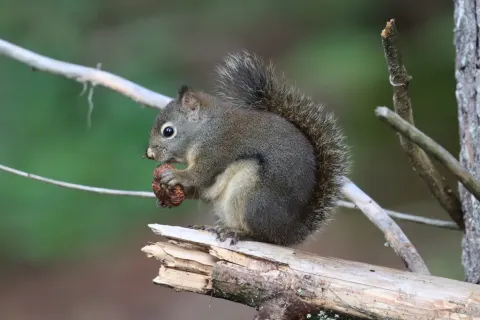
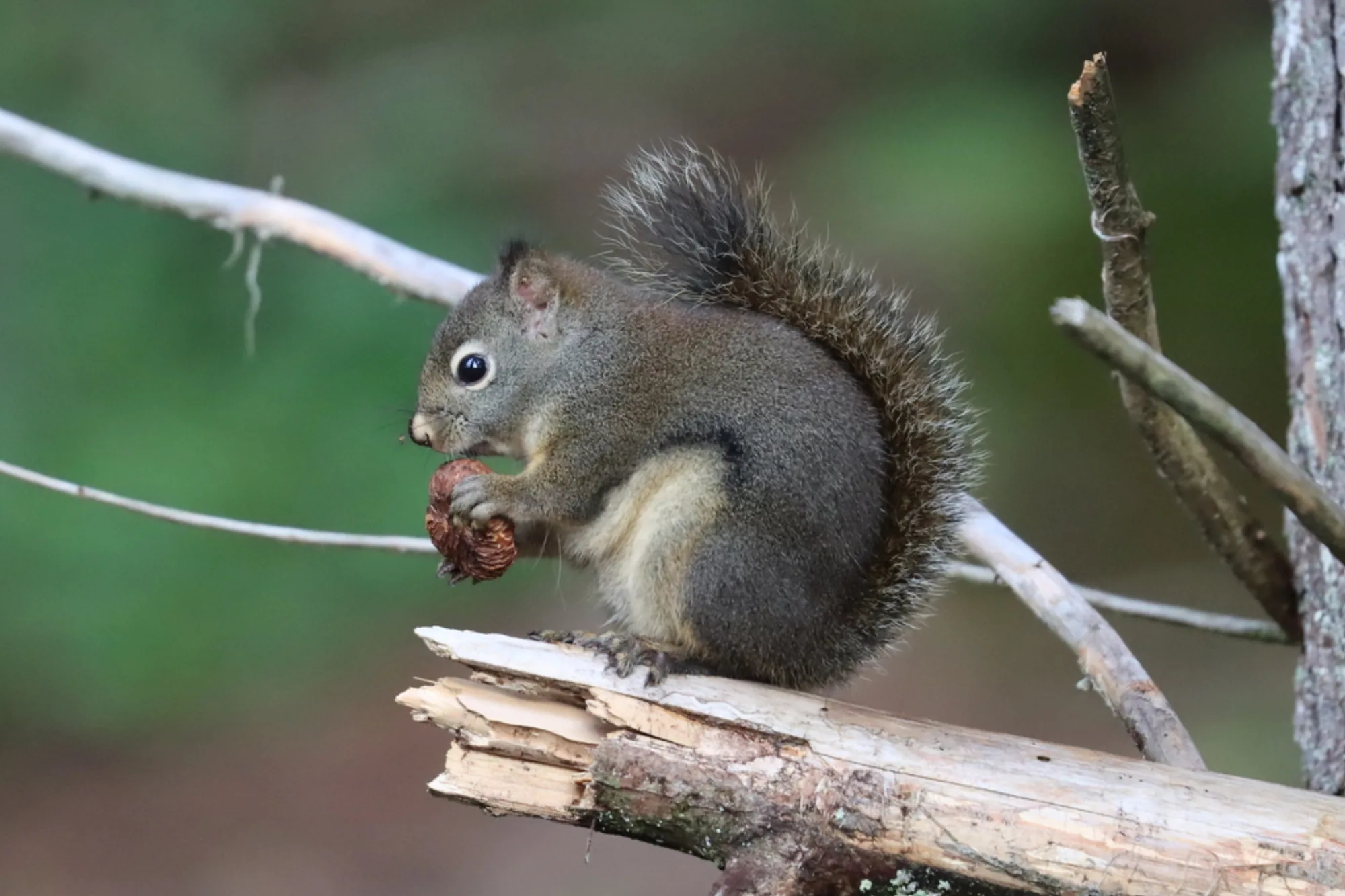
A white eye-ring and a long tail help distinguish the Douglas's Squirrel, a pine squirrel of western North America. Adults measure about 33 cm from nose to tail, with the tail accounting for about 13 cm, and weigh 150 to 300 g. Its coat changes with the seasons: in summer, the back is greyish to almost greenish-brown and the chest and belly are pale orange. In winter, the coat becomes browner, the underside greyer and the ears more tufted.
Along the Pacific Coast, this squirrel lives in coniferous forests from California's Sierra Nevada north to the southwestern coast of British Columbia. It favours old-growth or mature second-growth forest. An isolated subspecies lives in dry pine forests in a small part of Baja California. Active by day throughout the year, Douglas's Squirrels often chatter noisily at intruders. They sleep in ball-shaped nests in trees on summer nights and use tree holes in winter. Each squirrel holds a territory in winter, while a breeding pair defends one together. Their food is mainly conifer seeds, but they also eat acorns, berries, mushrooms, some fruit and bird eggs. They store food in a midden, where discarded cone scales can accumulate into piles several metres across as generations reuse the site.
Mating can begin in February, and young are weaned at about eight weeks. A litter can contain up to six kits, although four is more usual. Pacific martens and bobcats hunt them, as do domestic cats, owls and northern goshawks. People also pose a threat by destroying old-growth forest and taking seeds from the squirrels' cone caches for tree cultivation.
Written from the English Wikipedia article Douglas squirrel (CC BY-SA 4.0).
- Records
- 2,098
- Countries
- 3
- Atlas places
- 4
These are open occurrence records, so they show where people looked for and recorded the Douglas's Squirrel as much as where it lives. Cells are up to 25 km across, and every location is generalised to its cell.
Generalised encounter areas, not exact locations. Each shape is a grid cell coloured by how likely the species is there.
- Very likelyUnited States25 km zone · medium confidence · 1604 records · updated 80 days ago
- Very likelyCanada25 km zone · medium confidence · 463 records · updated 80 days ago
- Very likelyMexico25 km zone · medium confidence · 31 records · updated 80 days ago
Conservation status not assessed here yet, so every location is generalised to its grid cell.