Eastern Chipmunk
Tamias striatus
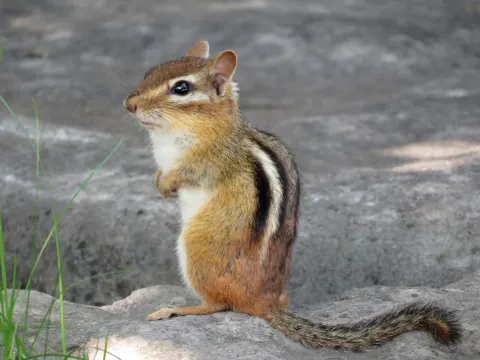
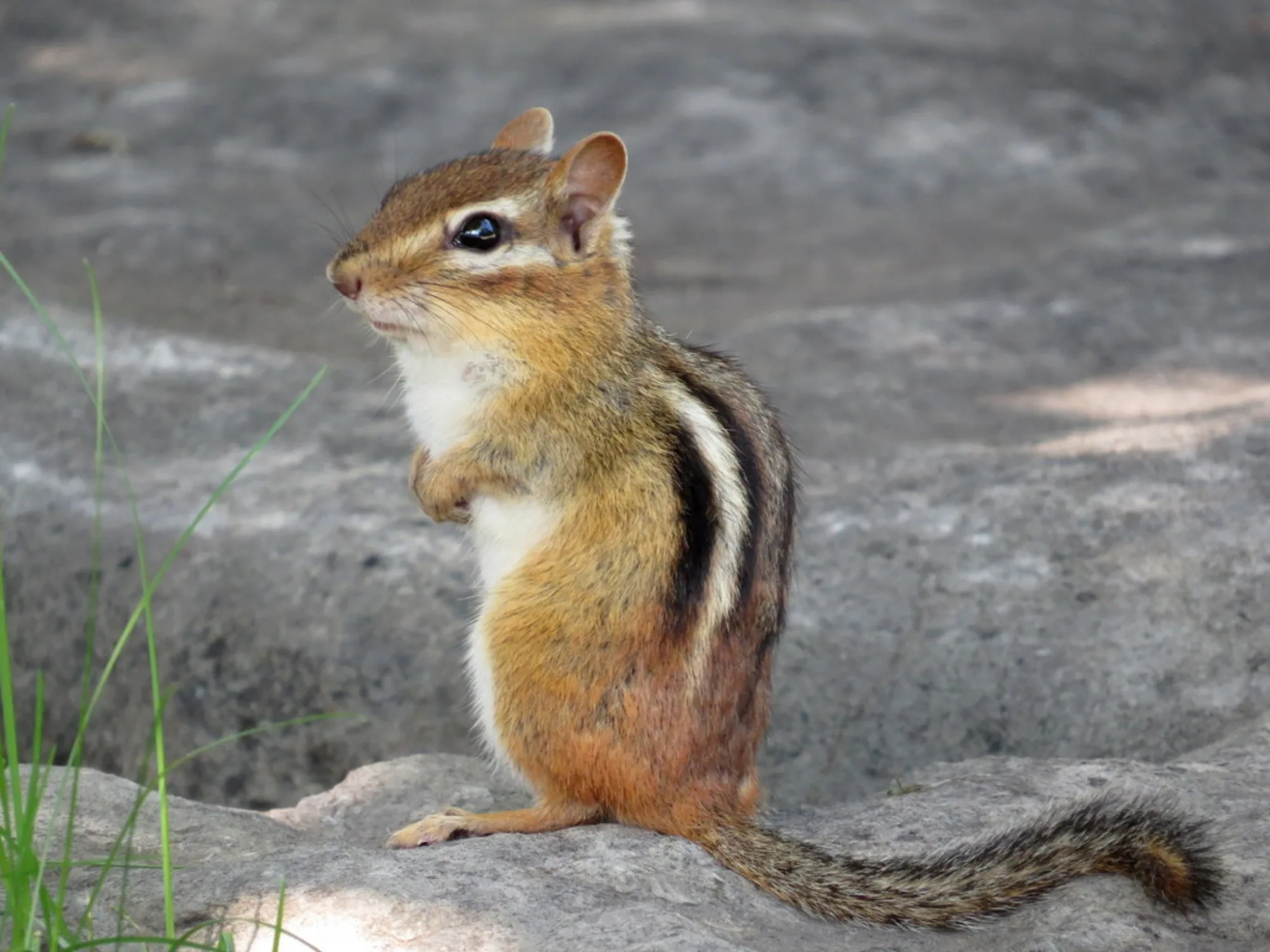
Reddish-brown fur and five dark stripes along the back make the Eastern Chipmunk a distinctive sight in eastern North America. Lighter brown stripes lie between the dark markings, while a dark tail and pale underparts complete its colouring. A tawny stripe runs from its whiskers to below each ear, and light stripes mark the area above its eyes. This small chipmunk reaches about 30 cm long, including its tail, and weighs 66 to 150 g. It lives in deciduous woods and urban parks across the eastern United States and southern Canada, favouring places where rocks, brush, log piles or shrubs provide cover.
A capable tree climber, it makes its nest underground in an extensive network of tunnels, often with several entrances. Leaves, rocks, sticks and other material help conceal its burrow. Mostly active by day, it spends much of its time looking for food, from bulbs, seeds, fruits and nuts to mushrooms, insects, worms and bird eggs. It carries food in cheek pouches and defends its burrow, generally living alone outside the breeding season. Females usually raise one or two litters, each with three to five young; breeding occurs between February and April, then again between June and August. Young typically stay with their mothers for around six to eight weeks, and the chipmunk may spend long periods hibernating in winter. Hawks, owls, foxes, snakes and domestic cats and dogs are among its predators, while the larvae of Cuterebra botflies can also parasitise it.
Written from the English Wikipedia article Eastern chipmunk (CC BY-SA 4.0).
- Records
- 7,780
- Countries
- 2
- Atlas places
- 4
These are open occurrence records, so they show where people looked for and recorded the Eastern Chipmunk as much as where it lives. Cells are up to 25 km across, and every location is generalised to its cell.
Generalised encounter areas, not exact locations. Each shape is a grid cell coloured by how likely the species is there.
- Very likelyUnited States25 km zone · high confidence · 6364 records · updated 80 days ago
- Very likelyCanada25 km zone · medium confidence · 1416 records · updated 80 days ago
Conservation status not assessed here yet, so every location is generalised to its grid cell.