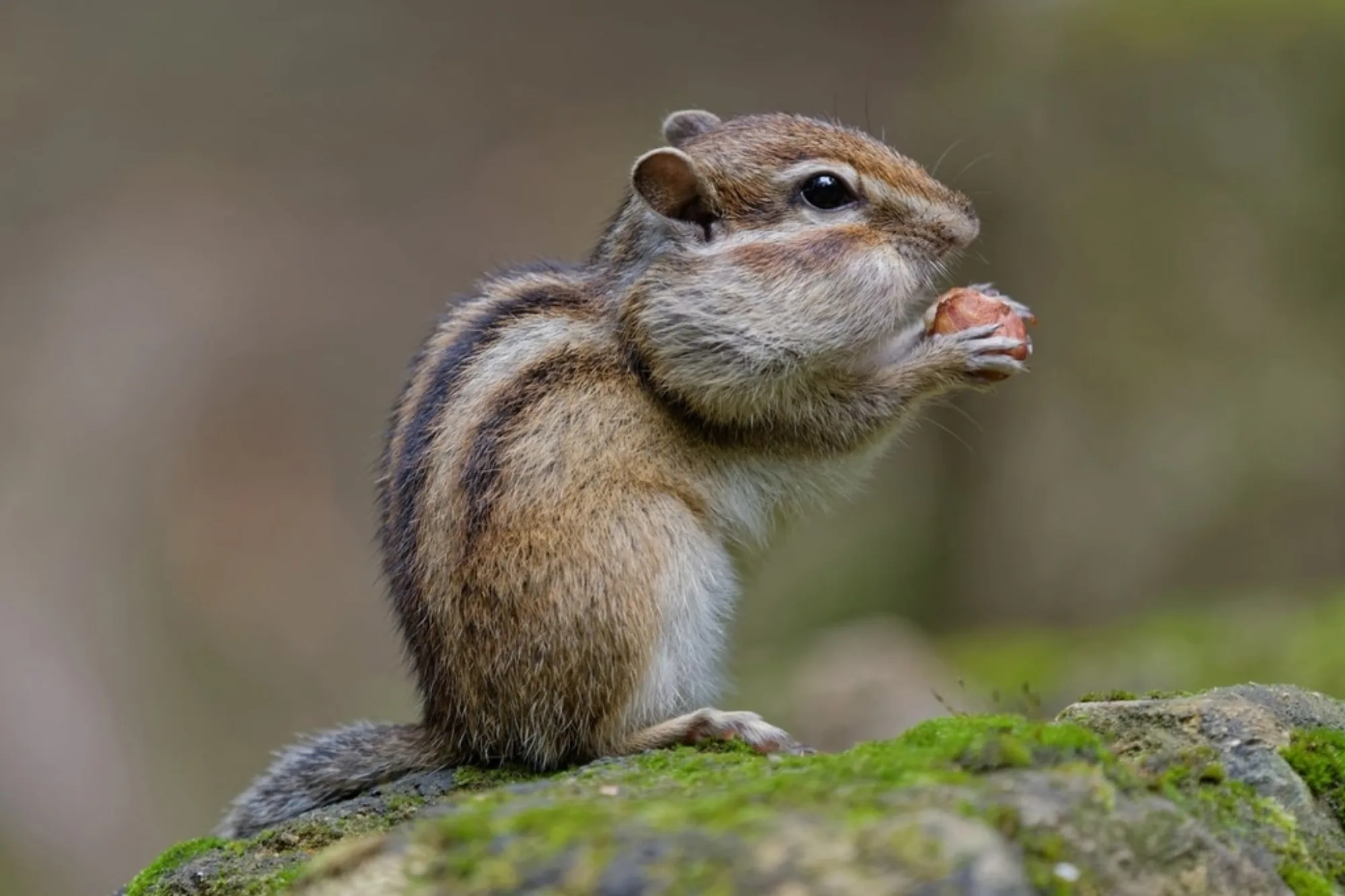
Siberian Chipmunk
Tamias sibiricus
Four pale stripes and five dark ones run along the back of the Siberian Chipmunk, a small chipmunk native to northern Asia. It measures 18 to 25 cm in length, with the tail making up a third of that, and its colour varies slightly across its range. Native populations occur from Russia through parts of Kazakhstan, Mongolia, China and Korea to islands including Hokkaido in Japan. Introduced populations have also settled in some European suburban woods and city parks, following escapes and releases from captivity. In its native range, this adaptable animal is usually found in coniferous woods, rocky forest and mountain areas, shrub-filled habitats, and along roads or waterways. In Europe, it also lives in deciduous or mixed forests and green urban spaces.
Siberian Chipmunks generally live alone within loose colonies, each holding a territory, though they often share a winter burrow with another chipmunk. The burrow contains a nest and separate chambers for food and waste, and its occupant stores 3 to 4 kg of food for the winter underground. Seeds, particularly pine seeds, are a usual food, but the diet also includes roots, insects, fruit, fungus and other animals. Breeding usually follows hibernation in mid April, with three to eight young born in a litter; females care for them and teach them to forage. Birds of prey, weasels, small cats and foxes hunt the chipmunks, which rely on alertness, camouflage and their burrows for protection. Some are traded for their pelts and other body parts, while roads and swamps can hinder their movement into new areas.
Written from the English Wikipedia article Siberian chipmunk (CC BY-SA 4.0).
- Records
- 1,380
- Countries
- 11
No atlas park has a record of the Siberian Chipmunk in or around it yet.
These are open occurrence records, so they show where people looked for and recorded the Siberian Chipmunk as much as where it lives. Cells are up to 25 km across, and every location is generalised to its cell.
Generalised encounter areas, not exact locations. Each shape is a grid cell coloured by how likely the species is there.
- Very likelyFrance25 km zone · medium confidence · 437 records · updated 80 days ago
- Very likelyRussia25 km zone · medium confidence · 397 records · updated 80 days ago
- Very likelySwitzerland25 km zone · high confidence · 330 records · updated 80 days ago
- Very likelySouth Korea25 km zone · medium confidence · 140 records · updated 80 days ago
- Very likelyBelgium25 km zone · medium confidence · 42 records · updated 80 days ago
- Very likelyChina25 km zone · medium confidence · 22 records · updated 80 days ago
- LikelyJapan25 km zone · medium confidence · 6 records · updated 80 days ago
- LikelyMongolia25 km zone · medium confidence · 3 records · updated 80 days ago
- LikelyGermany25 km zone · medium confidence · 2 records · updated 80 days ago
- LikelyNetherlands25 km zone · medium confidence · 1 record · updated 80 days ago
Conservation status not assessed here yet, so every location is generalised to its grid cell.