Southern Tamandua
Tamandua tetradactyla
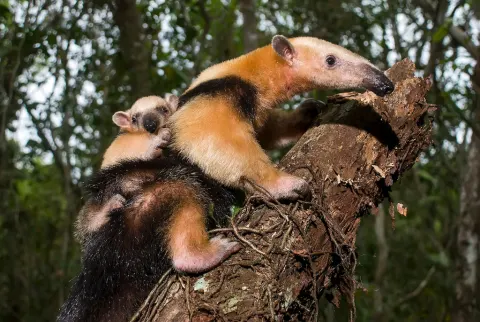
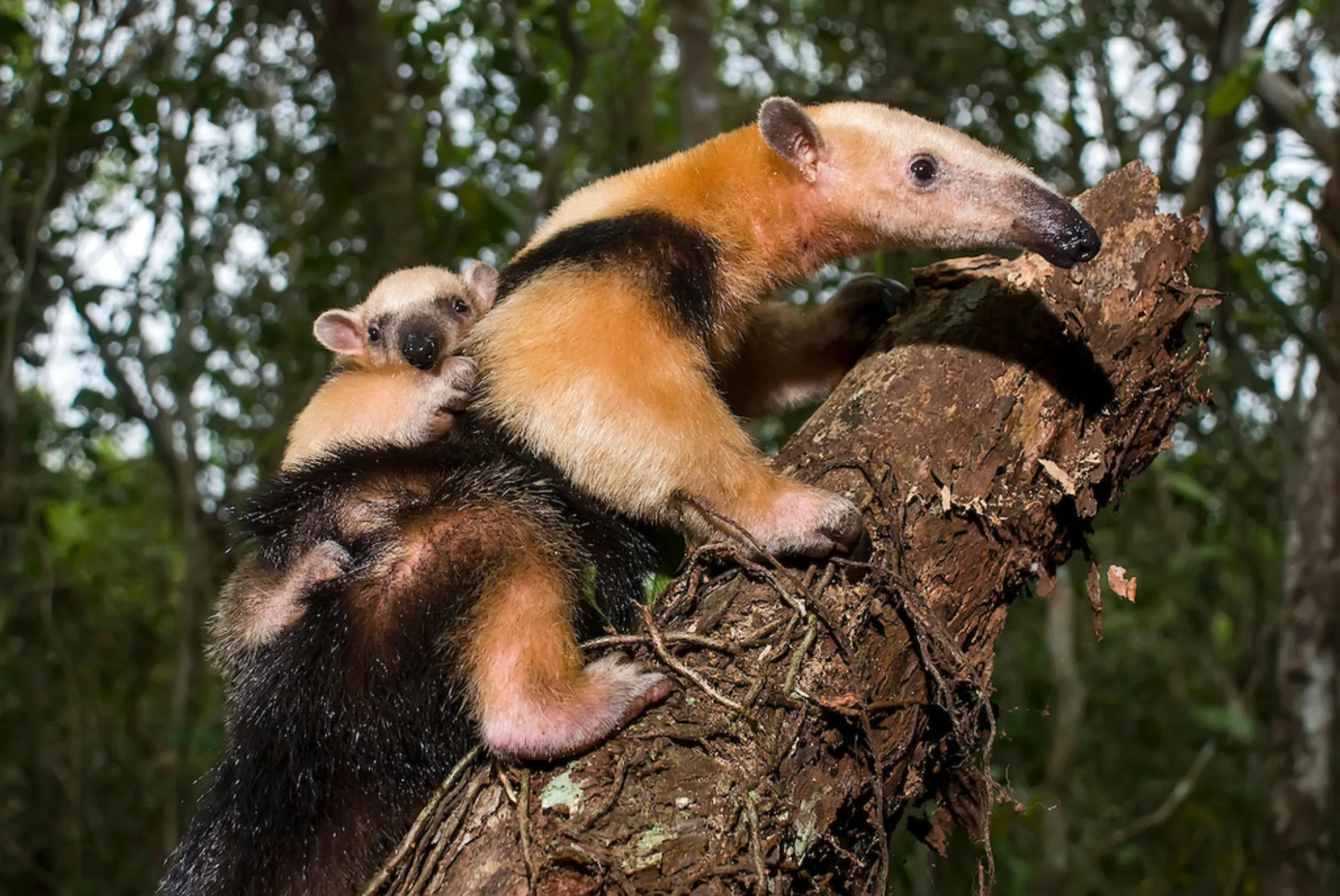
A long, curved snout and a grasping tail give the Southern Tamandua its distinctive outline. This medium-sized South American anteater has a body length of 34 to 88 cm, with a tail another 37 to 67 cm long. Its coat varies across its range: animals in the southeast often have black markings from shoulder to rump, while the rest of the body may be blonde, tan or brown. In Trinidad, individuals are almost always solid blonde. Strong, curved foreclaws help it tear into insect nests and defend itself.
The species ranges from Venezuela through much of South America to northern Argentina, southern Brazil and Uruguay, and also lives on Trinidad. It occurs at elevations up to 1,600 m, in wet and dry forests, savannas and thorn scrub. It seems particularly common near streams and rivers, especially where vines and epiphytes grow thickly. Mostly active at night, it sometimes ventures out during the day and rests in hollow trunks or burrows made by other animals. It spends much of its foraging time in trees, using its tail to hold branches. On the ground, it moves at an amble.
Ants and termites make up much of its diet, which also includes beetle larvae and occasionally a little fruit. It finds food by scent, breaks open nests with its powerful forelimbs and licks up insects with its long tongue. A female gives birth to one young each year, and the youngster rides on her back for months, sometimes up to a year. Wildfires and habitat loss threaten the species, as does hunting for tail tendons used to make rope. Potential predators include large canids, cats, eagles and large snakes.
Written from the English Wikipedia article Southern tamandua (CC BY-SA 4.0).
- Records
- 189
- Countries
- 12
- Atlas places
- 9
These are open occurrence records, so they show where people looked for and recorded the Southern Tamandua as much as where it lives. Cells are up to 25 km across, and every location is generalised to its cell.
Generalised encounter areas, not exact locations. Each shape is a grid cell coloured by how likely the species is there.
- Very likelyBrazil25 km zone · medium confidence · 88 records · updated 80 days ago
- Very likelyArgentina25 km zone · medium confidence · 50 records · updated 80 days ago
- Very likelyColombia25 km zone · medium confidence · 19 records · updated 80 days ago
- Very likelyTrinidad & Tobago25 km zone · medium confidence · 8 records · updated 80 days ago
- Very likelyVenezuela25 km zone · medium confidence · 8 records · updated 80 days ago
- Very likelyFrench Guiana25 km zone · medium confidence · 6 records · updated 80 days ago
- Very likelyUnited States25 km zone · medium confidence · 4 records · updated 80 days ago
- LikelyPeru25 km zone · medium confidence · 5 records · updated 80 days ago
- LikelyEcuador25 km zone · low confidence · 1 record · updated 80 days ago
- UncommonBolivia25 km zone · low confidence · 0 records · updated 80 days ago
Conservation status not assessed here yet, so every location is generalised to its grid cell.