European Mole
Talpa europaea
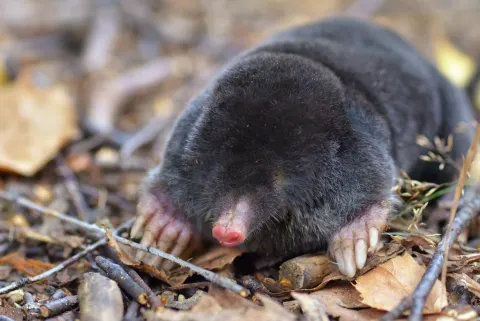
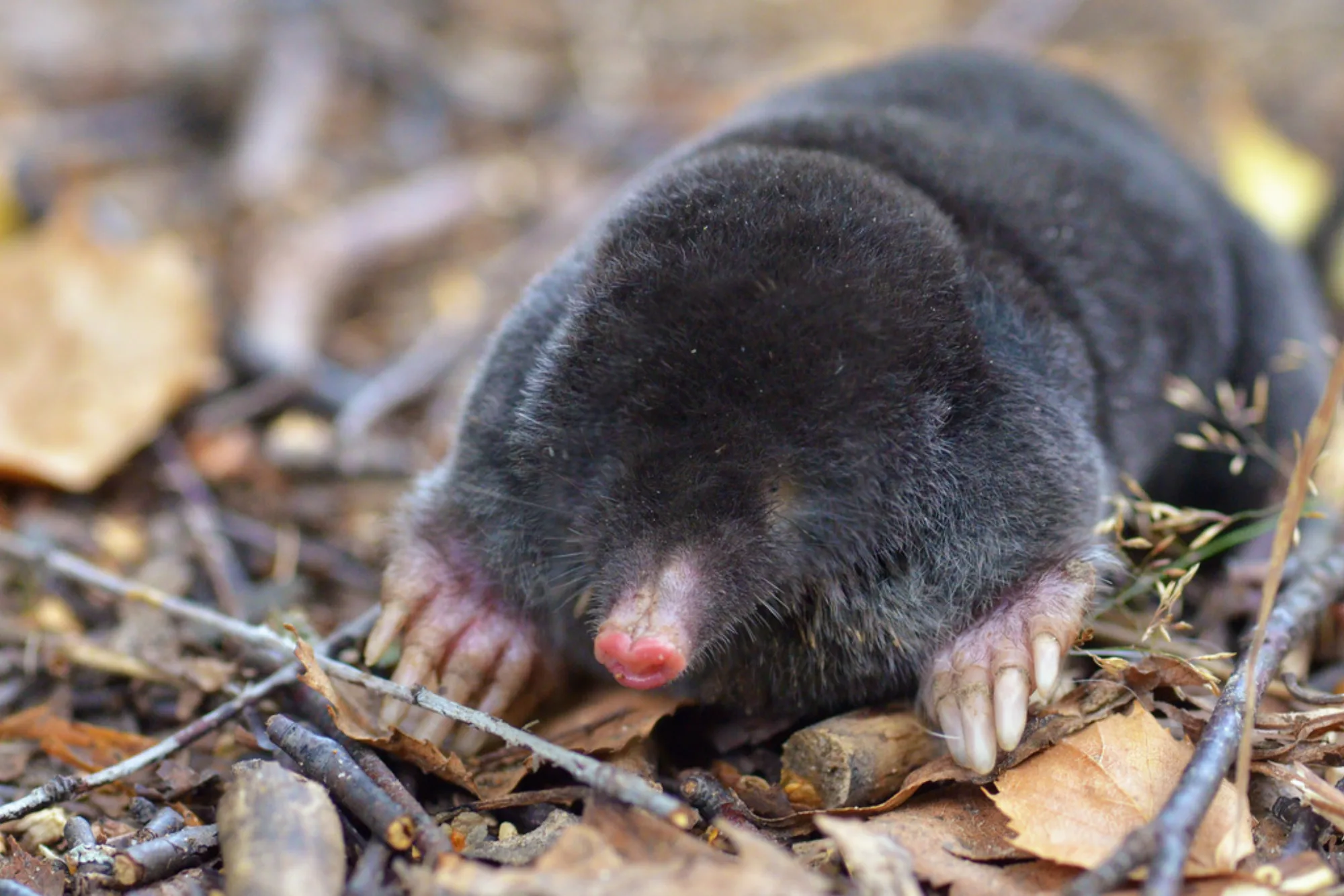
A line of fresh molehills can reveal the underground activity of the European Mole, a mammal that pushes displaced earth to the surface as it digs. Its cylindrical body measures 11 to 16 cm and weighs 70 to 130 g, with females typically smaller than males. The small eyes are hidden in fur, while the ears appear as small ridges in the skin. Usually dark grey, its coat can also be white, light grey, tan, taupe or black.
The species ranges across Europe and westernmost Asia, from the United Kingdom and southern Scandinavia to northern Greece and western Siberia. It spends much of its time beside drainage lines and streams, and the abundance of earthworms strongly influences how many moles live in an area. It avoids flooded and dry soils, though dry areas become important when its usual habitat floods. In suitable urban greenspace, a population needs 10 hectares to persist, and more available habitat supports more territories.
European Moles hunt through tunnel systems that they continually extend. Earthworms are their favoured food, although they also eat insects, centipedes and mammals, including rodents and other moles. Where earthworms are scarce, insects make up the main part of the diet. Breeding takes place in spring, with most litters of two to seven born around the end of April or beginning of May. Young leave their mothers' burrows in spring and early summer to find territories, sometimes travelling above ground to establish or enter a tunnel system.
Written from the English Wikipedia article European mole (CC BY-SA 4.0).
- Records
- 29,826
- Countries
- 8
No atlas park has a record of the European Mole in or around it yet.
These are open occurrence records, so they show where people looked for and recorded the European Mole as much as where it lives. Cells are up to 25 km across, and every location is generalised to its cell.
Generalised encounter areas, not exact locations. Each shape is a grid cell coloured by how likely the species is there.
- Very likelyFrance25 km zone · high confidence · 12959 records · updated 80 days ago
- Very likelyUnited Kingdom25 km zone · high confidence · 11470 records · updated 80 days ago
- Very likelySwitzerland25 km zone · high confidence · 4699 records · updated 80 days ago
- Very likelyGermany25 km zone · high confidence · 309 records · updated 80 days ago
- Very likelyFinland25 km zone · high confidence · 154 records · updated 80 days ago
- Very likelyAustria25 km zone · high confidence · 94 records · updated 80 days ago
- Very likelyBelgium25 km zone · high confidence · 71 records · updated 80 days ago
- Very likelyItaly25 km zone · high confidence · 70 records · updated 80 days ago
Conservation status not assessed here yet, so every location is generalised to its grid cell.