Blue-spotted Fantail Ray
Taeniura lymma
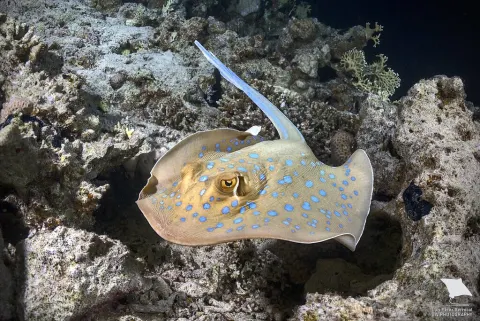
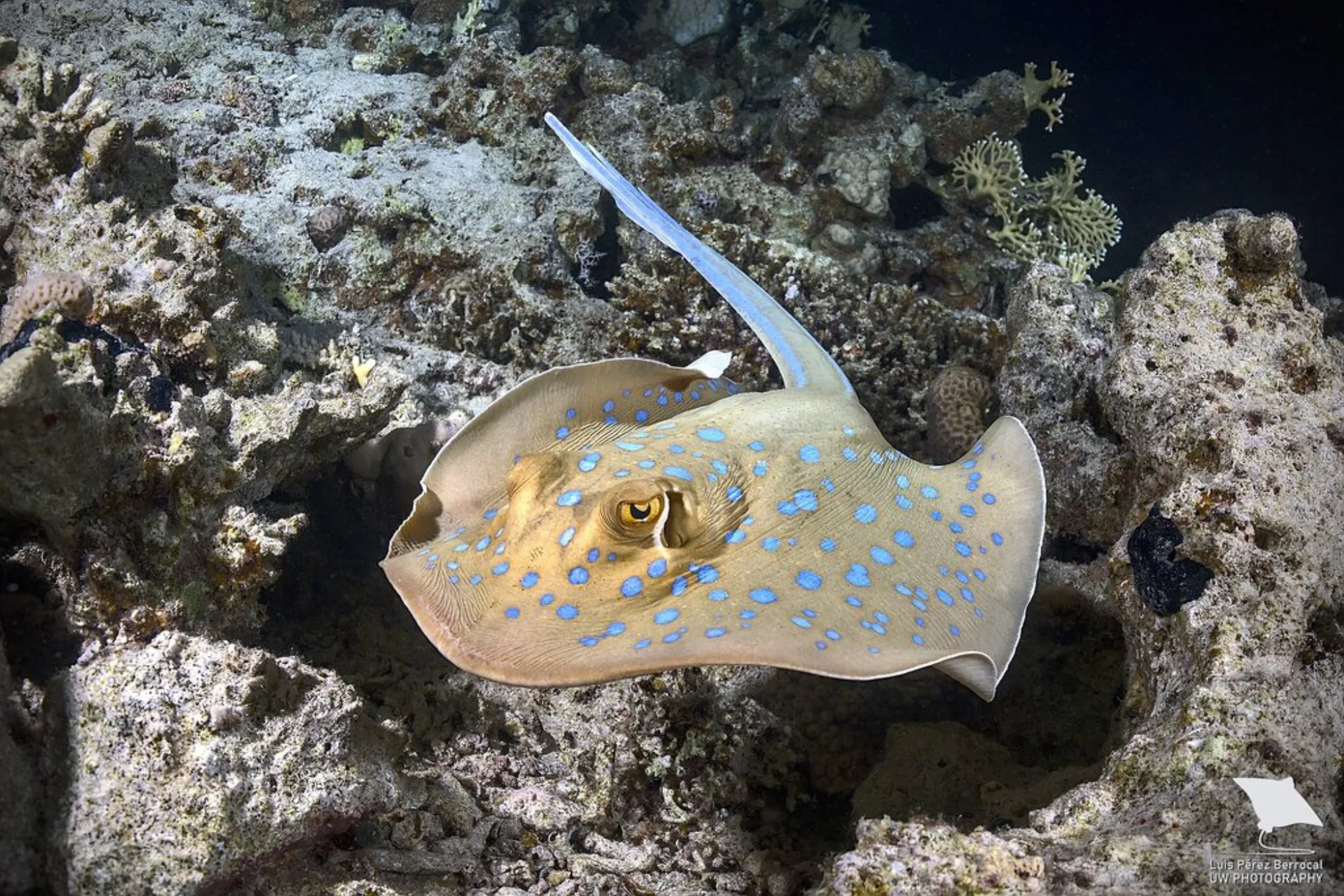
Electric blue spots scattered across a yellowish brown or green back make the Blue-spotted Fantail Ray (Taeniura lymma) easy to recognise. This small stingray has a rounded, oval outline, large protruding eyes and a relatively short, thick tail. Two blue stripes usually run along the tail, although rays off southern Africa may lack them. It can grow to 35 cm across and 80 cm long.
The ray lives in tropical coastal waters across the Indian Ocean and the western Pacific. Its range stretches from South Africa around the Indian Ocean to Southeast Asia, and from the Philippines to northern Australia and islands farther east. Look for it on coral reefs and nearby sandy flats, in tidal pools and near seagrass beds. It occurs from the intertidal zone down to 30 m. During the day, it generally rests alone in caves or beneath coral ledges and other debris, sometimes leaving only its tail visible. It rarely buries itself in sand. At night, small groups follow the rising tide onto shallow sandy flats to feed, then separate and return to reef shelters as the water recedes. They dig in the sand for molluscs, worms, shrimps, crabs and small bottom-dwelling fish, while other fish may follow to pick up missed food.
Breeding takes place from late spring to summer, and females give birth to as many as seven young. Hammerhead sharks and bottlenose dolphins prey on these rays, which tend to flee in a fast zigzag when threatened. Their coral reef habitat is being degraded by development and destructive fishing, while fisheries and collecting for aquariums put further pressure on populations. The ray is also taken for food, both deliberately and incidentally, in parts of East Africa, Southeast Asia and Australia.
Written from the English Wikipedia article Bluespotted ribbontail ray (CC BY-SA 4.0).
- Records
- 2,184
- Countries
- 20
- Atlas places
- 4
These are open occurrence records, so they show where people looked for and recorded the Blue-spotted Fantail Ray as much as where it lives. Cells are up to 25 km across, and every location is generalised to its cell.
Generalised encounter areas, not exact locations. Each shape is a grid cell coloured by how likely the species is there.
- Very likelyAustralia25 km zone · high confidence · 1635 records · updated 80 days ago
- Very likelyEgypt25 km zone · medium confidence · 383 records · updated 80 days ago
- Very likelySaudi Arabia25 km zone · medium confidence · 44 records · updated 80 days ago
- Very likelySouth Africa25 km zone · medium confidence · 22 records · updated 80 days ago
- LikelyIndonesia25 km zone · medium confidence · 23 records · updated 80 days ago
- LikelyMalaysia25 km zone · medium confidence · 17 records · updated 80 days ago
- LikelyThailand25 km zone · medium confidence · 10 records · updated 80 days ago
- LikelyYemen25 km zone · medium confidence · 10 records · updated 80 days ago
- LikelyPhilippines25 km zone · medium confidence · 8 records · updated 80 days ago
- LikelyPapua New Guinea25 km zone · medium confidence · 7 records · updated 80 days ago
Conservation status not assessed here yet, so every location is generalised to its grid cell.