Ruddy Shelduck
Tadorna ferruginea
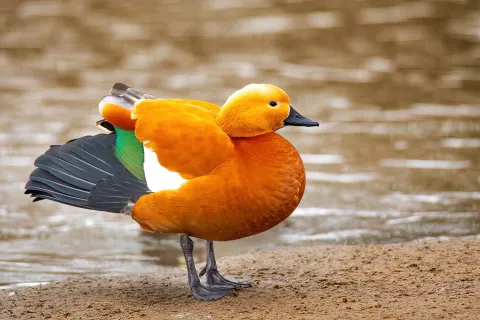
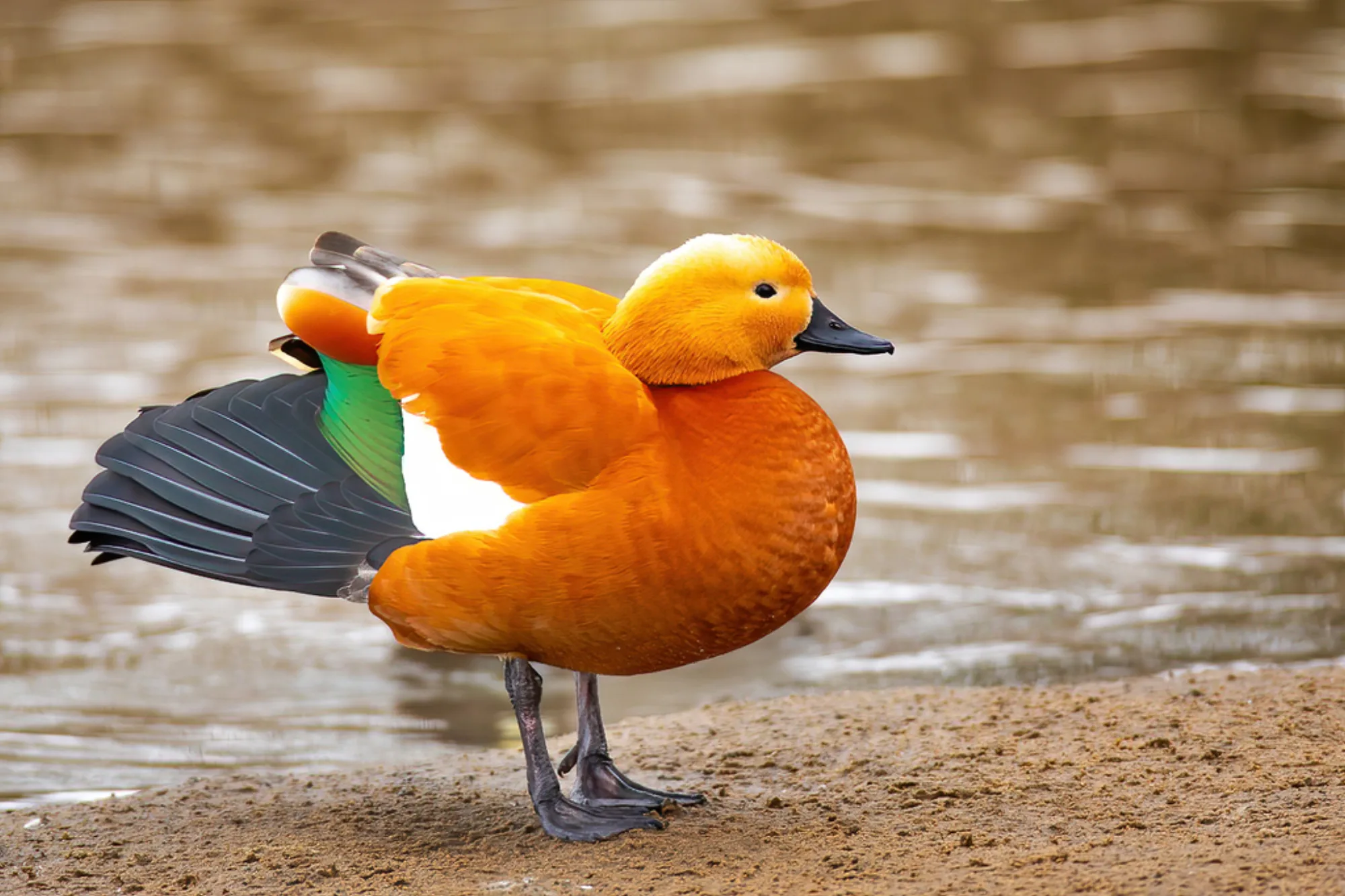
Orange-brown plumage and a pale head make the Ruddy Shelduck stand out around open water. It measures 58 to 70 cm long, and its wings span 110 to 135 cm. In flight, white patches on the wings contrast with black flight feathers and tail; on the ground, listen for a series of loud, nasal honks. The male usually has a narrow black collar, while the female has a paler, whitish head and neck and no collar. After breeding, the male loses his collar during the moult, then regains it in a later partial moult.
The main breeding range extends eastwards from southeast Europe, taking in western China, Mongolia and the area around Lake Baikal. Eastern birds mostly migrate to the Indian subcontinent for winter, while small populations remain year-round in Northwest Africa and Ethiopia. Look for them on open inland waters, including lakes and reservoirs; they breed along rivers and in large wetlands where there are shingle banks and mud flats. Beyond the breeding season, lowland habitats include marshes, flooded grassland, ponds and streams, as well as slow rivers and brackish lagoons.
Mainly active at night, these birds eat grasses, young shoots, grain, water plants and invertebrates found both on land and in water. They graze on land and feed in shallow water, sometimes tipping forward in deeper water, but do not dive. Pairs form lasting bonds and may nest far from water, in a tree hole, cliff crevice, ruined building or animal burrow. The female incubates about eight eggs, and both parents care for the young. After breeding, adults lose the ability to fly for about a month during their moult and move to large bodies of water to avoid predators. In Europe, hunting and the drainage of wetlands contribute to a general decline in numbers.
Written from the English Wikipedia article Ruddy shelduck (CC BY-SA 4.0).
- Records
- 121,255
- Countries
- 76
- Atlas places
- 8
These are open occurrence records, so they show where people looked for and recorded the Ruddy Shelduck as much as where it lives. Cells are up to 25 km across, and every location is generalised to its cell.
Generalised encounter areas, not exact locations. Each shape is a grid cell coloured by how likely the species is there.
- Very likelyIndia25 km zone · high confidence · 48755 records · updated 86 days ago
- Very likelySpain25 km zone · high confidence · 14619 records · updated 86 days ago
- Very likelyTürkiye25 km zone · high confidence · 7524 records · updated 86 days ago
- Very likelyGermany25 km zone · high confidence · 7095 records · updated 86 days ago
- Very likelyRussia25 km zone · high confidence · 4872 records · updated 86 days ago
- Very likelyChina25 km zone · high confidence · 3702 records · updated 86 days ago
- Very likelyNepal25 km zone · high confidence · 2982 records · updated 86 days ago
- Very likelyGreece25 km zone · high confidence · 2508 records · updated 86 days ago
- Very likelySwitzerland25 km zone · high confidence · 2483 records · updated 86 days ago
- Very likelyMongolia25 km zone · high confidence · 2406 records · updated 86 days ago
Conservation status not assessed here yet, so every location is generalised to its grid cell.