Crested Shelduck
Tadorna cristata
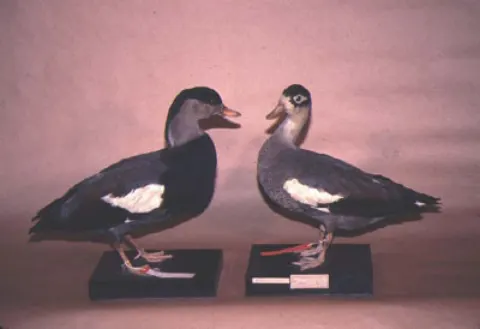
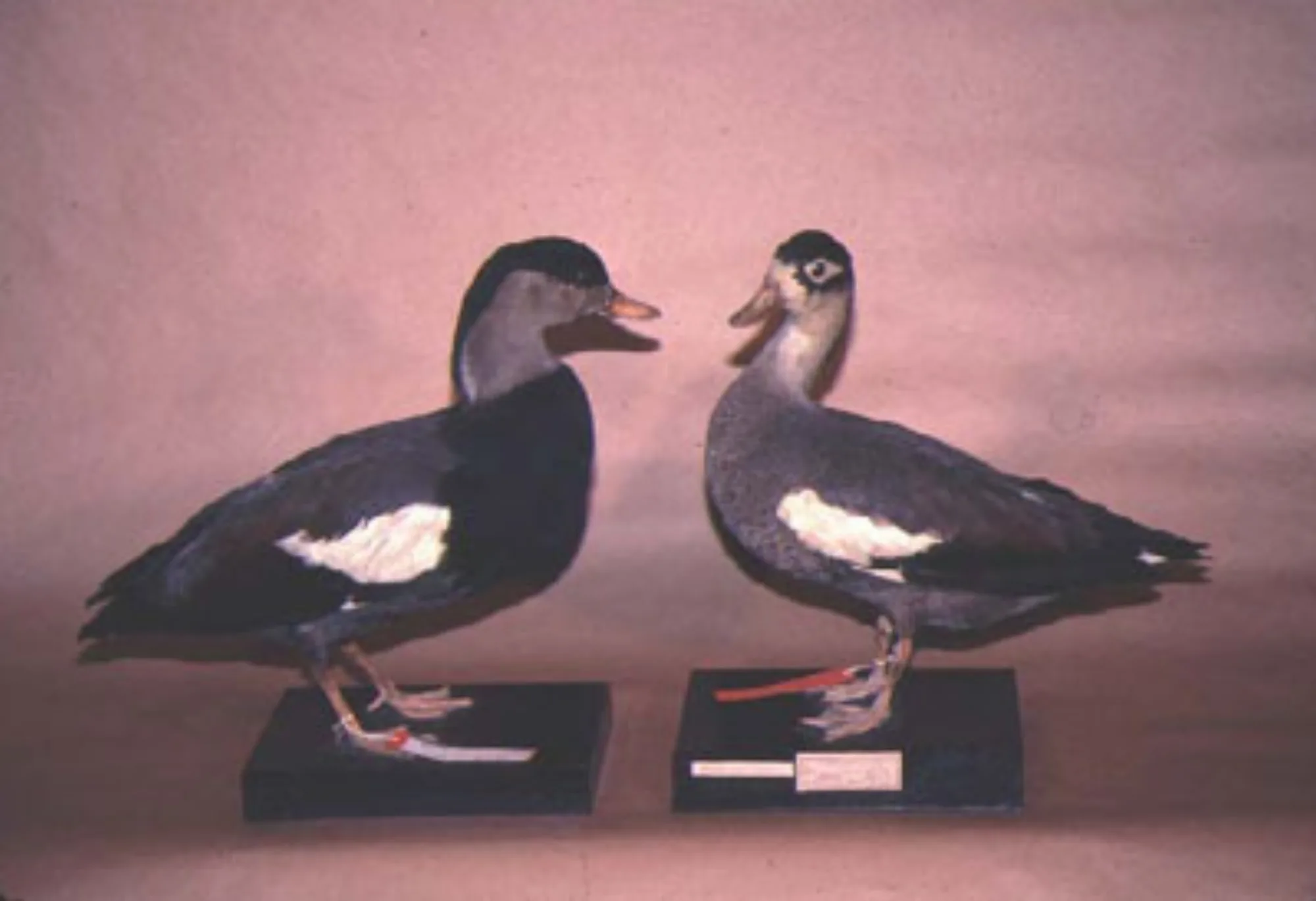
This elusive waterfowl, measuring between 63 and 71 centimetres, is slightly larger than a mallard. The Crested Shelduck is named for the green tuft of feathers that extends from the heads of both sexes. Males display a greenish-black crown, breast, and tail, contrasted by a grey belly and white wing coverts. Females are identified by a large white ring around the eye and a dark brown body. Both have pinkish legs and bills, though the male features a small knob at the base of his bill.
Historically, this bird was found near Vladivostok in Russia and across Korea, but its current range is likely a small relict of its former distribution. It is thought to inhabit various wetlands and deep-water environments, including river mouths and interior marshes. While it may breed in mountainous areas or on volcanic lakes, it is believed to be a migratory species that travels to Japan and southwest Korea for the winter. Sightings are extremely rare, with no definitive records occurring since 1964.
In the wild, these birds have been seen in small groups of two to eight. Their diet is varied, consisting of aquatic vegetation, algae, invertebrates, and even carrion or garbage. Though their nesting habits are not fully documented, they may use tree cavities or burrows, laying fewer than ten eggs. The survival of the species is currently threatened by the loss of habitat, hunting, and overcollection. Development projects also pose a risk to the specific areas where historical records suggest the bird once lived.
Written from the English Wikipedia article Crested shelduck (CC BY-SA 4.0).
- Atlas places
- 0
These are open occurrence records, so they show where people looked for and recorded the Crested Shelduck as much as where it lives. Cells are up to 25 km across, and every location is generalised to its cell.
No encounter zones yet
Where and when you can expect to see Crested Shelduck is calculated from observation density. No zones have been computed for this species yet.