Mexican Free-tailed Bat
Tadarida brasiliensis
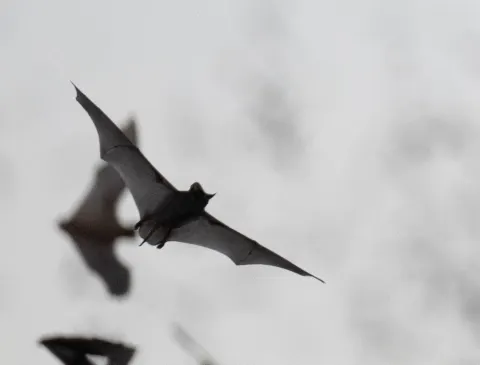
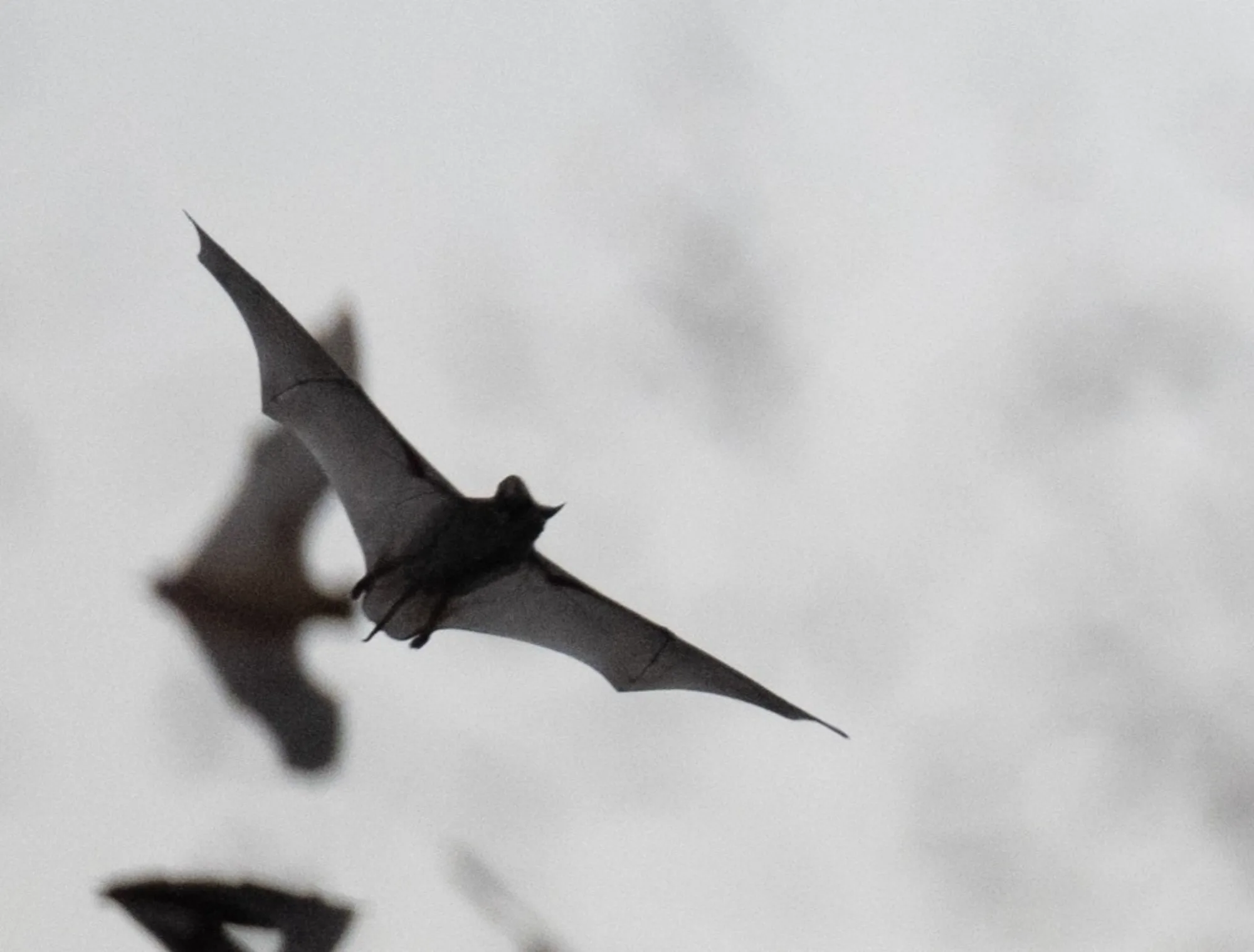
A long, free-projecting tail gives the Mexican Free-tailed Bat its name. This medium-sized bat is typically 9 cm long, with dark brown to grey fur, broad rounded ears and long, narrow wings with pointed tips. Its tail can account for almost half its length, while deep wrinkles mark its upper lip.
It occurs across the southern continental United States, most of Mexico and Central America, parts of South America and the Caribbean. Caves are its main roosts, though it also uses dark spaces in buildings and gathers beneath bridges. Bracken Cave, north of San Antonio, holds nearly 20 million bats, while a colony spends summer under Austin's Congress Avenue Bridge. Some populations migrate south, while others remain in the same region year-round and may change roosts with the seasons.
After dusk, the bats set out to hunt, using echolocation to find insects such as moths, beetles and flies. They usually catch flying prey on the wing and can travel 50 km in a night to reach feeding areas. During the breeding season, females gather in maternity roosts and each gives birth to one pup after a gestation of 11 to 12 weeks. Mothers recognise their pups by scent and calls; the young are weaned and independent at 4 to 7 weeks. Large colonies concentrated in a few places are vulnerable to habitat destruction. At Cueva de la Boca in Mexico, vandalism, pollution and uncontrolled tourism contributed to a steep population decline. Artificial light can also distress the bats, and white-nose syndrome can affect them.
Written from the English Wikipedia article Mexican free-tailed bat (CC BY-SA 4.0).
- Records
- 4,033
- Countries
- 13
- Atlas places
- 4
These are open occurrence records, so they show where people looked for and recorded the Mexican Free-tailed Bat as much as where it lives. Cells are up to 25 km across, and every location is generalised to its cell.
Generalised encounter areas, not exact locations. Each shape is a grid cell coloured by how likely the species is there.
- Very likelyMexico25 km zone · high confidence · 2874 records · updated 80 days ago
- Very likelyUnited States25 km zone · medium confidence · 838 records · updated 80 days ago
- Very likelyArgentina25 km zone · medium confidence · 156 records · updated 80 days ago
- Very likelyChile25 km zone · medium confidence · 76 records · updated 80 days ago
- Very likelyGuadeloupe25 km zone · medium confidence · 27 records · updated 80 days ago
- Very likelyMartinique25 km zone · medium confidence · 17 records · updated 80 days ago
- LikelyGuatemala25 km zone · medium confidence · 12 records · updated 80 days ago
- LikelyColombia25 km zone · medium confidence · 11 records · updated 80 days ago
- LikelyJamaica25 km zone · medium confidence · 10 records · updated 80 days ago
- LikelyMontserrat25 km zone · medium confidence · 5 records · updated 80 days ago
Conservation status not assessed here yet, so every location is generalised to its grid cell.