Ethiopian African Mole Rat
Tachyoryctes macrocephalus
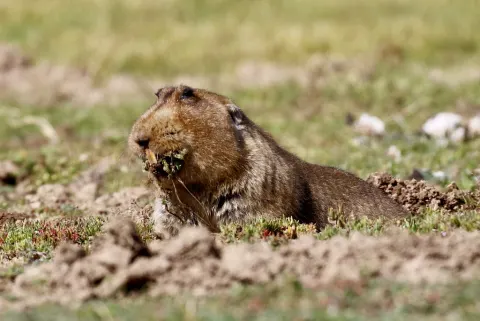
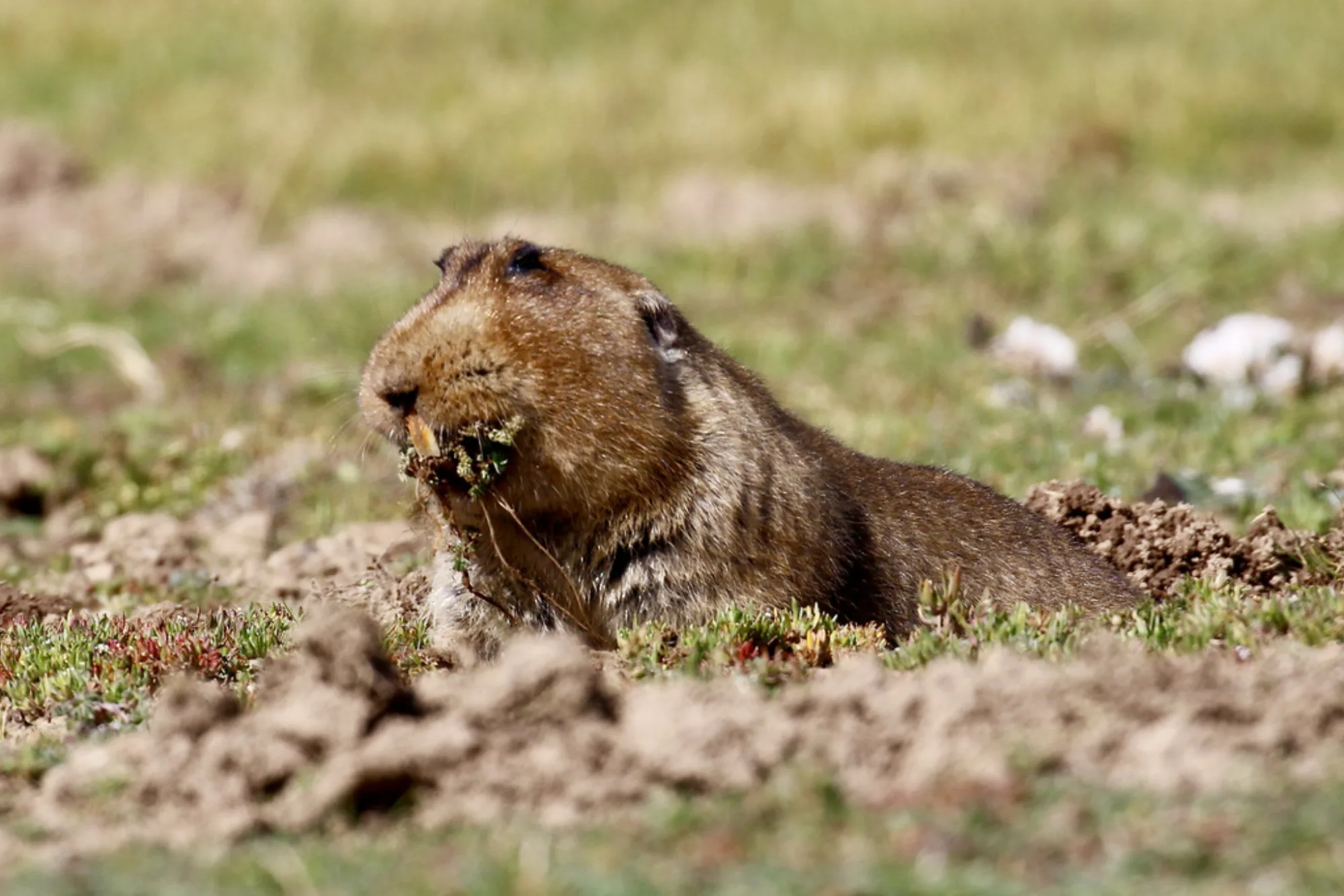
In the high grasslands of Ethiopia's Bale Mountains, the Ethiopian African Mole Rat spends most of its life below ground. This thick-furred rodent has a large head, small eyes set high on its forehead, prominent front teeth, short limbs and a short tail. Its fur is usually russet, with grey at the base, and males are often larger than females. The eyes can scan for predators, while claws help distinguish its short limbs.
The mole rat makes extensive burrow networks, with branches used for nesting, food storage and defecation. Its tunnels can stretch up to 34 m, and males and females usually occupy separate systems. To feed, it digs up to the surface and reaches for vegetation while keeping the lower half of its body inside. It eats mostly grasses and herbs, although some individuals feed mainly on roots. After about 20 minutes of foraging, it closes the tunnel from inside once the nearby herbs are exhausted. Breeding takes place throughout the year, with rainfall and changing temperatures helping to determine its timing. A litter usually contains one or two young, which are weaned at about 50 days and acquire adult colouring over the following weeks.
The species lives within a limited area of high-altitude grassland, where its habitat is deteriorating. Human settlement has affected its burrowing, while livestock compete for vegetation and trample potential food. Livestock droppings can also overload the soil with nutrients, encouraging invasive plants. Predators include the Ethiopian wolf, servals, African striped weasels and Abyssinian owls. When attacked, the mole rat tries to escape into an existing hole, or bites if none is nearby.
Written from the English Wikipedia article Giant root-rat (CC BY-SA 4.0).
- Records
- 72
- Countries
- 1
No atlas park has a record of the Ethiopian African Mole Rat in or around it yet.
These are open occurrence records, so they show where people looked for and recorded the Ethiopian African Mole Rat as much as where it lives. Cells are up to 25 km across, and every location is generalised to its cell.
Generalised encounter areas, not exact locations. Each shape is a grid cell coloured by how likely the species is there.
- Very likelyEthiopia25 km zone · medium confidence · 72 records · updated 80 days ago
Conservation status not assessed here yet, so every location is generalised to its grid cell.