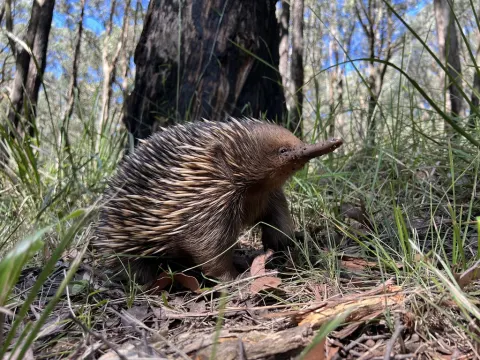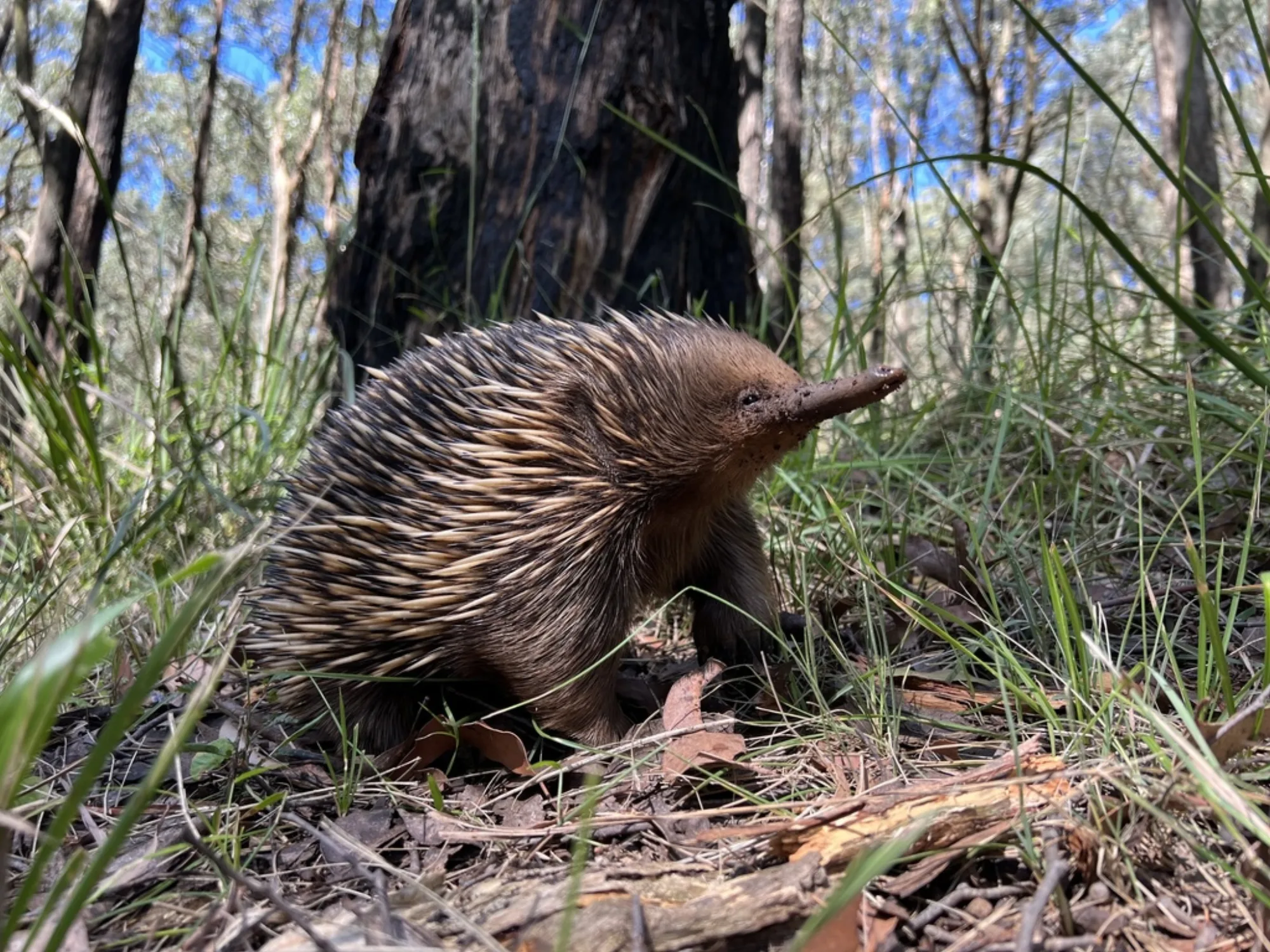
Short-beaked Echidna
Tachyglossus aculeatus
Covered in fur and cream-coloured spines, the Short-beaked Echidna has a long, distinctive snout, small eyes and short, powerful legs. Its fur ranges from honey to dark reddish-brown or black, and its body typically measures 30 to 45 cm long. This egg-laying mammal occurs throughout Australia, as well as in eastern New Guinea's coastal areas and highlands. In Australia, it is most common in forests with plenty of fallen logs containing termites, but also lives in scrub, grassland, dry areas and the outer suburbs of cities. In southern New Guinea, it has been found in open woodland.
Usually solitary, echidnas wander over wide areas and have no fixed shelter apart from a burrow for raising young. They are generally active by day, but shift towards dusk or night in warm weather, when they struggle to cope with heat. During the Australian winter, they spend periods in hibernation. Strong claws help them tear open nests and rotting logs to find ants and termites, which they catch with a sticky tongue. They also eat scarab beetle larvae, along with small beetles and earthworms. When threatened, an echidna may curl into a spiny ball or dig rapidly into the ground.
A female lays a single egg in a pouch, where it hatches and the young feeds on her milk. As its spines grow, the youngster moves to a nursery burrow, leaving at around six months. Roads and habitat destruction have caused local losses in Australia, while introduced predators and parasites have also reduced abundance there. In New Guinea, increased hunting for food has caused declines in the species' population and range.
Written from the English Wikipedia article Short-beaked echidna (CC BY-SA 4.0).
- Records
- 48,794
- Countries
- 1
- Atlas places
- 6
These are open occurrence records, so they show where people looked for and recorded the Short-beaked Echidna as much as where it lives. Cells are up to 25 km across, and every location is generalised to its cell.
Generalised encounter areas, not exact locations. Each shape is a grid cell coloured by how likely the species is there.
- Very likelyAustralia25 km zone · high confidence · 48794 records · updated 80 days ago
Conservation status not assessed here yet, so every location is generalised to its grid cell.