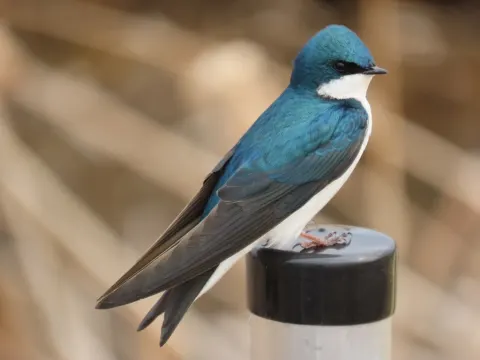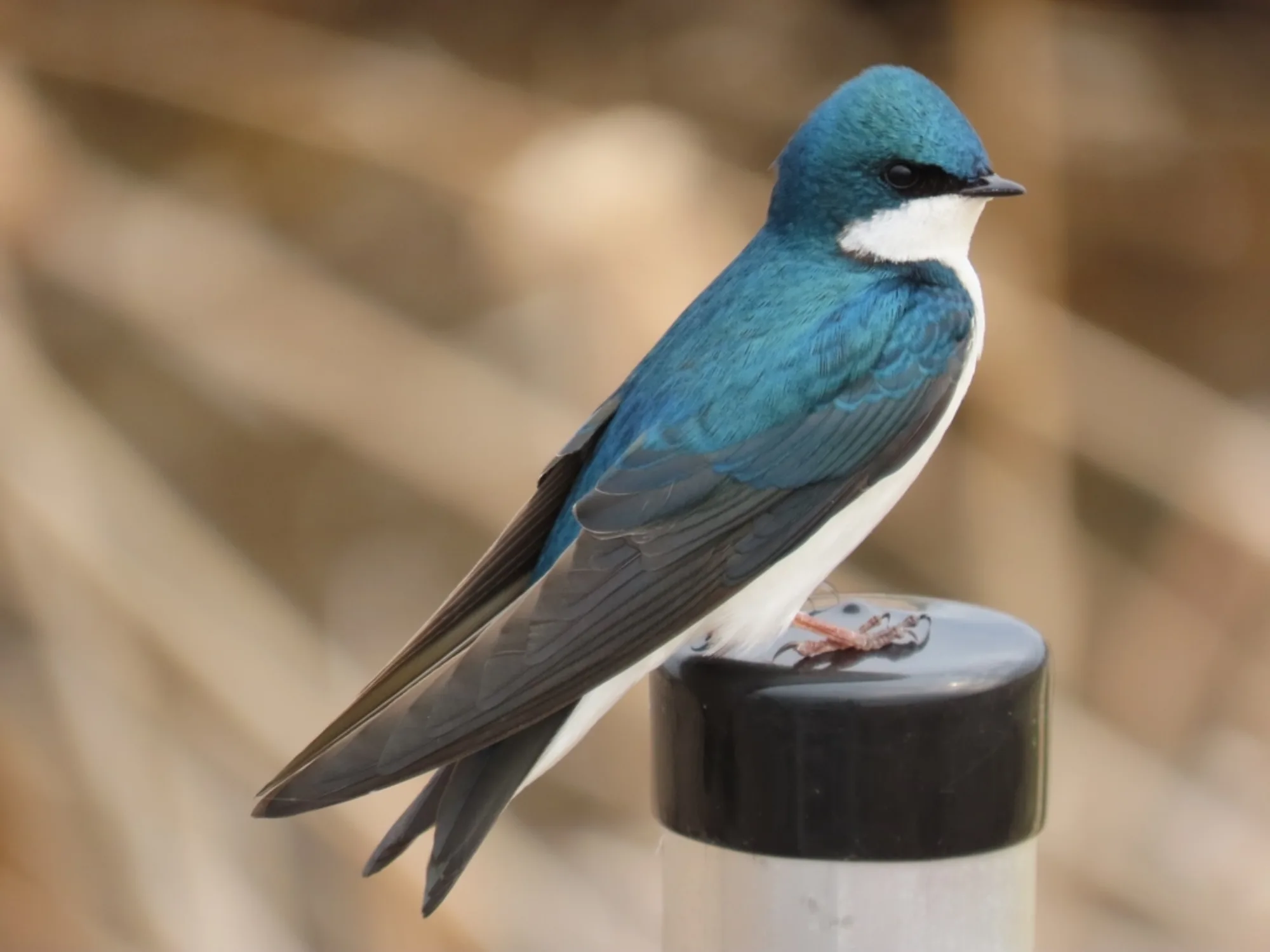
Tree Swallow
Tachycineta bicolor
Glossy blue-green above and white below, the Tree Swallow is a migratory bird of the Americas. Its wings and tail are blackish, while females tend to be duller than males. Young birds have brown upperparts and breasts washed with grey-brown. At about 12 to 14 cm long, it flies with a mixture of flapping and gliding.
Tree Swallows breed across parts of the US and Canada, reaching north-central Alaska and the Canadian tree line. They favour open and wooded country, especially near water. Their winter range includes southern US coasts, the West Indies, Panama and the northwestern coastline of South America. Outside the breeding season, they can gather in flocks of thousands and often roost in reeds or cane over water. They forage alone or in groups, catching mostly insects, although they also eat spiders, molluscs and fruit. Insects can be caught in flight or taken from surfaces including water and vegetation.
Pairs nest alone or in loose groups, using existing holes in natural or artificial structures, including nest boxes. The female usually lays four to seven white eggs and incubates them for around 14 to 15 days; both parents feed the chicks, which generally fledge after 18 to 22 days. Forest clearing and the loss of marshes affect the swallow, while competition for nest sites comes from birds including starlings, house sparrows and house wrens. Acidified lakes make calcium-rich food harder to find for chicks, and cold weather can reduce the supply of flying insects.
Written from the English Wikipedia article Tree swallow (CC BY-SA 4.0).
- Records
- 2,800,124
- Countries
- 25
- Atlas places
- 3
These are open occurrence records, so they show where people looked for and recorded the Tree Swallow as much as where it lives. Cells are up to 25 km across, and every location is generalised to its cell.
Generalised encounter areas, not exact locations. Each shape is a grid cell coloured by how likely the species is there.
- Very likelyUnited States25 km zone · high confidence · 2271655 records · updated 86 days ago
- Very likelyCanada25 km zone · high confidence · 506108 records · updated 86 days ago
- Very likelyMexico25 km zone · high confidence · 13009 records · updated 86 days ago
- Very likelyBelize25 km zone · high confidence · 4165 records · updated today
- LikelyCuba25 km zone · high confidence · 1433 records · updated today
- LikelyGuatemala25 km zone · high confidence · 782 records · updated today
- LikelyHonduras25 km zone · high confidence · 666 records · updated today
- LikelyCayman Islands25 km zone · high confidence · 524 records · updated today
- LikelyBermuda25 km zone · high confidence · 429 records · updated today
- LikelyBahamas25 km zone · high confidence · 381 records · updated today
Conservation status not assessed here yet, so every location is generalised to its grid cell.