Blue-breasted Quail
Synoicus chinensis
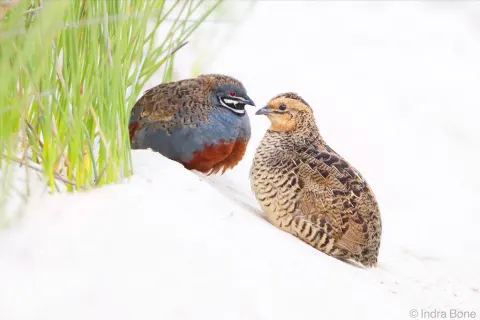
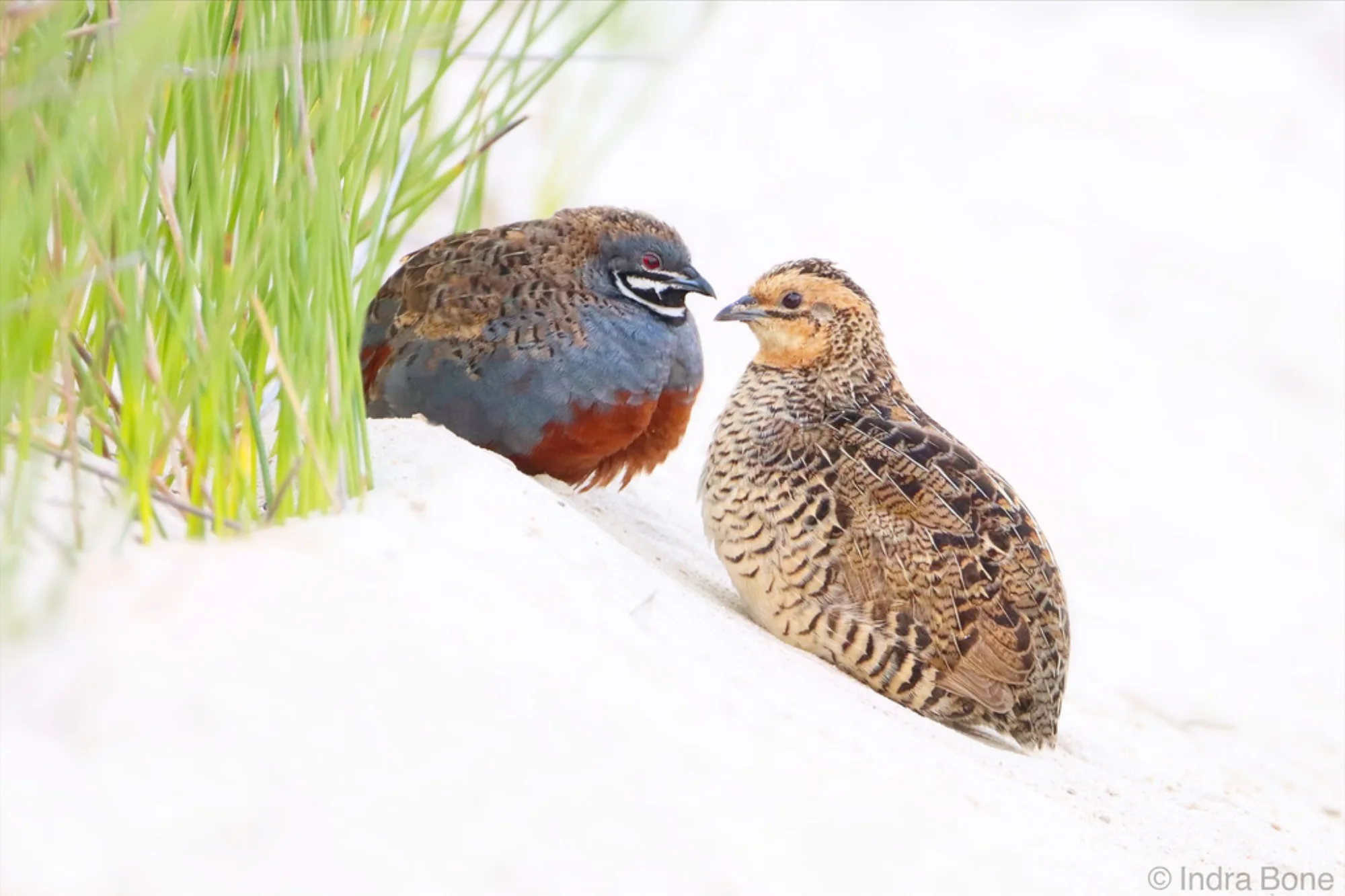
Small enough to measure just 12 to 15 cm long, the Blue-breasted Quail has a wingspan of about 25 cm and weighs 20 to 57 g. Males have dark brown backs and wings, blue-grey necks and flanks, and red-brown underparts. Their faces carry black and white markings, including a white band below the black chin. Females are less boldly marked, with rufous-brown plumage and a paler belly. Listen for a piping whistle rendered as ti-yu or ti-ti-yu, or for sharp cheeps when a bird is flushed. Males also give a descending whistle and a raspy call described as snoring.
Its wild range extends from southern China through South and Southeast Asia to Oceania, reaching southeastern Australia. The account gives no specific description of its wild habitat, but describes the quail as a ground-living bird. Its food includes grass seeds, rape seeds and green vegetation, along with insects, especially termites. The nest is on the ground and lined with dry grass. A clutch normally contains 4 to 7 eggs, though it can rarely reach 9, and incubation lasts 16 to 18 days. Young birds are able to fly at one month old and become sexually mature at 3 months. The natural breeding system is unknown, although captive birds have been reported to form monogamous pairs.
In the wild, these quail may live only 1.5 years; in captivity they typically live 3 to 6 years, although some can reach 13. The species is listed as threatened under Victoria's Flora and Fauna Guarantee Act, but no specific threats are described in the available account.
Written from the English Wikipedia article King quail (CC BY-SA 4.0).
- Records
- 4,598
- Countries
- 18
- Atlas places
- 15
- Great Sandy National Park (K'gari)· Australia
- Blue Mountains National Park· Australia
- Lore Lindu National Park· Indonesia
- Manas National Park· India
- Udawalawe National Park· Sri Lanka
- Yala National Park· Sri Lanka
- Baluran National Park· Indonesia
- Daintree National Park· Australia
- Gal Oya National Park· Sri Lanka
- Kakadu National Park· Australia
- Kaziranga National Park· India
- Kinabalu Park· Malaysia
- Lamington National Park· Australia
- Wasgamuwa National Park· Sri Lanka
- West Bali National Park· Indonesia
These are open occurrence records, so they show where people looked for and recorded the Blue-breasted Quail as much as where it lives. Cells are up to 25 km across, and every location is generalised to its cell.
Generalised encounter areas, not exact locations. Each shape is a grid cell coloured by how likely the species is there.
- Very likelyAustralia25 km zone · medium confidence · 2551 records · updated 80 days ago
- Very likelyIndia25 km zone · medium confidence · 404 records · updated 80 days ago
- Very likelyPhilippines25 km zone · high confidence · 276 records · updated 80 days ago
- Very likelyIndonesia25 km zone · medium confidence · 204 records · updated 80 days ago
- Very likelyCambodia25 km zone · high confidence · 200 records · updated 80 days ago
- Very likelySingapore25 km zone · medium confidence · 195 records · updated 80 days ago
- Very likelyChina25 km zone · high confidence · 158 records · updated 80 days ago
- Very likelySri Lanka25 km zone · high confidence · 148 records · updated 80 days ago
- Very likelyPapua New Guinea25 km zone · high confidence · 130 records · updated 80 days ago
- Very likelyTimor-Leste25 km zone · medium confidence · 58 records · updated 80 days ago
Conservation status not assessed here yet, so every location is generalised to its grid cell.