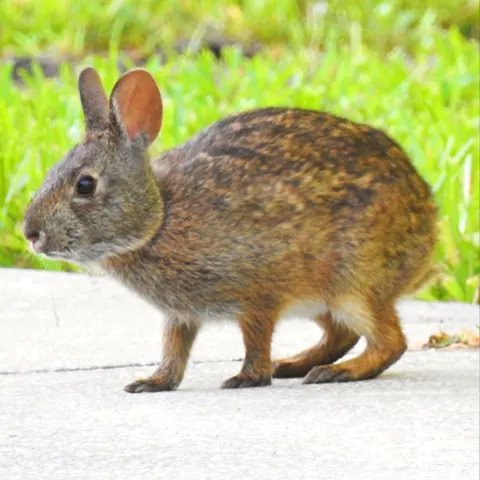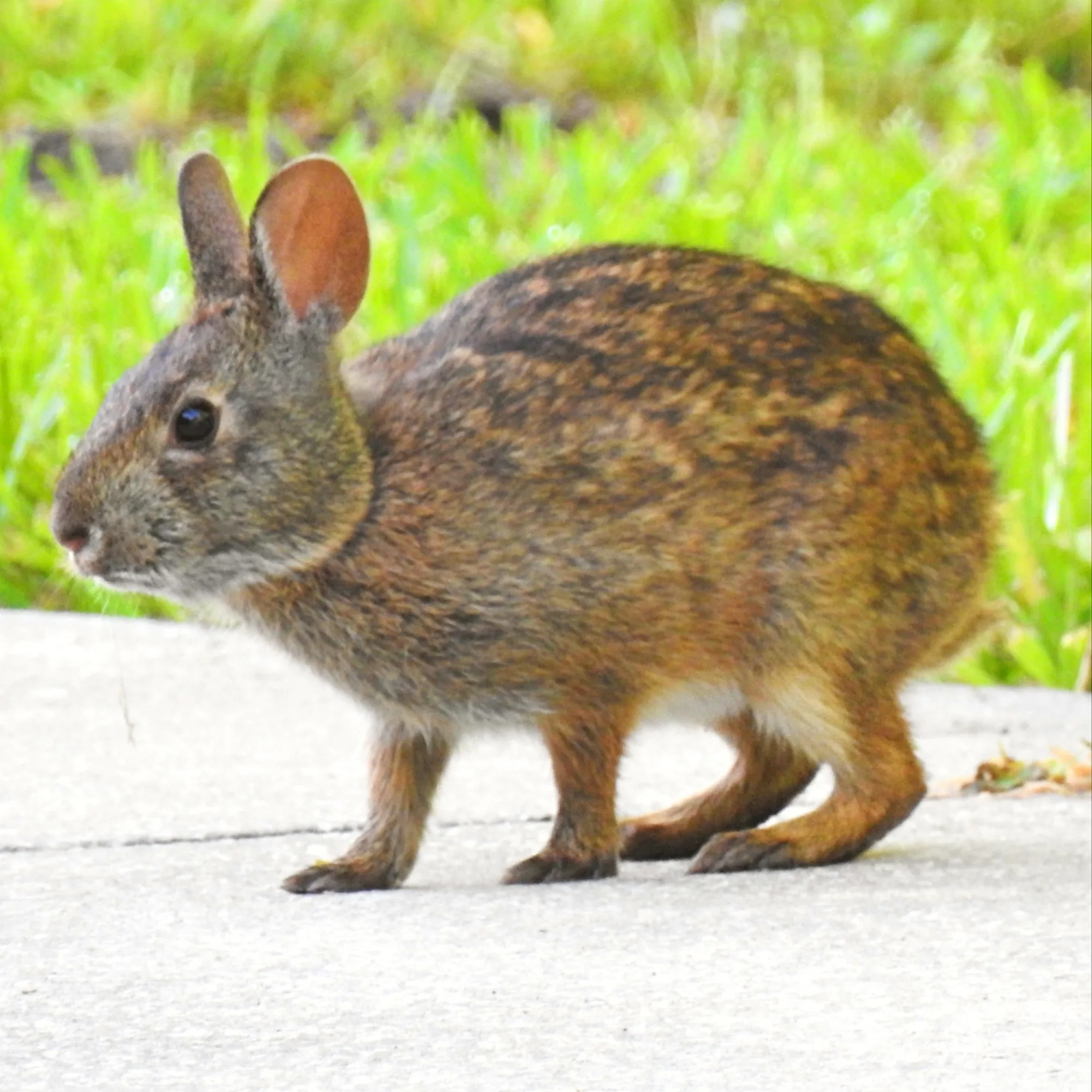
Marsh Rabbit
Sylvilagus palustris
In the wetlands of the southeastern United States, the Marsh Rabbit moves easily between dense cover and water. This small brown cottontail resembles the eastern cottontail, but has shorter ears, legs and tail, and usually has a brownish-grey underside to its tail. Its upper fur can be blackish brown or dark reddish, while the belly is generally a muted brownish grey. Some mainland rabbits have a dull white belly, and juveniles are darker and duller than adults.
Its range reaches south from southeastern Virginia across Florida and into the Keys, with populations also in parts of the Carolinas, Georgia and Alabama. It lives in freshwater and brackish marshes, swamps and other wet lowlands, always with access to water. In southern Florida, it also uses sandy islands and mangrove swamps. Most active at night, it rests by day in dense vegetation, hollow logs or abandoned burrows. It can dig a shallow resting place among plants or under thickets, and makes trails through vegetation along marsh edges. A strong swimmer, it may hide in muddy water with only its eyes and nose exposed, then swim to fresh cover if spotted. Its plant diet includes leaves and bulbs of cattails and other marsh plants, as well as cultivated carrots, sweet potatoes and sugar cane. Breeding continues year-round, with nests made from rushes, grasses and leaves, lined with hair and often tucked into thickets or swampy places.
Owls, northern harriers, bobcats and snakes prey on marsh rabbits, while fires and dogs are among the greatest threats linked to human activity. In the southern Everglades, invasive Burmese pythons have caused marsh rabbits to mostly disappear. In the lower Florida Keys, rising seas and land development have reduced habitat and blocked movement towards less flooded areas.
Written from the English Wikipedia article Marsh rabbit (CC BY-SA 4.0).
- Records
- 615
- Countries
- 1
- Atlas places
- 1
These are open occurrence records, so they show where people looked for and recorded the Marsh Rabbit as much as where it lives. Cells are up to 25 km across, and every location is generalised to its cell.
Generalised encounter areas, not exact locations. Each shape is a grid cell coloured by how likely the species is there.
- Very likelyUnited States25 km zone · medium confidence · 615 records · updated 80 days ago
Conservation status not assessed here yet, so every location is generalised to its grid cell.