Eastern Cottontail
Sylvilagus floridanus
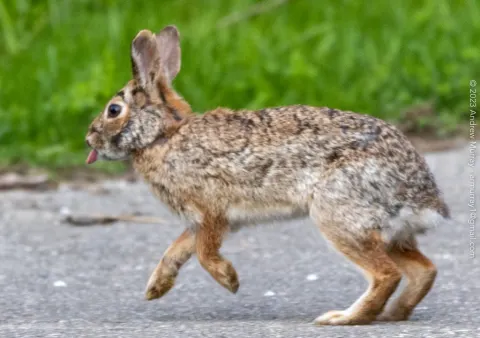
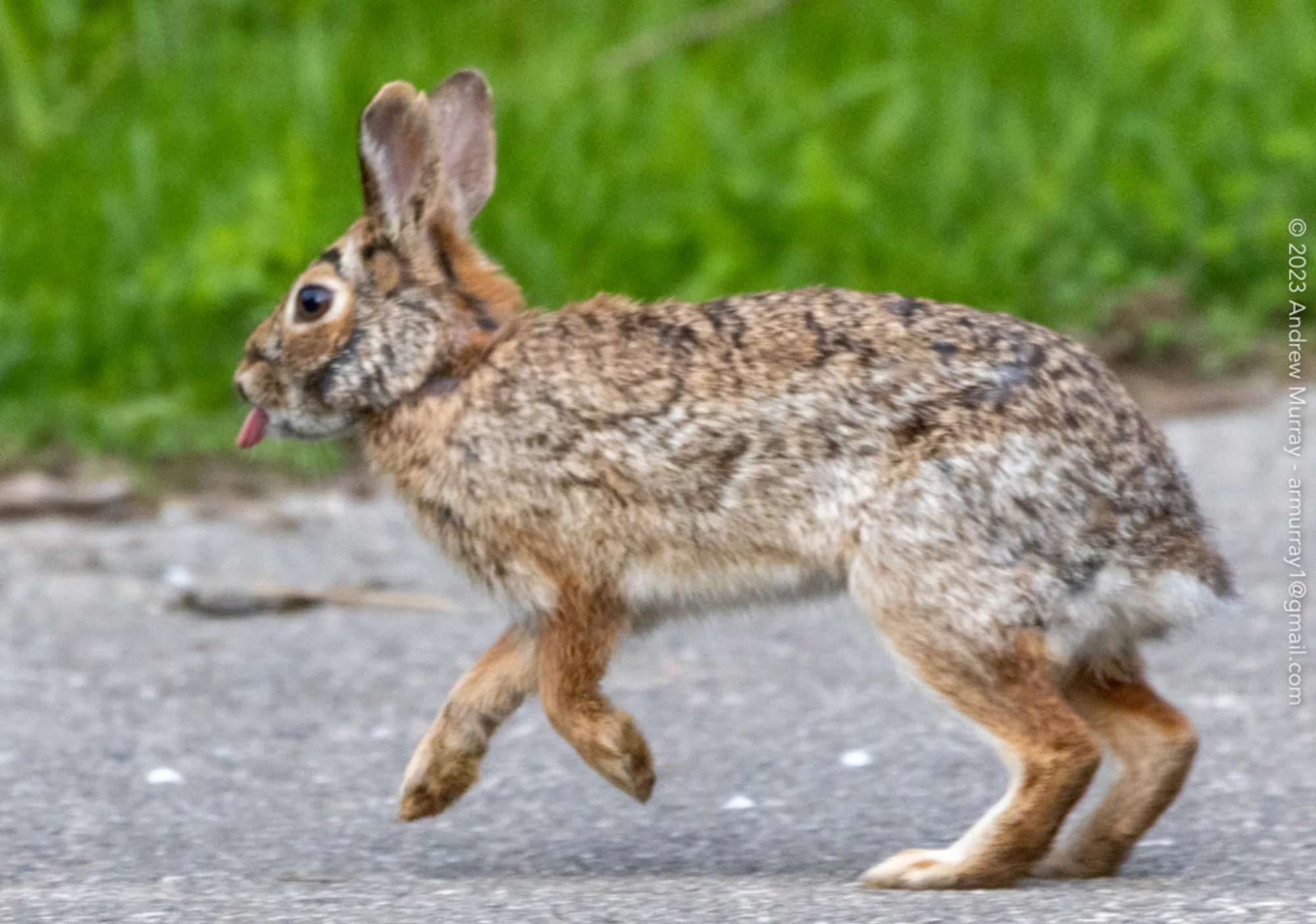
A flash of white from its short, fluffy tail can help identify the Eastern Cottontail, a medium-sized rabbit with long ears and large brown eyes. Its fur ranges from reddish-brown to greyish-brown, with a white underside and a rusty patch near the tail. Young rabbits have a white mark on the forehead that fades as they mature. Adults measure 36 to 48 cm in total length, including the tail.
Its range stretches from southern Canada through much of the United States and into Mexico, Central America and northern South America. Look for it in meadows, grassy clearings and old fields where shrubs or hedgerows offer nearby cover. It also lives in agricultural and suburban areas, particularly near thickets, fencerows and forest edges, but generally avoids dense forest. Most active at dawn, dusk and night, it can also appear by day when conditions are foggy or overcast. It often rests motionless beneath vegetation during the day, and when chased may flee in a zigzag.
The rabbit feeds on grasses and other tender plants, turning to twigs, buds and bark in winter or when snow covers the vegetation. Breeding begins earlier in the southern United States than in New England, and females can produce several litters a year. Nests are usually in grassy or weedy places near brush, lined with dry grass and the mother's fur. Foxes, hawks and owls are among its predators, while vehicle collisions are a significant cause of death. Individual populations can also face local habitat loss.
Written from the English Wikipedia article Eastern cottontail (CC BY-SA 4.0).
- Records
- 10,701
- Countries
- 5
- Atlas places
- 1
These are open occurrence records, so they show where people looked for and recorded the Eastern Cottontail as much as where it lives. Cells are up to 25 km across, and every location is generalised to its cell.
Generalised encounter areas, not exact locations. Each shape is a grid cell coloured by how likely the species is there.
- Very likelyUnited States25 km zone · medium confidence · 8009 records · updated 80 days ago
- Very likelyCanada25 km zone · medium confidence · 2489 records · updated 80 days ago
- Very likelySwitzerland25 km zone · high confidence · 185 records · updated 80 days ago
- Very likelyColombia25 km zone · medium confidence · 18 records · updated 80 days ago
Conservation status not assessed here yet, so every location is generalised to its grid cell.