Desert Cottontail
Sylvilagus audubonii
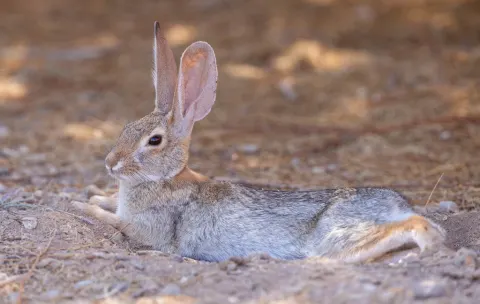
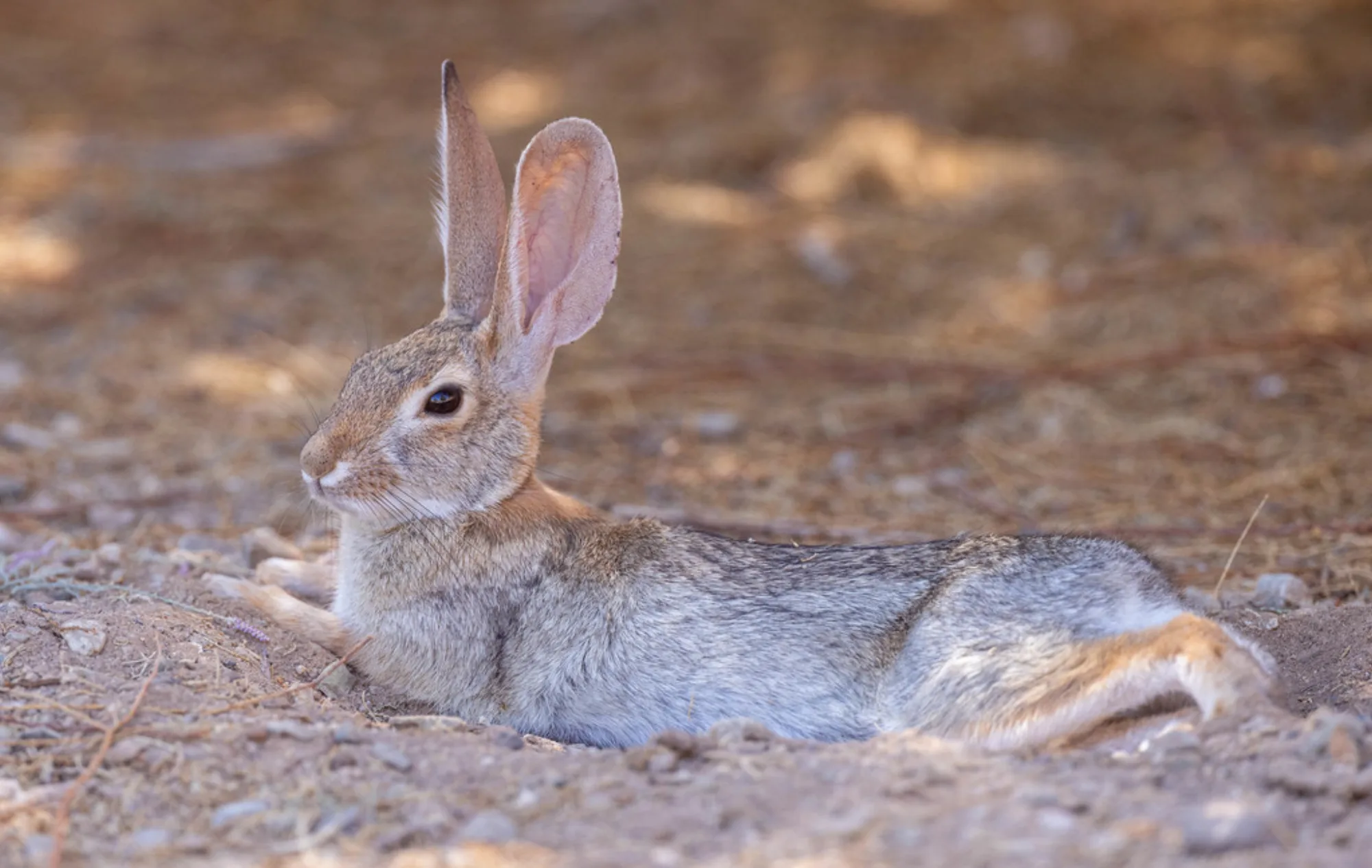
Look for the Desert Cottontail's upright ears and rounded, greyish-brown tail, edged and underlined in white, which flashes as the rabbit runs away. It has white belly fur, while adults measure 36 to 42 cm long and weigh 700 to 1,200 g. Across the western United States, its range runs from eastern Montana south to western Texas, and continues into northern and central Mexico. It reaches central and southern California and Baja California in the west, and occurs at elevations up to 1,830 m. Dry, near-desert grasslands are a favoured habitat, though it also lives in pinyon-juniper forest and along waterways in arid regions.
Early morning and early evening are good times to look for cottontails feeding, sometimes in small groups. They are seldom out looking for food on windy days, when the wind makes approaching predators harder to hear. Grass makes up 90% of their diet, supplemented by foods including mesquite leaves and peas, bark, fallen fruit, prickly pear pads and shrub twigs. They rarely need to drink, obtaining most of their water from plants or dew. Females give birth in burrows left by other mammals, and pairs have multiple litters throughout the year, although few young reach adulthood. When a potential predator appears, a cottontail normally freezes, then may flee in a zigzag if danger seems close. Predators include birds of prey, coyotes, snakes, cats and dogs, while people also hunt the rabbit for sport. Land clearing, cattle grazing and human-induced fires threaten its habitat or populations, and competition with black-tailed jackrabbits can be a problem when dry conditions reduce the available vegetation.
Written from the English Wikipedia article Desert cottontail (CC BY-SA 4.0).
- Records
- 3,885
- Countries
- 2
- Atlas places
- 6
These are open occurrence records, so they show where people looked for and recorded the Desert Cottontail as much as where it lives. Cells are up to 25 km across, and every location is generalised to its cell.
Generalised encounter areas, not exact locations. Each shape is a grid cell coloured by how likely the species is there.
- Very likelyUnited States25 km zone · medium confidence · 3641 records · updated 80 days ago
- Very likelyMexico25 km zone · high confidence · 244 records · updated 80 days ago
Conservation status not assessed here yet, so every location is generalised to its grid cell.