Garden Warbler
Sylvia borin
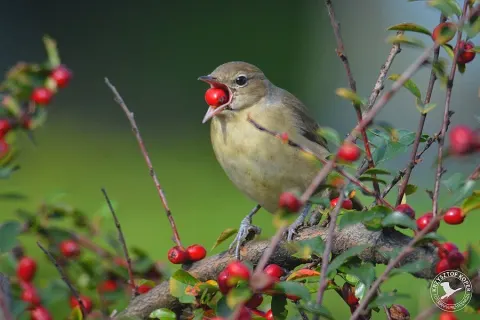
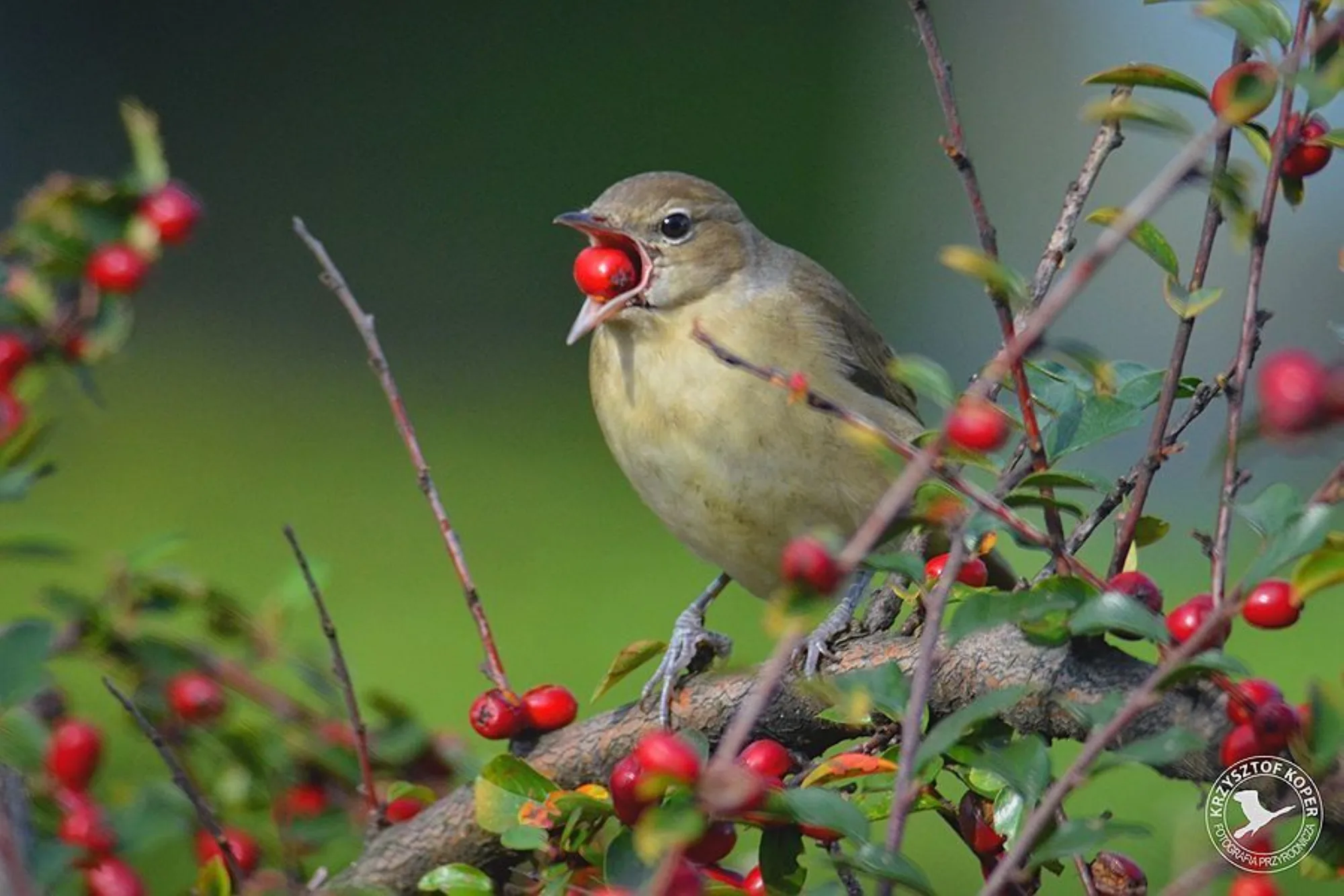
Plain colouring makes the Garden Warbler easy to overlook and difficult to distinguish from other unstreaked warblers. This small bird has long wings and a long tail, olive-brown upperparts, dull white underparts and a whitish ring around its dark eye. Males and females look alike, while young birds are paler and greyer above. Listen for the male's rich, musical warbling, often given from dense cover in bursts lasting a few seconds. Its song resembles that of the blackcap, though it is more mellow and slightly lower in pitch.
Garden Warblers breed across most of Europe and east through temperate Asia to Siberia, then migrate to sub-Saharan Africa for the winter. On the breeding grounds, look for them in open woodland, thickets and woodland edges with dense bushes or low growth, especially near water. Despite their name, they rarely occupy gardens. In Africa they use varied habitats with trees, avoiding closed forest and arid areas. During the breeding season they pick insects and other small prey from leaves and twigs, sometimes hovering as they feed. Fruit becomes more important before migration, with figs a particular favourite where available; in Africa they eat both insects and fruit.
A concealed cup of grass, moss and twigs holds a typical clutch of four or five blotched eggs. Both parents incubate the eggs and feed the chicks, which leave the nest about 10 days after hatching. Eurasian sparrowhawks and domestic cats hunt Garden Warblers, while birds and mammals take their eggs and young. In the UK, food shortages during bad weather also account for some nesting failures, and numbers have declined slightly across much of Europe.
Written from the English Wikipedia article Garden warbler (CC BY-SA 4.0).
- Records
- 341,204
- Countries
- 22
No atlas park has a record of the Garden Warbler in or around it yet.
These are open occurrence records, so they show where people looked for and recorded the Garden Warbler as much as where it lives. Cells are up to 25 km across, and every location is generalised to its cell.
Generalised encounter areas, not exact locations. Each shape is a grid cell coloured by how likely the species is there.
- Very likelyFinland25 km zone · high confidence · 86371 records · updated 80 days ago
- Very likelySweden25 km zone · high confidence · 81084 records · updated 80 days ago
- Very likelyNorway25 km zone · high confidence · 57779 records · updated 80 days ago
- Very likelyBelgium25 km zone · high confidence · 40619 records · updated 80 days ago
- Very likelyFrance25 km zone · high confidence · 35142 records · updated 80 days ago
- Very likelyUnited Kingdom25 km zone · high confidence · 17567 records · updated 80 days ago
- Very likelyÅland Islands25 km zone · high confidence · 6443 records · updated 80 days ago
- Very likelyPalestinian Territories25 km zone · high confidence · 3074 records · updated 80 days ago
- Very likelySpain25 km zone · high confidence · 2123 records · updated 80 days ago
- Very likelyPortugal25 km zone · high confidence · 2021 records · updated 80 days ago
Conservation status not assessed here yet, so every location is generalised to its grid cell.