Eurasian Blackcap
Sylvia atricapilla
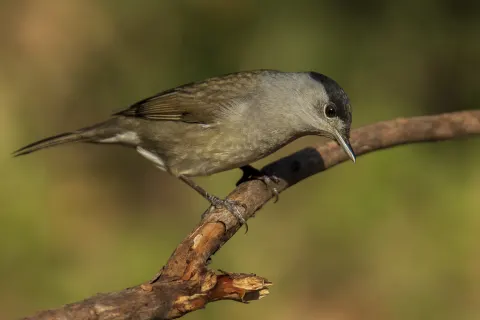
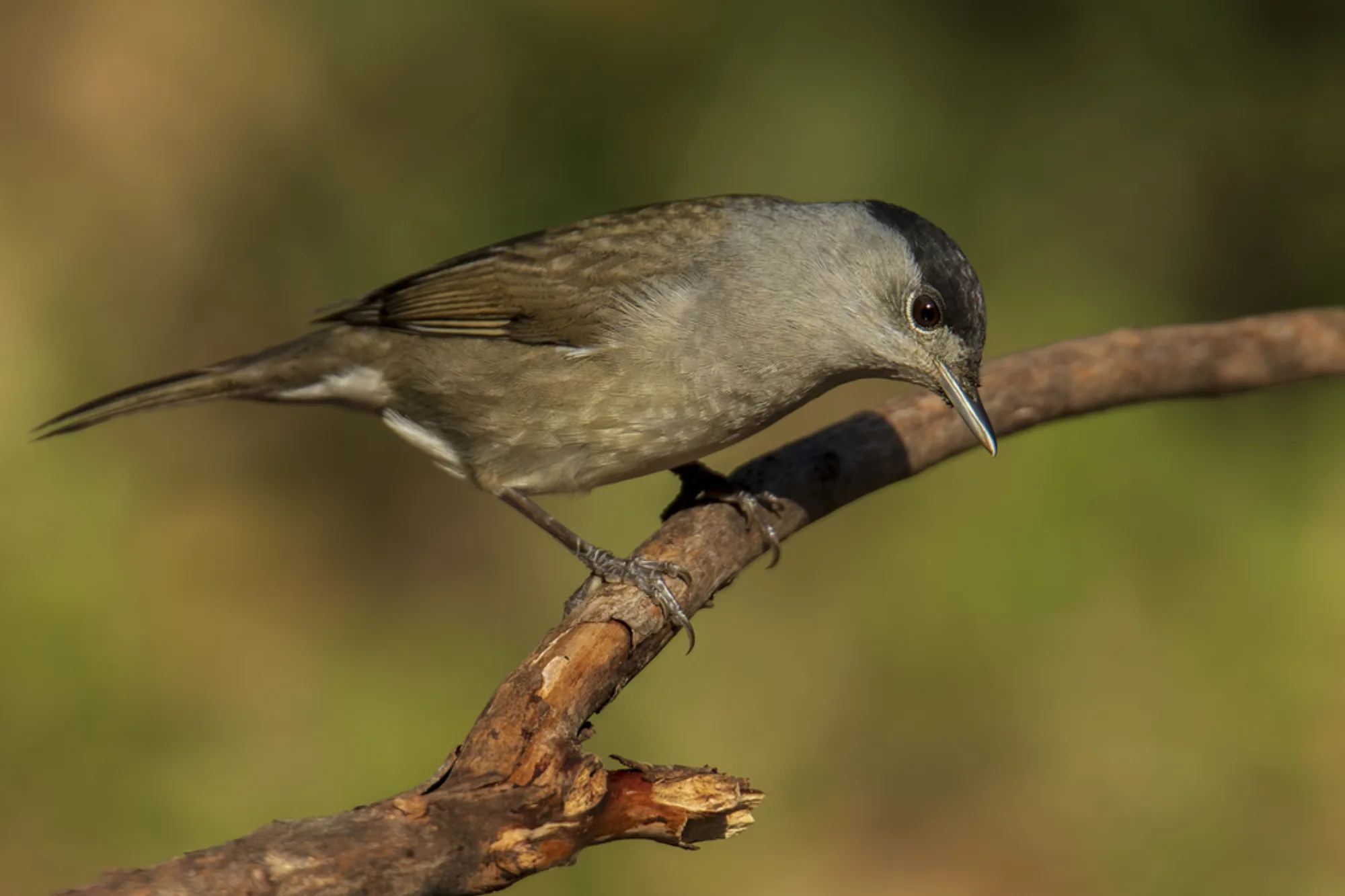
A rich, musical warble can reveal a Eurasian Blackcap before the bird comes into view. This common, widespread warbler has olive-grey upperparts and pale grey underparts, with a neat black cap on the male and a reddish-brown one on the female. The male's song often rises to a loud, high-pitched finish, though birds in some isolated places have a simpler song. Its main call sounds like stones knocking together.
Blackcaps breed from northwestern Africa through much of Europe and into western Asia, favouring mature deciduous woodland with scrub beneath the trees. They also use parks, large gardens and overgrown hedges where there are tall trees and established cover below. Some stay within their breeding range for winter, while others migrate to areas including the Mediterranean and Africa. In Great Britain and Ireland, gardens now host wintering birds from continental Europe. Wintering blackcaps wander in search of fruit, but may remain where food is plentiful and return in later years.
During the breeding season, blackcaps mainly eat insects, picking prey from leaves and twigs. Later in the year, small fruit becomes their main food, while winter garden visitors also take food such as bread, fat and peanuts. Males defend breeding territories against other blackcaps and garden warblers. The nest is a cup, usually concealed low in brambles or scrub, and both parents feed the chicks. The young leave the nest after about 11 to 12 days and continue to receive help with feeding. Threats include illegal trapping and hunting around the Mediterranean, as well as predators and disease. Domestic cats are the most important predator, while jays, magpies and mammals take eggs and young.
Written from the English Wikipedia article Eurasian blackcap (CC BY-SA 4.0).
- Records
- 1,291,611
- Countries
- 102
- Atlas places
- 11
- Bwindi Impenetrable National Park· Uganda
- Ngorongoro Conservation Area· Tanzania
- Lake Manyara National Park· Tanzania
- Volcanoes National Park· Rwanda
- Akagera National Park· Rwanda
- Arusha National Park· Tanzania
- Eravikulam National Park· India
- Mount Elgon National Park· Uganda
- Mount Kenya National Park· Kenya
- Nairobi National Park· Kenya
- Table Mountain National Park· South Africa
These are open occurrence records, so they show where people looked for and recorded the Eurasian Blackcap as much as where it lives. Cells are up to 25 km across, and every location is generalised to its cell.
Generalised encounter areas, not exact locations. Each shape is a grid cell coloured by how likely the species is there.
- Very likelyFrance25 km zone · high confidence · 230769 records · updated 86 days ago
- Very likelyBelgium25 km zone · high confidence · 152286 records · updated 86 days ago
- Very likelyUnited Kingdom25 km zone · high confidence · 137581 records · updated 86 days ago
- Very likelySpain25 km zone · high confidence · 137344 records · updated 86 days ago
- Very likelySweden25 km zone · high confidence · 113593 records · updated 86 days ago
- Very likelyPortugal25 km zone · high confidence · 105547 records · updated 86 days ago
- Very likelyNorway25 km zone · high confidence · 97056 records · updated 86 days ago
- Very likelyLuxembourg25 km zone · high confidence · 84697 records · updated 86 days ago
- Very likelyIsrael25 km zone · high confidence · 34058 records · updated 86 days ago
- Very likelyFinland25 km zone · high confidence · 24244 records · updated 86 days ago
Conservation status not assessed here yet, so every location is generalised to its grid cell.