Wild Boar
Sus scrofa
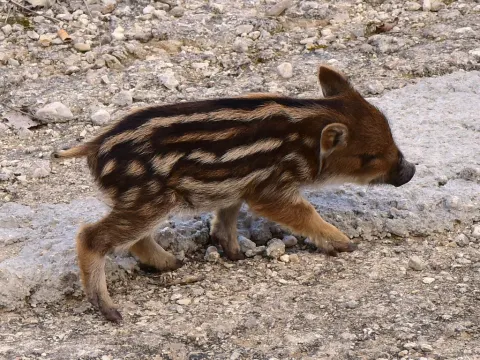
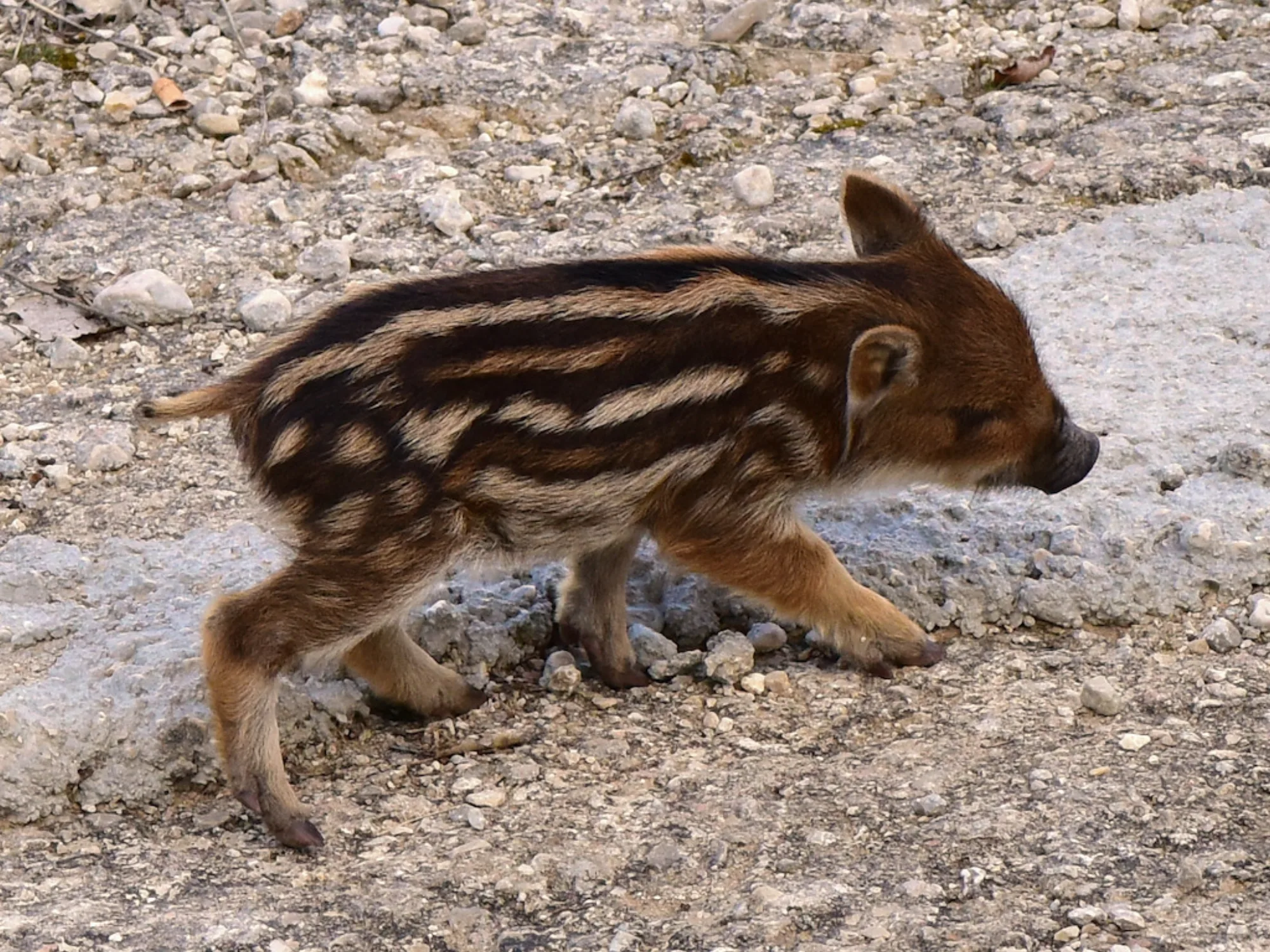
Stocky and short-legged, the Wild Boar has a large head, a thick neck and a hump behind its shoulders. Its winter coat is made up of coarse bristles over soft brown underfur, with longer hair along the back. Colour varies widely, from very pale to black, while piglets have pale stripes across brown or rusty-brown coats. Adult males have prominent canine teeth that project from the mouth, and their back mane is especially visible in autumn and winter.
Its natural range covers North Africa and much of Eurasia; people have also introduced it to the Americas and Oceania. It uses habitats ranging from boreal taiga to desert and can live high in mountains. In Europe it favours deciduous and mixed woodland, particularly oak and beech forest around marshes and meadows. It needs dense cover for shelter and water for drinking and bathing. On Komodo and Rinca, it mostly lives in savanna or open monsoon forest.
Females and their young live in groups led by an older female, while grown males tend to live alone when they are not breeding. Boars dig for roots and other underground plant foods, and also eat nuts, berries, insects, eggs and carrion. In temperate regions, acorns and beechnuts are especially important. Births occur between March and May, with an average litter of 4 to 6 piglets born in a nest of twigs, grass and leaves. Piglets begin travelling with their mother at two weeks old. Wolves are the main predators across most of the boar's range, particularly threatening in deep winter snow, and hunting has caused declines in many areas.
Written from the English Wikipedia article Wild boar (CC BY-SA 4.0).
- Records
- 228,452
- Countries
- 77
- Atlas places
- 16
- Galápagos National Park· Ecuador
- Yala National Park· Sri Lanka
- Komodo National Park· Indonesia
- Arthur's Pass National Park· New Zealand
- Chitwan National Park· Nepal
- Kakadu National Park· Australia
- Kumana National Park· Sri Lanka
- Baluran National Park· Indonesia
- Bardiya National Park· Nepal
- Eravikulam National Park· India
- Kaziranga National Park· India
- Langtang National Park· Nepal
- Mount Aspiring National Park· New Zealand
- Sundarbans National Park· India
- Taman Negara National Park· Malaysia
- West Bali National Park· Indonesia
These are open occurrence records, so they show where people looked for and recorded the Wild Boar as much as where it lives. Cells are up to 25 km across, and every location is generalised to its cell.
Generalised encounter areas, not exact locations. Each shape is a grid cell coloured by how likely the species is there.
- Very likelySwitzerland25 km zone · high confidence · 69908 records · updated 86 days ago
- Very likelyFrance25 km zone · high confidence · 61341 records · updated 86 days ago
- Very likelySpain25 km zone · high confidence · 50353 records · updated 86 days ago
- Very likelyGermany25 km zone · high confidence · 8545 records · updated 86 days ago
- Very likelyAustralia25 km zone · high confidence · 7905 records · updated 86 days ago
- Very likelyJapan25 km zone · high confidence · 7072 records · updated 86 days ago
- Very likelyBelgium25 km zone · high confidence · 6538 records · updated 86 days ago
- Very likelyItaly25 km zone · high confidence · 3308 records · updated 86 days ago
- Very likelyLuxembourg25 km zone · high confidence · 2936 records · updated 86 days ago
- Very likelyEstonia25 km zone · high confidence · 2298 records · updated 86 days ago
Conservation status not assessed here yet, so every location is generalised to its grid cell.