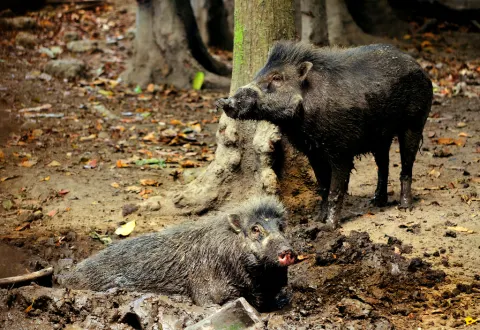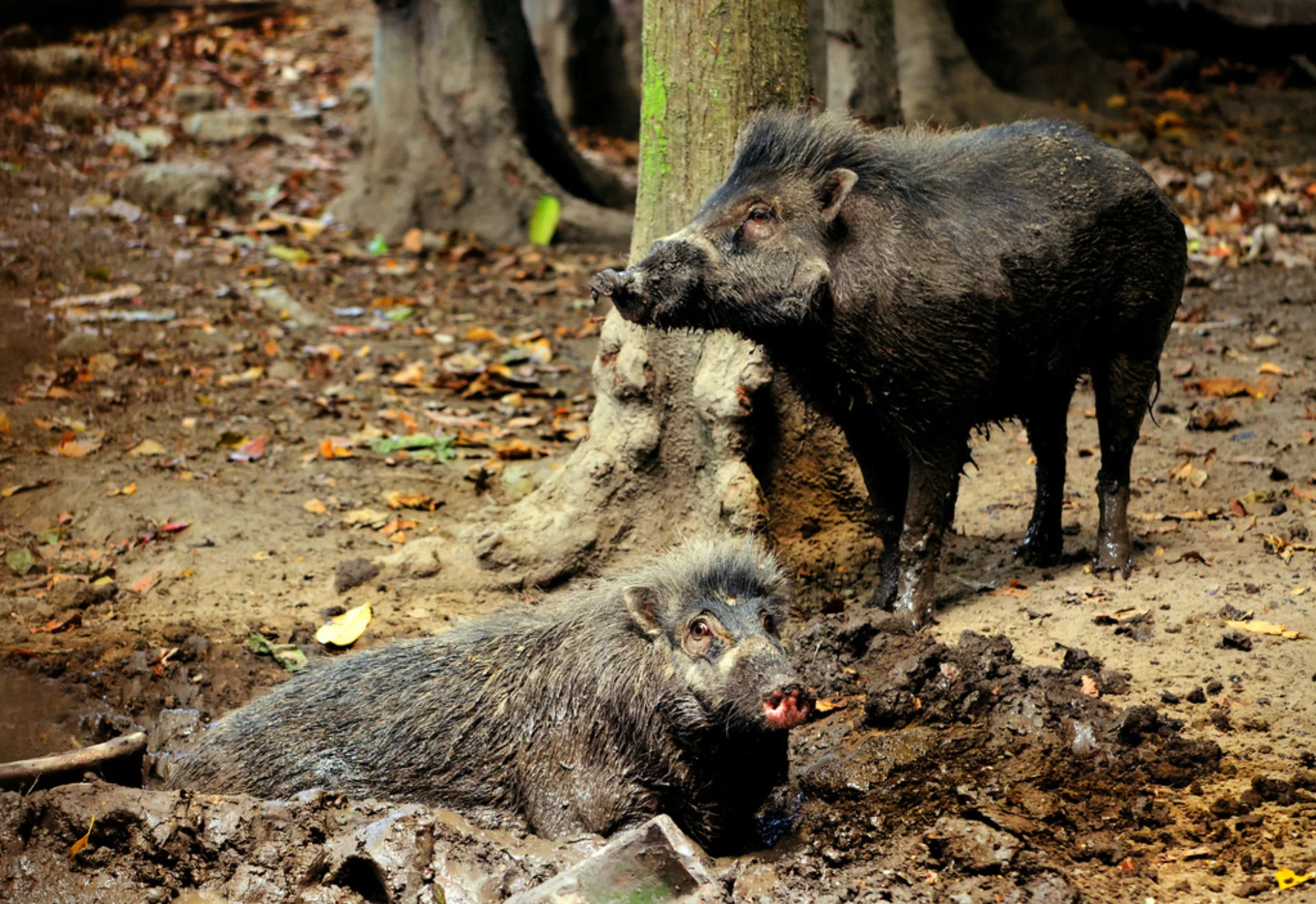
Visayan Warty Pig
Sus cebifrons
On the central Philippine islands of Negros and Panay, small populations of the Visayan Warty Pig still survive. The species was native to six Visayan islands, but it is believed to have disappeared from the other four, although some may survive on Masbate. Forest is its natural habitat, and its food there includes roots, tubers and fruit. A male can be recognised by three pairs of fleshy warts on its face and a growth of stiff, spiky hair. Little is known about the pigs' behaviour or characteristics in the wild, because so few remain.
These pigs usually gather in groups numbering four to six. They also eat cultivated crops, and this has become much more common as forest has been cleared for farming. Piglets are often seen in their native western Visayan Islands during the dry season, between January and March. A litter has an average of three to four piglets. In captivity at a French zoo, the species became the first pig recorded using tools to dig.
The greatest threat is the loss of habitat to commercial logging and slash-and-burn farming. Around 95% of the pigs' natural habitat has been cleared by farmers planting crops, and the cleared land often becomes unproductive after a few years, leaving the pigs with severely limited food sources. People also hunt them for food, while farmers kill them because they can damage crops as they forage. Another threat comes from interbreeding with feral domestic pigs, which can alter the wild pigs' genetic makeup.
Written from the English Wikipedia article Visayan warty pig (CC BY-SA 4.0).
- Records
- 3
- Countries
- 1
No atlas park has a record of the Visayan Warty Pig in or around it yet.
These are open occurrence records, so they show where people looked for and recorded the Visayan Warty Pig as much as where it lives. Cells are up to 25 km across, and every location is generalised to its cell.
Generalised encounter areas, not exact locations. Each shape is a grid cell coloured by how likely the species is there.
- Very likelyPhilippines25 km zone · medium confidence · 3 records · updated 80 days ago
Conservation status not assessed here yet, so every location is generalised to its grid cell.