Northern Hawk-Owl
Surnia ulula
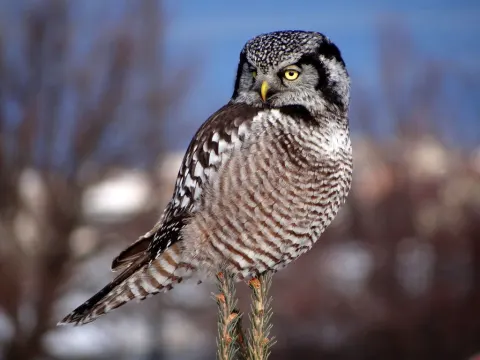
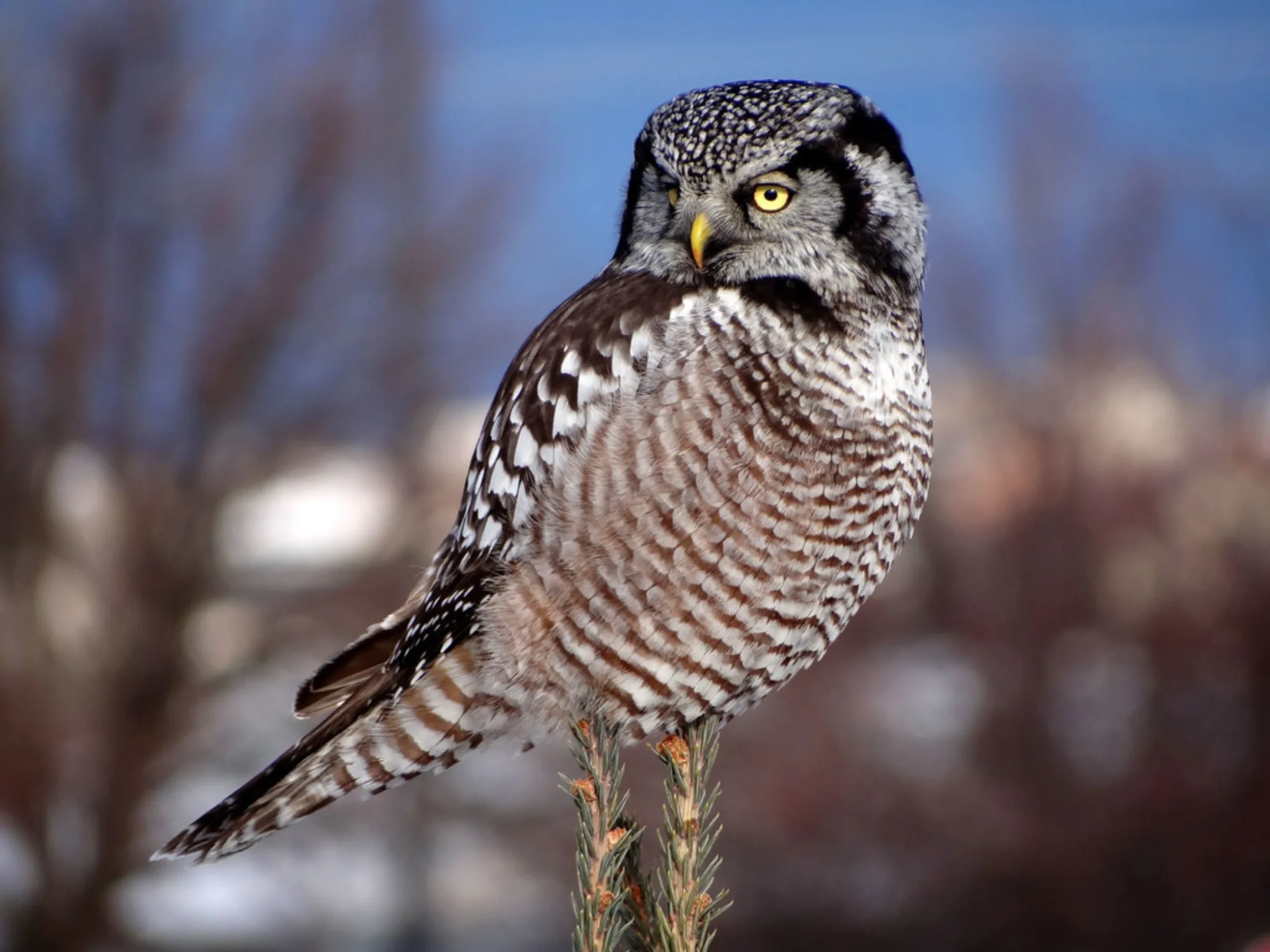
Often active in daylight, the Northern Hawk-Owl has a hawk-like appearance and behaviour that set it apart from many other owls. It has a rounded head, yellow eyes and a yellow curved beak, with a white face edged in black. Its dark brown upperparts are spotted off-white, while brown bands mark the pale belly and long tail. Females are slightly larger than males, measuring 37.2 to 44.7 cm long compared with 35 to 42.5 cm for males.
Across northern North America and Eurasia, this owl lives mainly in open coniferous woodland or conifers mixed with deciduous trees. Look for it around bogs, clearings, meadows, swamp valleys and recently burned ground, rather than in dense spruce-fir forest. It usually remains within its breeding range, though it sometimes moves south, including on rare winter visits to the northern United States. From a perch, often a spruce, it scans for prey before dropping into a gliding dive. Its hearing helps it find rodents beneath snow, where it can plunge to catch them. Voles are important prey, alongside other mammals and birds; frogs and fish are also sometimes taken. In winter, ground-dwelling birds make up a larger share of its diet than they do in summer.
It usually nests atop the hollow remains of old, dead spruces, but may also use cliffsides. The female does most of the incubation while the male finds food, and both continue to feed the young after they leave the nest. Adults may attack people who approach young owls too closely, so anyone finding a recently fledged bird should move away and watch for its parents. Fire suppression is thought to reduce hunting openings and dead wood for nests, while the effects of modern forestry on populations remain uncertain.
Written from the English Wikipedia article Northern hawk-owl (CC BY-SA 4.0).
- Records
- 19,688
- Countries
- 4
No atlas park has a record of the Northern Hawk-Owl in or around it yet.
These are open occurrence records, so they show where people looked for and recorded the Northern Hawk-Owl as much as where it lives. Cells are up to 25 km across, and every location is generalised to its cell.
Generalised encounter areas, not exact locations. Each shape is a grid cell coloured by how likely the species is there.
- Very likelyNorway25 km zone · high confidence · 17391 records · updated 80 days ago
- Very likelyFinland25 km zone · high confidence · 2260 records · updated 80 days ago
- LikelySweden25 km zone · medium confidence · 37 records · updated 80 days ago
Conservation status not assessed here yet, so every location is generalised to its grid cell.